Mining Mercury: A Vision for the Solar System's First Planetary-Scale Industrial Base

Mercury's extreme environment makes it an ideal planetary-scale industrial base for the inner solar system.
Drawing on SFIA channel analysis, this article argues that Mercury — the overlooked, sun-blasted innermost planet — is the ideal starting point for a space industrial civilization. Its apparent flaws (extreme temperatures, no atmosphere, no ecosystem) are precisely its industrial strengths: solar irradiance up to ten times Earth's, low escape velocity, and a natural vacuum suited to electromagnetic launch. MESSENGER data revealed rich metals, moderate volatiles, and polar water ice. The article maps a complete development roadmap — from robotic terminator-chasing mining crews and mass driver/skyhook transport systems to a recursively growing Star Forge that converts sunlight and rock into orbital habitats, solar collectors, and Dyson swarm components — while urging that scientific knowledge be extracted before the planet's geological record is consumed.
Mining Mercury: A Vision for the Solar System's First Planetary-Scale Industrial Base
When people dream of space colonization, the conversation inevitably centers on Mars, Venusian cloud cities, or the subsurface oceans of Europa. Mercury — that small, sun-scorched rock hugging our star — is almost universally overlooked. Yet in the grand narrative of space industry, Mercury may be the most underrated destination of all. It's not a planet you go to for quality of life. It's the planet you use to build everything else.
This article draws on analysis from the Science & Futurism with Isaac Arthur (SFIA) channel to explore why Mercury could become the industrial heart of the inner solar system — from robotic mining crews and solar furnaces, to mass drivers, skyhooks, and ultimately a "Star Forge" capable of bootstrapping an interplanetary civilization.
Why Mercury Is the Ideal Industrial Planet
Mercury is overlooked precisely because it's so inhospitable: dayside surface temperatures can melt lead and persist for months, while nights plunge colder than liquid nitrogen. There's no atmosphere, no moon, no weather, no oceans. But flip the question — "Where should I build the first planetary-scale industrial base?" — and Mercury's apparent disadvantages instantly become assets.
It offers an almost lavish abundance of sunlight, rich rocky and metallic material, oxygen locked in minerals, and polar ice in permanently shadowed craters. Crucially, its gravity well is shallow enough that launching material into space is far less costly than from Earth or Venus. The lack of atmosphere means launch systems face no aerodynamic drag, no rain to corrode equipment, no hurricanes to destroy solar farms, and no local ecosystem to pollute.
"Mercury isn't worth mining because it's easy. It's worth mining because once you can operate there, it becomes a gateway to something far larger."
Key Parameters: Small, Fast, Hot, Airless
Mercury orbits at roughly 0.39 AU from the Sun, receiving an average of six to seven times more solar irradiance than Earth — and significantly more at perihelion. It completes one orbit every 88 Earth days, but rotates very slowly. Due to its 3:2 spin-orbit resonance, a full solar day on Mercury lasts approximately 176 Earth days.
This means the terminator — the moving boundary between day and night — crawls across the equator at only about 3.6 km/h, roughly walking pace. This is an enormously useful property. Mining camps or factory convoys could follow the terminator, acting as "industrial nomads" that perpetually avoid both the scorching noon heat and the brutal deep-night cold.
Mercury's surface gravity is about 0.38 g — the same as Mars — but its escape velocity is only around 4.25 km/s, lower than Mars's 5 km/s and far below Earth's 11.2 km/s. The raw energy required to reach escape velocity from Mercury is approximately 9 MJ/kg. Combined with the absence of an atmosphere, this makes launch economics substantially more favorable.
Mercury's 3:2 spin-orbit resonance is one of the rarer orbital dynamics phenomena in the solar system and deserves a brief explanation. Most tidally locked moons (like our own) settle into 1:1 resonance, always presenting the same face to their host body. Mercury, however, was locked into a 3:2 state by solar tidal forces — amplified by its relatively high orbital eccentricity of about 0.206 — meaning it completes exactly three rotations for every two orbits around the Sun. This means Mercury does not permanently face the Sun with one side, a misconception that was widely accepted before radar observations in the 1960s corrected the record. The engineering significance is considerable: as seen from Mercury's surface, the Sun follows a highly complex path across the sky and even appears to briefly reverse direction — rising, dipping back below the horizon, then rising again near perihelion. For industrial convoys tracking the terminator, precisely predicting solar position and irradiance variation is a fundamental requirement for thermal management system design.
A Metal-Rich but Chemically Strange World
Mercury is often described as a "hot version of the Moon," but it is far stranger. It is the second densest planet in the solar system after Earth, with a metallic core roughly 2,074 km in radius — about 85% of the planet's total radius — overlaid by a comparatively thin mantle and crust.
The surface, however, is not simply a sheet of iron waiting to be scooped up. NASA's MESSENGER spacecraft revealed unexpectedly moderate abundances of volatile elements — sodium, sulfur, potassium, chlorine — while surface iron concentrations are actually relatively low. This overturned the old assumption that the innermost planet should have been thoroughly "baked out," demonstrating that Mercury is not only metal-rich but chemically exotic, having retained far more volatiles than previously expected.
More remarkably, MESSENGER confirmed the presence of water ice at Mercury's poles. Despite being the closest planet to the Sun, the floors of permanently shadowed craters at both poles act as "cold traps" that never receive sunlight, allowing ice to persist over geological timescales. Water is not merely scientifically interesting — it is strategically vital, serving as a feedstock for life support, radiation shielding, propellant production, chemical processing, and agriculture. The existence of polar ice dramatically simplifies the bootstrapping of industrial operations.
Why Mercury Over Asteroids?
The most common objection to planetary mining is, "Why not just mine asteroids?" In practice, this is not an either/or choice. Asteroids win on low gravity and the absence of a significant gravity well to escape — ideal for early-stage resource extraction. Mercury's real value lies in concentration and scale: it consolidates an enormous mass of material in a single location.
Sunlight is the decisive factor. Solar irradiance at Earth orbit averages about 1,361 W/m². At Mercury's mean orbital distance, it reaches roughly 9,000 W/m², rising to about 14,000 W/m² at perihelion, with over 6,000 W/m² even at aphelion. A one-square-kilometer collector operating at 30% efficiency near Mercury could generate gigawatt-scale power — not a rooftop solar panel, but a power plant.
The absence of atmosphere also makes solar furnaces exceptionally attractive: mirrors can concentrate sunlight for smelting, sintering, glassmaking, ceramic production, oxygen extraction, and metal refining, all without interference from clouds, rain, or wind. Mass drivers benefit equally — Mercury's natural vacuum imposes no aerodynamic penalty, and the low escape velocity allows long, gradual launch ramps powered entirely by solar energy.
Early Extraction: Robots and Industrial Nomads on the Terminator
The first Mercury miners will almost certainly be robotic, though given the communication delays and operational complexity, human oversight teams — for maintenance, troubleshooting, and real-time judgment — would likely be present from an early stage. Before serious Mercury development begins, humanity will almost certainly have gained extensive experience with robotic mining on the Moon, Mars, and especially asteroids.
Early extraction will focus on the "unglamorous" bulk materials: oxygen, silicon, iron, aluminum, magnesium, calcium, sulfur, carbon. Civilizations are not built from gold and platinum — they are built from these common resources. Dirt becomes bricks; rock becomes glass; ore becomes structural beams. The critical inflection point arrives when the thousandth mine can be built almost entirely from materials sourced on Mercury itself.
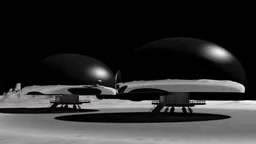
Radiation is a persistent hazard, and Mercury's low solar angle makes crater walls extraordinarily useful. Mobile teams can migrate between craters, sheltering in the shadow cast by crater rims that block the majority of direct sunlight, then deploying reflective shades and dispatching rovers to collect material. Heavier smelting equipment could even be left at repeatedly visited sites, waiting months for convoys to return.
From Mass Drivers to Skyhooks: The Railway to Space
Once Mercury can produce materials at scale, it needs export infrastructure. Chemical rockets are an inelegant solution for bulk cargo from a low-gravity, airless world — especially given the scarcity of local volatiles for propellant production. Mercury is an ideal setting for mass drivers: electromagnetic launch rails that accelerate cargo to orbital or escape velocities. The vacuum environment imposes no drag penalty, the low escape velocity permits long, gradual acceleration ramps, and the abundant solar power makes electrical launch energy effectively free at scale.
Conventional space elevators, as envisioned for Earth, are poorly suited to Mercury — its slow rotation places synchronous orbit at an impractically distant altitude hundreds of thousands of kilometers away. More appropriate alternatives are skyhooks and rotovators. A mass driver gives the payload a portion of the required velocity; a skyhook intercepts it in flight without requiring a full rocket launch; a rotovator then slings it toward higher orbit. The complete transport system would be layered: surface rail → mass driver → skyhook → orbital refinery → solar orbit.
The mass driver's operating principle derives from electromagnetic launch technology — essentially a linear induction motor: cargo is loaded into a conductive launch sled, and coils along the track fire in sequence to accelerate the payload continuously. Unlike chemical rockets, mass drivers consume no propellant (energy comes from an external source — on Mercury, solar power), are theoretically reusable indefinitely, and exhibit dramatically falling per-kilogram launch costs as scale increases. A skyhook is an orbital rotating tether system: a tether rotates around its center of mass, and when the tip sweeps through low orbit, a payload traveling at a comparatively low velocity can be "caught" during a brief rendezvous window, then flung toward higher orbit. By conservation of momentum, the tether's orbit drops slightly with each catch, and is restored by onboard ion thrusters or the momentum of outbound cargo. Together, these two systems form a "low-speed launch + aerial relay" architecture that effectively sidesteps Mercury's shortage of chemical propellant feedstocks.
The Star Forge Phase: Recursive Industrial Growth
Once Mercury hosts mines, furnaces, power infrastructure, and launch systems, it becomes an industrial base for the inner solar system. Near-solar industry differs fundamentally from terrestrial industry: power is extraordinarily abundant, but waste heat becomes the primary engineering challenge. Radiators, sunshades, reflective surfaces, and thermal routing become critical design constraints.

The mature industrial ecosystem would be composed of specialized, networked nodes: Mercury as the mine, Mercury orbit as the refinery, and inner solar orbit as the factory floor. At full development, Mercury could be called a "Star Forge" — a near-solar manufacturing system that transforms local planetary material and intense sunlight into the foundational infrastructure of a spacefaring civilization.
Growth at this stage becomes recursive: factories produce components for larger factories; larger factories produce more power collectors; more collectors drive more refineries. A mature Mercury industrial complex could manufacture solar power collectors, directed energy facilities, structural shells for rotating habitats such as O'Neill cylinders, and the basic elements of a Dyson swarm. Mercury's mass is approximately 3.3 × 10²³ kg — even extracting just 1% would yield a staggering quantity of habitats, mirrors, and spacecraft. You would not need to dismantle Mercury to make productive use of it for a very long time.
The O'Neill cylinder was proposed by physicist Gerard O'Neill in 1976: two counter-rotating cylinders generate artificial gravity through rotation, with the inner surfaces serving as habitation areas capable of supporting tens of thousands to millions of residents. The Dyson swarm, conceived by physicist Freeman Dyson, is not a solid shell but rather a vast collection of independent solar power satellites orbiting a star, collectively capturing a substantial fraction of its total radiated energy. Both concepts are extraordinarily material-intensive: a standard O'Neill cylinder design requires hundreds of millions of tonnes of structural material; individual Dyson swarm collectors, though extremely thin, would require planetary-scale mass to achieve meaningful coverage. This is the core logic of the Star Forge narrative — Earth cannot supply material at that scale without self-destruction, but gradually disassembling a 3.3 × 10²³ kg planet that is itself uninhabitable into space infrastructure is thermodynamically and ethically more defensible than sacrificing a world with a living biosphere.
Can Mercury Be Terraformed, and Should a Dead World Be Protected?
Once Mercury is covered in mines and orbital mirrors, the question of terraforming inevitably arises. The answer is surprising: technically yes — but not soon, not easily, and not cheaply. Mercury's problem is not a lack of energy but an excess of sunlight combined with a severe shortage of volatiles. The first step in any terraforming effort would be "dimming the Sun" — deploying a massive sunshade at Mercury's L1 Lagrange point — followed by importing water and nitrogen from comets, icy moons, or Venus's atmosphere. Oxygen is comparatively accessible, given how abundantly it is locked in rock.
Mercury is not an early terraforming target but a late-stage industrial one — something to be contemplated only after humanity already possesses mass drivers, comet-towing capability, solar sunshades, and planetary-scale manufacturing capacity.
Finally, there is the ethical dimension. Mercury has no biosphere, which simplifies the moral calculus of mining — but does not eliminate it entirely. It preserves a detailed record of planetary formation, impact history, volcanism, volatile chemistry, and magnetic field evolution. A thoughtful civilization would extract knowledge before extracting resources — protecting selected crater sites, studying the polar ice before consuming it. The choice is not between "mining" and "preservation" but whether we can become the kind of civilization capable of balancing both.
Mercury may never be anyone's favorite planet. But it may well become one of the first worlds we truly industrialize — not with smokestacks and poisoned rivers, but with mirrors, mines, buried cities, mass drivers, and orbital furnaces, turning sunlight and rock into civilization.
Related articles

Chain of Thought Isn't Just for AI: How Humans Can Use CoT to Improve Thinking Quality
Chain of Thought isn't just a prompt trick for large models. Starting from a Hacker News discussion, this article analyzes why CoT works for human thinking too, breaks down actionable ways to transfer it, and highlights the key differences between human CoT and machine CoT.
Cloudflare Teams Up with OpenAI: Closi…
Cloudflare Teams Up with OpenAI: Closing the Loop from Vulnerability Discovery to Defense with AI
Cloudflare uses OpenAI Daybreak to investigate security vulnerabilities and generate reviewable remediation plans, while developers use Codex to boost coding efficiency and quality.

Orca Multi-Agent Orchestration in Practice: A Guide to Parallel Collaboration with Claude and Codex
Orca is Stable AI's free open-source agent workbench supporting 34 agents like Claude Code and Codex in parallel. Learn its Git worktree isolation, multi-model orchestration, and mobile management.