Minions: Building a Distributed Virtual Cloud from Idle Apple Silicon GPUs

The Minions paper proposes aggregating idle Apple Silicon GPUs into a distributed virtual GPU cloud as a low-cost supplement to centralized compute.
The *Minions* paper addresses the pain points of centralized GPU clouds—high cost, insufficient elasticity, and long queues—by proposing to aggregate idle Apple Silicon GPUs across macOS devices into a dynamic, distributed virtual GPU cloud for large-scale ML inference. It doesn't compete head-on with data center GPUs but reuses already-deployed, already-paid-for idle edge compute, especially appealing to teams with many Macs. The article notes the real challenges lie in cross-device scheduling, task partitioning, communication overhead, and device availability fluctuations. With limited details disclosed in the abstract, performance in latency-sensitive scenarios and whether unified memory advantages survive in distributed environments remain unverified.
The cost pressure and elasticity bottlenecks of centralized GPU clouds are spurring an unexpected alternative path—organizing idle Apple Silicon devices around us into a distributed inference network. A paper titled Minions: A Dynamic and Distributed Virtual GPU Cloud Built on Idle Apple Silicon Devices systematically proposes this vision.
The Overlooked Compute: Idle Apple Silicon GPUs
The paper opens by pointing out a sharp supply-demand mismatch. On one hand, demand for GPU-accelerated machine learning inference continues to climb, but centralized GPU infrastructure exposes three limitations: high cost, insufficient elasticity, and long queue waits when resources are tight. On the other hand, modern Apple Silicon macOS devices come equipped with capable GPUs that sit idle most of the time during everyday use.
This mismatch isn't new, but Minions' angle is worth noting: rather than trying to compete head-on with NVIDIA's flagship data center GPUs, it targets edge compute that "already exists, is already paid for, but is underutilized."
Apple Silicon's unified memory architecture: This is key to understanding its role as an inference compute foundation. In traditional PC architectures, the CPU and GPU each have their own memory, and data must be copied back and forth over the PCIe bus, with both bandwidth and latency forming bottlenecks. Apple Silicon uses an SoC design where the CPU, GPU, and Neural Engine share the same high-bandwidth unified memory (e.g., 100–400 GB/s on M-series chips). This means model weights only need to be loaded once, and no explicit data movement is required between CPU preprocessing and GPU inference, significantly reducing latency and power consumption for small and medium model inference. However, this advantage is built on single-machine sharing; once extended to a distributed environment, cross-device communication still has to go over the network, and the bandwidth benefits of unified memory cannot be directly transferred. Apple Silicon is therefore suited as an edge inference node, not as a replacement for NVLink-style high-speed interconnects inside data centers.
How Minions Organizes Distributed GPU Resources
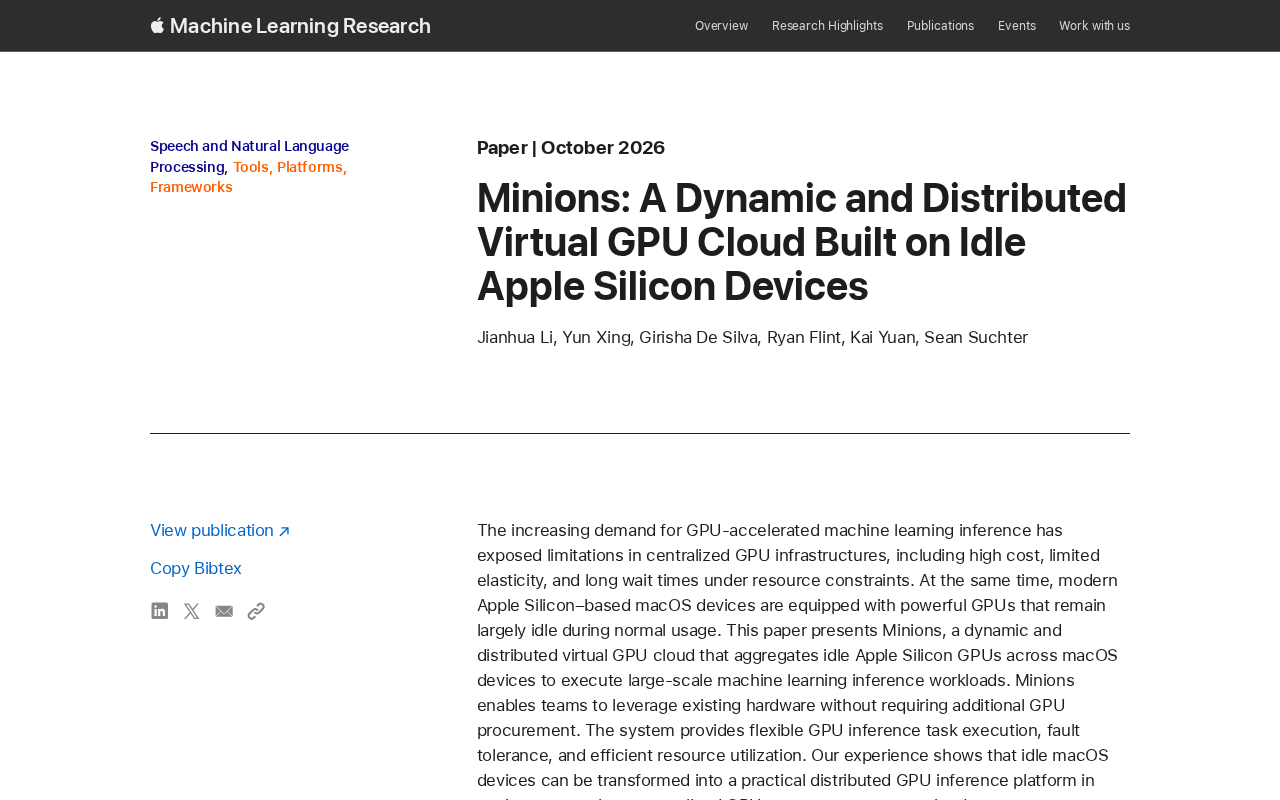
According to the paper's abstract, Minions is defined as a "dynamic and distributed virtual GPU cloud," with its core mechanism being to aggregate idle Apple Silicon GPUs across macOS devices to execute large-scale machine learning inference workloads.
There are two keywords here: dynamic and distributed. Dynamic means the resource pool isn't statically allocated but changes in real time with device availability; distributed means inference tasks must be split and scheduled across devices in different physical locations to be completed collaboratively. The paper emphasizes the goal of letting teams "leverage existing" device resources—hinting that its original intent is to reduce reliance on building new centralized infrastructure, rather than requiring additional hardware investment.
From an engineering perspective, the core challenge of this path isn't single-machine GPU performance, but cross-device scheduling, task partitioning, network communication overhead, and dynamic fluctuations in device availability. The paper's abstract doesn't dive into specific technical details, but these issues are key to judging the feasibility of the approach.
Task partitioning and scheduling for distributed inference: When a single model can't fit on one device, or an inference needs to be completed across devices collaboratively, common approaches include pipeline parallelism (splitting by layer, with devices processing in sequence) and tensor parallelism (splitting a single layer's matrix operations across multiple devices). The former has lower network bandwidth requirements but uneven device utilization; the latter communicates frequently and is latency-sensitive. The "dynamic" aspect emphasized by Minions adds another dimension: a device might go offline mid-inference, so the scheduler must support task migration, retries, or degradation. These mechanisms are conceptually similar to distributed scheduling frameworks like Ray and Kubernetes, but when targeting consumer-grade macOS devices, they must also handle desktop OS-specific interference factors such as power management policies, sleep/wake cycles, and background process priorities—making the engineering complexity considerable.
Why This Direction Is Worth Watching
The value of Minions isn't in proposing a brand-new technical primitive, but in offering a redistribution approach to how compute supply is provided.
For small and medium teams, the cost barrier and queue times of centralized GPU clouds have long been real pain points. If idle Apple Silicon devices can be effectively organized, this could theoretically form a low-cost, more elastic supplementary compute source. For enterprises or research institutions that already deploy Mac devices at scale, this means potential room for compute reuse.
But caution is warranted. The paper's abstract reveals limited information, and the performance of distributed inference in latency-sensitive scenarios, the actual overhead of cross-device communication, and the complexity of task scheduling are all realistic constraints that determine whether such approaches can be deployed. Apple Silicon's unified memory architecture has unique advantages in certain inference scenarios, but whether these advantages survive when extended to a distributed environment remains an open question.
Minions represents a trend worth tracking: when the marginal cost of centralized compute remains stubbornly high, how to reorganize and utilize already-existing idle resources may become a pragmatic branch of distributed AI infrastructure.
Existing practices in edge compute aggregation: Minions is not an isolated idea, and similar approaches have precedents. Federated learning lets multiple devices train collaboratively without centralizing data; volunteer computing projects like BOINC and Folding@home have long aggregated idle CPU/GPU power for scientific computing; and in recent years, research has attempted to use idle phones or edge devices for LLM inference. The common lesson from these projects is that aggregating idle resources is feasible in terms of throughput, but faces non-technical challenges such as node heterogeneity, poor availability, incentives, and security. Minions' difference lies in scoping to the relatively homogeneous Apple Silicon ecosystem and focusing on inference rather than training. This convergence helps reduce scheduling complexity, but it also means its applicable boundary is constrained by the installed base of macOS devices, making it hard to generalize to the broader heterogeneous compute market.
One-line Summary
The Minions paper proposes aggregating idle Apple Silicon GPUs to build a distributed virtual GPU cloud, offering a low-cost supplementary path to centralized compute.
Paragraph Summary
Aiming at the pain points of centralized GPU clouds—high cost, insufficient elasticity, and long queue times—the Minions paper proposes aggregating idle Apple Silicon GPUs across macOS devices into a dynamic, distributed virtual GPU cloud for large-scale machine learning inference. The approach doesn't seek to compete head-on with data center GPUs, but rather to reuse already-deployed, already-paid-for, but idle edge compute, making it especially appealing to teams with many Mac devices. The article notes that the real challenges lie not in single-machine performance, but in cross-device scheduling, task partitioning, communication overhead, and fluctuations in device availability. Since the paper's abstract discloses limited information, performance in latency-sensitive scenarios and whether unified memory advantages can be preserved in a distributed environment remain to be verified.
Related articles

Felix Rieseberg Personal Homepage
Felix Rieseberg's personal homepage sparks attention on Hacker News. This article covers the Slack engineer's technical background, the rise and fall of nativefier, and the value of a developer homepage as a tech calling card.

@ai-sdk/vue 3.0.306 Patch Release Syncs with [email protected] Update
@ai-sdk/vue 3.0.306 released, synced with [email protected]. A routine patch release for the Vercel AI SDK ecosystem with no public API changes; the Vue adapter layer stays version-aligned with the core package.

Gemini 4 Argon API Launches: The Era of Million-Token Output Begins
Google launches Gemini 4 Argon with sparse MoE architecture, up to 1M output tokens, and a 68.90% Vals Index score, available across API, AI Studio, and the Gemini app.