MintFlow: Constrained Flow Matching Sampling via Minimal Trajectory Intervention

MintFlow enforces constraints on flow matching via minimal trajectory perturbation with a closed-form adjoint solution.
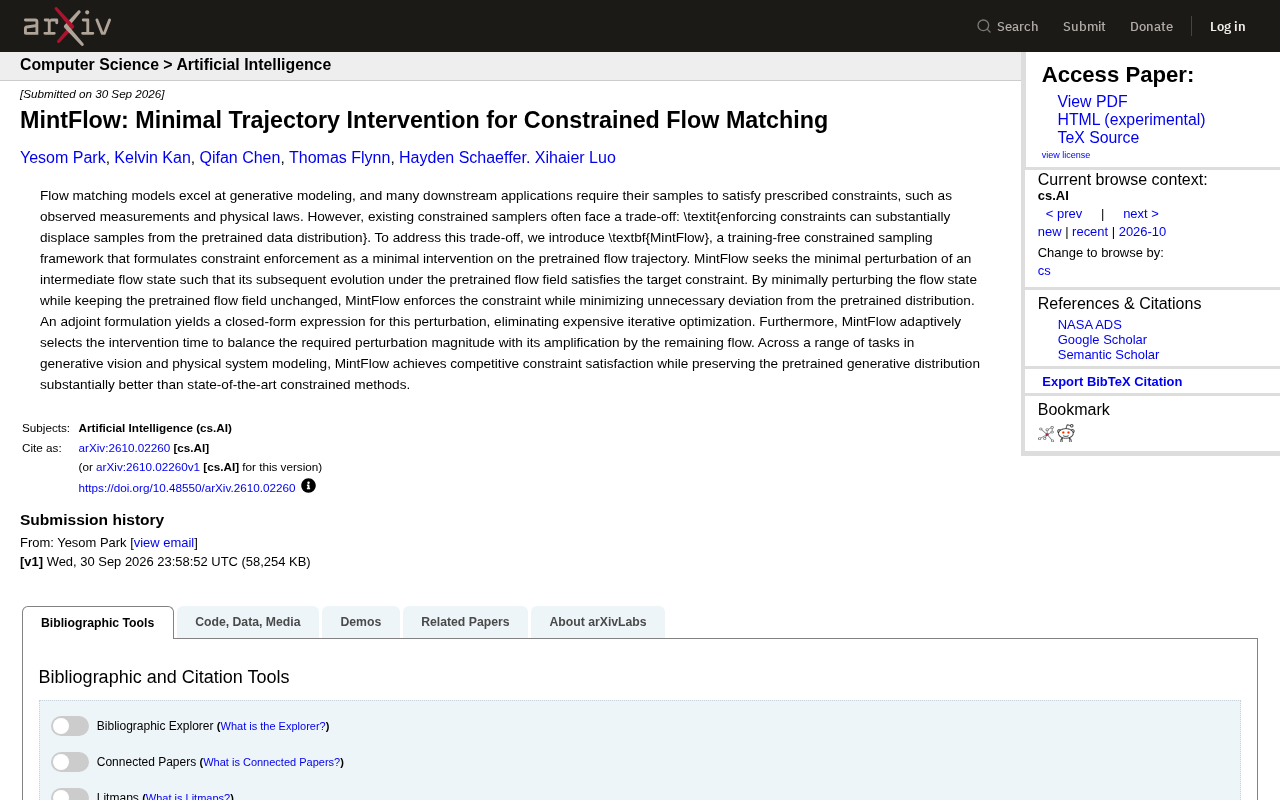
MintFlow is a training-free constrained sampling framework for flow matching generative models. Its core idea is to reframe constraint enforcement as a "minimal intervention" on pretrained flow trajectories — finding the smallest perturbation to an intermediate state so that continued evolution under the original flow field yields a constraint-satisfying output. Technically, MintFlow uses the adjoint formulation to derive a closed-form solution for the perturbation, avoiding costly iterative optimization, while adaptively selecting the intervention time to balance perturbation magnitude against downstream amplification. Experiments on generative vision and physical system modeling tasks show that MintFlow achieves competitive constraint satisfaction while significantly better preserving the pretrained distribution compared to state-of-the-art methods.
The Constraint Problem in Flow Matching Models
Flow Matching has emerged as a standout approach in generative modeling, establishing itself alongside diffusion models as one of the dominant generation paradigms. However, in many real-world downstream applications, simply generating realistic samples isn't enough — we often need those samples to satisfy predefined constraints. In image inpainting, for instance, samples must be consistent with observed pixel measurements; in scientific computing, generated outputs must obey physical laws.
The trouble is that existing constrained sampling methods universally face a thorny trade-off: enforcing constraints pulls samples far away from the pretrained data distribution. In other words, the more strictly you force a sample to satisfy constraints, the more likely the output is to drift from what the model originally learned, resulting in degraded quality, distortions, or unnatural artifacts. Striking a balance between "satisfying constraints" and "maintaining distributional fidelity" has long been the central challenge in constrained generation.
Flow Matching is a generative model training paradigm built on continuous normalizing flows. Its core idea is to learn a vector field that progressively "flows" noise samples from a simple prior distribution (e.g., Gaussian) to the target data distribution along deterministic or stochastic trajectories. Compared to diffusion models, flow matching can often use straighter transport paths, enabling high-quality sampling in fewer inference steps. In recent years, major image generation models such as Stable Diffusion 3 and Flux have adopted the flow matching framework, cementing its status as a key generative modeling paradigm. The key concept in flow matching is the "trajectory": each sample's generation corresponds to a continuous path from noise to data, and the model's training objective is to make these paths as efficient and distribution-aligned as possible. MintFlow leverages precisely this controllability of trajectories, recasting constraint satisfaction as a localized intervention on specific trajectories.
MintFlow's Core Idea: Minimal Intervention
To address this trade-off, this arXiv paper introduces MintFlow — a training-free constrained sampling framework. Its central philosophy can be distilled into a single sentence: reframe the process of enforcing constraints as a minimal intervention on a pretrained flow trajectory.
Concretely, MintFlow does not modify the pretrained model's flow field itself. Instead, it seeks the smallest possible perturbation to some intermediate flow state such that, when this perturbed state continues to evolve under the original flow field, the final output satisfies the target constraint. This design philosophy of "perturb as little as possible, leave the flow field intact" means that while enforcing constraints, it minimizes unnecessary deviation from the pretrained distribution.
This is a remarkably elegant conceptual shift: rather than fighting against what the model has already learned, work with it — find the most efficient nudge point along the trajectory and let the sample naturally slide toward constraint satisfaction along its own dynamical path.
A Closed-Form Solution via the Adjoint Method
Another major technical highlight of MintFlow is that it avoids expensive iterative optimization. The paper applies an adjoint formulation to derive the required perturbation, yielding a closed-form expression for it.
This is highly significant from an engineering standpoint. Many constrained sampling methods require costly iterative optimization or gradient descent at each step, with computational overhead that scales rapidly with problem size. A closed-form solution means the perturbation can be computed directly, dramatically reducing sampling costs and making the method more practical for real-world deployment.
The adjoint method originates from optimal control theory and numerical optimization of differential equations. In Neural ODE training, the adjoint method is widely used to efficiently compute gradients of a loss function with respect to initial states or parameters. Its key advantage is that it avoids storing the entire forward trajectory in memory, instead back-propagating gradients by solving a "adjoint" reverse differential equation — significantly saving computational resources. In the context of MintFlow, the adjoint formulation is used to analyze the sensitivity question: "if we apply a small perturbation to an intermediate state, how does the final output change?" It is precisely through this tool that the paper can derive an analytic expression for the perturbation needed to satisfy the target constraint, bypassing step-by-step numerical search and directly computing both the direction and magnitude of intervention. This is the fundamental reason MintFlow achieves substantially better computational efficiency than gradient-descent-based constrained methods.
Adaptive Selection of Intervention Timing
Beyond "how much to perturb," MintFlow also addresses "when to perturb." The framework adaptively selects the intervention time to balance the magnitude of the required perturbation against the degree to which it gets amplified by the remaining flow evolution.
The intuition is straightforward: if you intervene too early in the trajectory, a tiny perturbation may be amplified into a massive deviation over the long subsequent evolution; but if you intervene too late, you may need an excessively large instantaneous perturbation to satisfy the constraint. MintFlow adaptively selects the optimal intervention moment, striking a compromise between these two extremes to minimize overall trajectory deviation.
Experimental Performance and Significance
The paper evaluates MintFlow across a range of tasks including generative vision and physical system modeling. Results show that MintFlow achieves competitive constraint satisfaction while significantly better preserving the pretrained generative distribution compared to current state-of-the-art constrained methods.
This result directly addresses the trade-off raised at the outset: MintFlow does not sacrifice distributional fidelity in exchange for constraint satisfaction — it finds a better balance between the two. For applications that require outputs to be both realistic and compliant — such as medical image reconstruction, physical simulation, and engineering design with hard constraints — this kind of approach has genuine practical value.
Implications for the Research Community
From a methodological perspective, MintFlow represents a noteworthy direction in constrained generation: rather than retraining models, it introduces constraints through lightweight, analytically tractable interventions on the inference process. This "plug-and-play" property lowers the barrier to adoption, allowing researchers and engineers to directly layer constraint capabilities onto existing pretrained flow matching models without incurring the substantial cost of retraining.
Of course, as a recently released preprint, MintFlow's actual generalization ability, stability under more complex constraints, and the numerical behavior of the adjoint formulation in high-dimensional settings still await further follow-up research and community replication. But the core perspective it introduces — "minimal intervention" — provides a valuable conceptual framework for understanding and improving constrained sampling.
In constrained generation evaluation, "constraint satisfaction" and "distributional fidelity" are two commonly opposing metrics. The former measures whether generated samples genuinely satisfy predefined constraints (e.g., whether pixel values in inpainted regions exactly match observed areas); the latter uses metrics like FID (Fréchet Inception Distance) to assess whether generated results still resemble real data. Many existing methods guarantee satisfaction by introducing strong penalty terms or repeatedly projecting onto the constraint set during inference, but this often pushes samples into low-probability regions of the distribution, producing blurry, over-smoothed, or visually distorted results. MintFlow's experimental results suggest that its "minimal intervention" design enables it to achieve a better Pareto frontier between constraint satisfaction and generation quality — reaching the same or higher levels of constraint satisfaction with a smaller distributional deviation cost. This is especially important for real-world applications that must balance both compliance and realism.
Summary
MintFlow reframes constrained flow matching sampling as a minimal perturbation to pretrained trajectories. Through the closed-form solution derived via the adjoint method and adaptive intervention timing, it achieves a better balance between constraint satisfaction and distributional fidelity. Its training-free, computationally efficient nature gives it practical potential for tasks requiring hard constraints — such as generative vision and physical system modeling. For researchers focused on the controllability of generative models, this is a work worth following.
Related articles

JobRunner MCP Server: AI Agents Can Now Fix Failed Java Jobs
JobRunner launches an open-source MCP server enabling AI agents to view cluster status, diagnose failures, and recover Java jobs—incident response from any cloud coding environment or existing agent.

MLAI Digital Launches 9 Security Agents: MCP Server Safeguards the Full Lifecycle of Agentic AI
MLAI Digital launches Security MCP Server with nine built-in specialized security agents covering vulnerability discovery, attack simulation, prompt injection detection, API and infrastructure assessment, and accelerated remediation—embedding security validation across the full Agentic AI lifecycle from development to production.

Running Isaac Lab on H100 GPUs: Exploring Better Approaches
Exploring optimization methods for running Isaac Lab on NVIDIA H100 GPUs, including MIG configuration, mixed precision, TensorRT acceleration, and community experience to improve robotics simulation and reinforcement learning efficiency.