MIPA: Mutual Information Maximization for Self-Supervised Dataset Distillation

MIPA efficiently achieves self-supervised dataset distillation by maximizing mutual information to align prototype assignments across augmented views.
The article introduces MIPA (Mutual Information Prototype Alignment), a dataset distillation method for self-supervised learning. Existing distillation methods are mostly designed for supervised learning and focus on class-discriminative information, neglecting the augmentation invariance required by SSL. MIPA treats synthetic images as learnable prototypes, uses a frozen encoder to extract features from real images and their augmented views, assigns prototypes based on similarity, and maximizes mutual information between cross-view assignments to encourage consistency while avoiding trivial solutions where all samples cluster into a few prototypes. Experiments show that synthetic data generated by MIPA yields better representation quality than existing methods when training self-supervised models, and significantly reduces computational and storage overhead under the same distillation budget. The article also validates the effectiveness of mutual information maximization in ensuring prototype diversity and discusses prospects for extending the method to more complex tasks and larger-scale datasets.
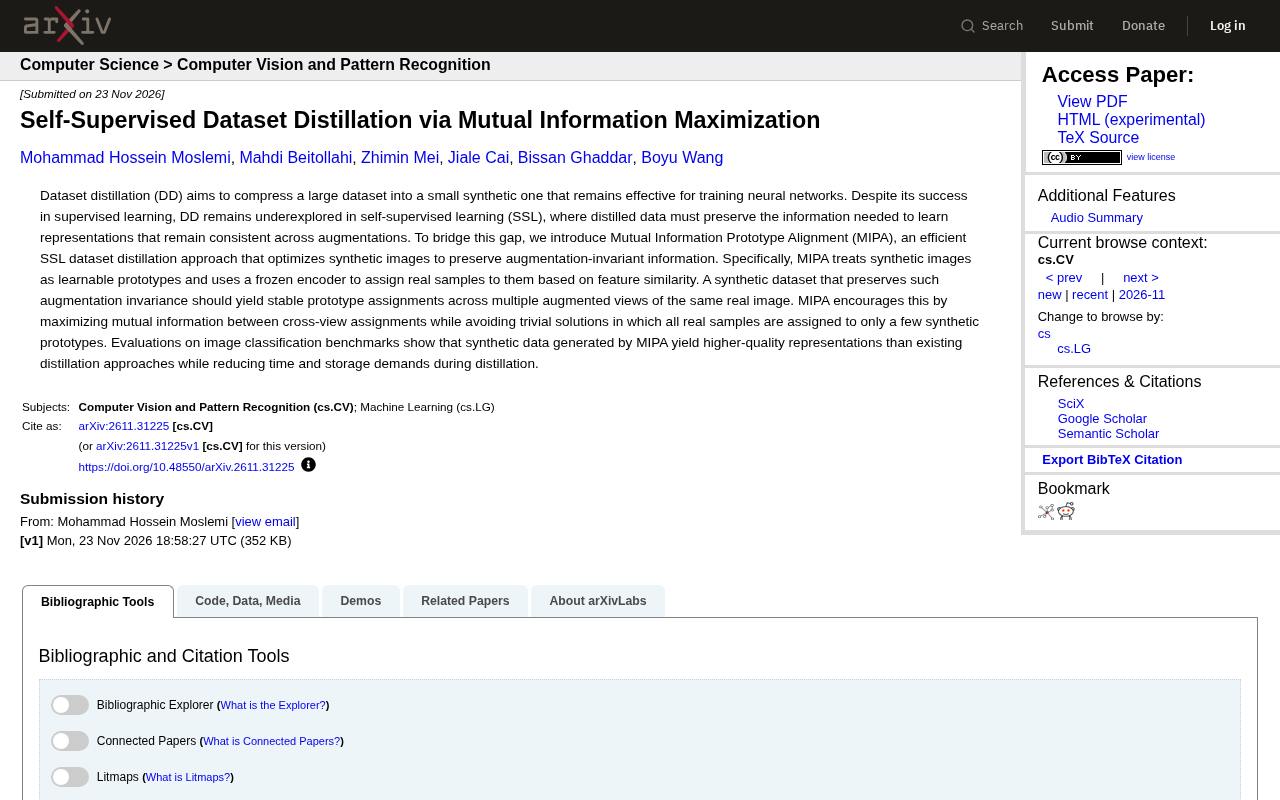
Dataset Distillation (DD) aims to compress a large dataset into a small synthetic dataset while preserving its effectiveness for training neural networks. However, most existing research focuses on supervised learning scenarios, and dataset distillation under self-supervised learning (SSL) remains underexplored. Self-supervised learning requires the distilled data to retain the information needed to learn augmentation-invariant representations, which poses new challenges for distillation methods. To address this, researchers have proposed an efficient self-supervised dataset distillation method called Mutual Information Prototype Alignment (MIPA), which optimizes synthetic images to preserve augmentation-invariant information.
Challenges of Self-Supervised Dataset Distillation
In self-supervised learning, models need to learn consistent representations from multiple views of data augmentations. This means the distilled synthetic data must not only retain the key features of the original dataset but also ensure these features remain stable under different augmentation transformations. Traditional dataset distillation methods are typically designed for supervised learning, focusing on preserving class-discriminative information while neglecting augmentation invariance—the core requirement of self-supervised learning. Therefore, designing a dataset distillation method specifically for self-supervised learning has become an urgent problem to solve.
MIPA was proposed precisely to fill this gap. It treats synthetic images as learnable prototypes and uses a frozen encoder to assign real samples to these prototypes based on feature similarity. The core idea is: a synthetic dataset that preserves augmentation invariance should produce stable prototype assignments for the same real image under different augmented views. By maximizing the mutual information between cross-view assignments, MIPA encourages this stability while avoiding the trivial solution where all real samples are assigned to a few prototypes.
Self-supervised learning (SSL) is a class of representation learning methods that require no manual labels, with the core idea of designing pretext tasks that let models learn useful features from the data itself. Common paradigms include contrastive learning (e.g., SimCLR, MoCo), masked image modeling (e.g., MAE), and self-distillation (e.g., BYOL, DINO). These methods generally rely on data augmentation: applying random crops, color jitter, flips, and other transformations to the same image to generate multiple views, then requiring the model to output consistent representations for these views. Therefore, the representations learned by SSL naturally possess augmentation invariance—that is, insensitivity to semantically preserving transformations. This property means that if distilled synthetic data is to be used for training SSL models, it must retain information sufficient to support this invariance learning, not just class-discriminative information. This is precisely what fundamentally distinguishes self-supervised dataset distillation from the supervised setting.
MIPA Method Details
The MIPA workflow can be summarized in the following steps:
- Prototype initialization: Treat synthetic images as learnable prototype parameters.
- Feature extraction: Use a frozen encoder (a pretrained self-supervised model) to extract features of real images and their augmented views.
- Prototype assignment: Based on feature similarity, assign each real sample to the most similar prototype.
- Mutual information maximization: For different augmented views of the same real image, maximize the mutual information between their prototype assignments, thereby encouraging assignment consistency.
- Avoiding trivial solutions: Through regularization or constraints, prevent all samples from being assigned to a few prototypes, ensuring prototype diversity.
The key to this method is that it does not require updating the encoder during distillation; instead, it leverages a pretrained encoder to provide stable feature representations, thereby efficiently optimizing the synthetic data. Compared with existing methods, MIPA reduces time and storage requirements during distillation, while the generated synthetic data can produce higher-quality representations.
Mutual information (MI) is a quantity in information theory that measures the statistical dependence between two random variables, defined as I(X;Y)=H(X)−H(X|Y), i.e., the reduction in uncertainty about X after knowing Y. In MIPA, mutual information is used to measure the consistency between prototype assignments of the same real image under different augmented views: if the assignments of two views are highly correlated, the mutual information is large; if the assignments are independent, the mutual information is zero. Maximizing mutual information is equivalent to encouraging the model to give predictable and consistent assignments across different views. However, directly maximizing mutual information carries the risk of trivial solutions—for example, mapping all samples to the same prototype, where the assignment is fully determined and mutual information may actually be high but uninformative. Therefore, MIPA must simultaneously introduce diversity constraints (such as marginal entropy maximization or prototype usage balance regularization) to ensure that the sample distribution assigned to each prototype is as uniform as possible, thereby balancing consistency and diversity.
Prototype in machine learning usually refers to a set of representative feature vectors or samples used to summarize the center of a class or cluster. In MIPA, the synthetic images themselves are directly parameterized as learnable prototypes, with each prototype corresponding to an anchor point in a high-dimensional feature space. After real samples are processed by the frozen encoder to extract features, soft or hard assignment is performed by computing similarity (e.g., cosine similarity) to each prototype. The ingenuity of this design is that synthetic images are both the product of distillation and act as clustering centers, unifying dataset distillation and prototype clustering within a single framework. The frozen encoder ensures the stability of the feature space, avoiding the instability and high computational cost of jointly optimizing the encoder and synthetic data during distillation.
Experimental Evaluation and Results
Researchers evaluated on image classification benchmarks, and the results show that when training self-supervised models with synthetic data generated by MIPA, the quality of learned representations is higher than with existing distillation methods. Specifically, under the same distillation budget, MIPA achieves better performance on multiple downstream tasks while significantly reducing computational overhead and storage requirements during distillation. This advantage benefits from MIPA's effective preservation of augmentation-invariant information and its efficient optimization strategy.
Experiments also validated the effectiveness of mutual information maximization in avoiding trivial solutions. By visualizing prototype assignments, researchers found that MIPA can evenly assign real samples to different prototypes without the situation where all samples cluster into a few prototypes, thereby ensuring the diversity of synthetic data.
Conclusion and Outlook
MIPA provides a novel and efficient solution for dataset distillation under self-supervised learning. It preserves augmentation-invariant information through mutual information maximization and ensures the quality of synthetic data via a prototype alignment mechanism. Experiments demonstrate that MIPA outperforms existing methods in both representation quality and efficiency. In the future, this method is expected to be extended to more complex self-supervised learning tasks and larger-scale datasets, further advancing the application of dataset distillation in the self-supervised domain.
With the growing popularity of self-supervised learning, how to efficiently compress and utilize unlabeled data will become an important research direction. The emergence of MIPA provides valuable ideas for this direction, and we look forward to further optimization and expansion by subsequent research on this basis.
One-line Summary
MIPA efficiently achieves self-supervised dataset distillation by maximizing mutual information to align prototype assignments across augmented views.
Paragraph Summary
The article introduces MIPA (Mutual Information Prototype Alignment), a dataset distillation method for self-supervised learning. Existing distillation methods are mostly designed for supervised learning, focusing on preserving class-discriminative information while neglecting the augmentation invariance required by self-supervised learning. MIPA treats synthetic images as learnable prototypes, uses a frozen encoder to extract features of real images and their augmented views, performs prototype assignment based on similarity, and maximizes mutual information between cross-view assignments to encourage assignment consistency while avoiding the trivial solution where all samples cluster into a few prototypes. Experiments show that synthetic data generated by MIPA yields better representation quality than existing methods when training self-supervised models, and significantly reduces computational and storage overhead under the same distillation budget. The article also validates the effectiveness of mutual information maximization in ensuring prototype diversity, and discusses prospects for extending the method to more complex tasks and larger-scale datasets.
Related articles

Prospero: A Lightweight Native AI Coding Tool Built with ImGui
Prospero is a bloat-free native AI coding tool built with ImGui, emphasizing lightweight design, high performance, and low dependencies. This article analyzes its design philosophy, technical choices, and the divergence between platformization and toolization in AI coding tools.

WebRTC Abused: New Variant of Credit Card Skimming Scripts on Shopping Sites
Security researchers found skimming scripts on popular shopping sites using WebRTC data channels to exfiltrate credit card data. This article analyzes the technical原理, differences from traditional Magecart attacks, and defense strategies for e-commerce platforms in third-party script governance and CSP policies.

Single GB10 Card Hits 101 tok/s: Inkling 2 Mini Performance Tested on vLLM
A developer shared on Hacker News running Inkling 2 Mini with vLLM on a single GB10 at 101 tok/s. This article analyzes the technical context, the significance of vLLM with small models on single cards, and caveats for interpreting tok/s metrics.