Mira Tours: AI Walking Tours Turn City Strolls into Private Audio Stories

Mira Tours uses AI to generate instant audio guides, letting travelers listen to city stories as they walk.
Mira Tours is a new product ranked #16 on Product Hunt, positioned as an "AI walking tour guide" that replaces traditional pre-made audio guides with instantly generated content. It offers two modes: customizing walking routes through conversation, or walking while listening to AI narrate stories about surrounding locations. The backend uses Google Cloud Run. The core value is letting independent travelers "have content to listen to no matter where they walk." However, accuracy, non-popular area coverage, audio quality, and offline availability still need real-world validation.
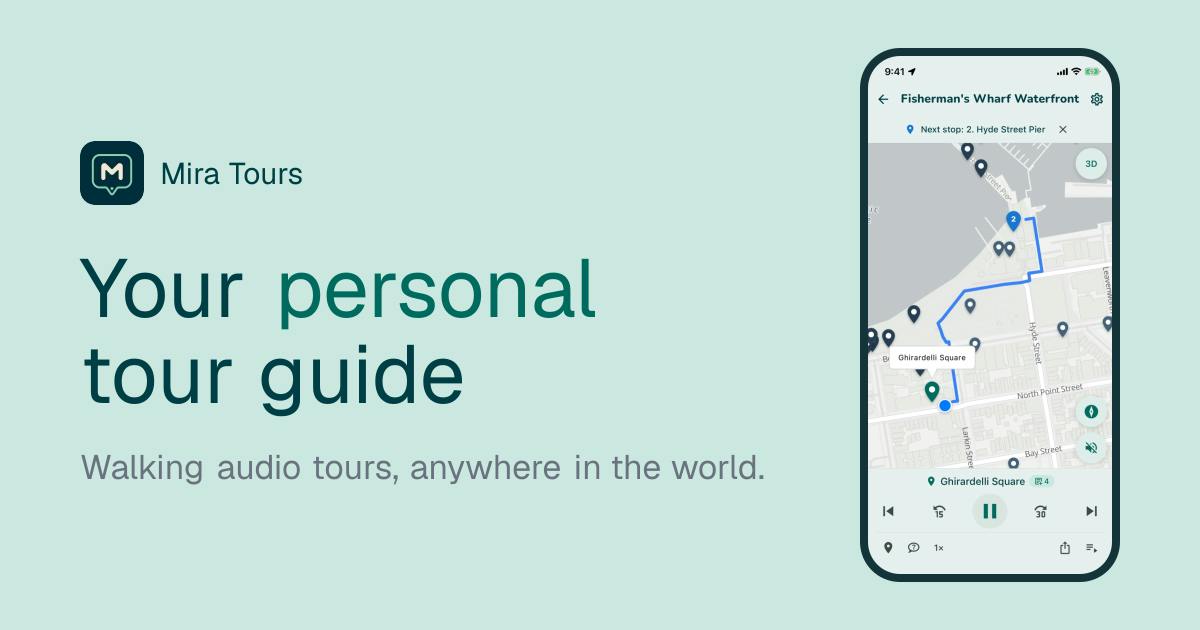
Wandering the streets of an unfamiliar city without knowing the stories behind the buildings around you—this is a common pain point for many travelers. Mira Tours, a new product ranked #16 on Product Hunt, aims to solve this with AI: it positions itself as an "AI walking tour guide," letting users walk and listen to stories anywhere in the world.
What Problem Does It Actually Solve
Traditional audio guides usually come with several limitations: you need to download an app in advance and purchase guide packages for specific cities, content is pre-recorded by editorial teams, routes are fixed, and coverage tends to focus only on popular attractions. Once you deviate from the prescribed route, the guide becomes useless.
Mira's approach is to transform guides from "pre-made content" into "on-the-fly generation." According to the official description, users have two ways to use it: first, describe a theme or area of interest through chat, and the AI generates a custom walking route on the spot; second, simply start walking and listen as the AI narrates stories about the places around you. The former is active customization, the latter is passive discovery—both emphasize the act of "getting out there."
This model works on the premise that AI can understand geographic location in real time and quickly produce credible, coherent narration. It tests not only the model's knowledge base, but also its response speed in mobile scenarios and the smoothness of audio generation.
Audio Guide is a long-standing form of travel assistance, from physical rental devices in museums to offline guide packages in mobile apps—the core logic has always been "pre-made content + fixed routes." Traditional products typically sell packages by city or attraction, requiring editorial teams to scout locations, write scripts, record audio, and produce updates on a monthly or even yearly cycle. This creates several structural problems: obscure neighborhoods are almost never covered; once content is recorded, it can't be dynamically adjusted to user interests; and the experience breaks down when users deviate from recommended routes. AI-generated guides attempt to bypass this asset-heavy process, using large models' knowledge base and real-time reasoning to replace human editors—transforming "one set of content per city" into "one set of content per user per walk." This is precisely the fundamental divide between Mira and its predecessors.
Product Details: Conversational Customization + Walk-and-Listen
In terms of product form, Mira is a typical "AI-native app"—no bloated menus or preset lists, just a conversation as the entry point. Users don't need to learn how to use it first; they simply state their needs. This design lowers the barrier to entry and aligns with the travel mindset of "no hassle, ready to use immediately."
On the technical side, Mira's listed tags include Google Cloud Run, indicating its backend uses a containerized cloud service architecture. This is a reasonable choice for an app that needs to generate content on demand and whose users are highly geographically dispersed: Cloud Run can scale elastically per request, avoiding the need to keep large numbers of server instances running for scattered walking requests worldwide, and it facilitates nearby responses across different regions.
You might not have noticed, but Mira also offers an Android version and is categorized under Travel and Artificial Intelligence, indicating it doesn't intend to be a general-purpose chat assistant, but rather focuses on the specific scenario of "real-time narration during travel."
Google Cloud Run is a fully managed containerized compute platform provided by Google Cloud, falling under the Serverless category. Developers simply package their application into a container image, and Cloud Run automatically handles underlying server creation, scaling, and load balancing. Its key feature is "pay-per-request, scale to zero"—when there are no user requests, instances can scale down to zero with no compute costs; when request volume surges, it can horizontally scale out numerous instances within seconds. For apps like Mira Tours, where users are extremely geographically dispersed, access times are random, and per-request compute is non-trivial, Cloud Run precisely solves the cost challenge of "keeping servers running for scattered global requests," while working with the global edge network to enable nearby responses and reduce latency in mobile scenarios.
Who Should Use It, Who Should Wait
Mira's target users are fairly clear: travelers who enjoy independent travel, prefer not to join tour groups, and want to understand a city's background. For these people, the greatest value is that "you can listen to content no matter where you walk," freeing them from the constraint of checking in at official routes. Urban wanderers, digital nomads, and those on temporary business trips wanting to explore in their spare time can all benefit.
But there are areas that need watching. How accurate and in-depth can AI-generated location narration be? Historical content errors carry significant costs. Additionally, public information shows only 3 reviews—the sample of actual user experience is still very limited. Audio quality, offline availability, and content coverage in non-popular areas all need more real-world feedback to verify.
The "hallucination" problem of AI-generated content is especially sensitive in guide scenarios. Without external fact-checking, large language models may present non-existent historical events, incorrect building dates, or fabricated anecdotes as if they were true. In general chat scenarios, users can often detect anomalies through common sense; but on foreign streets, travelers precisely lack local knowledge—making it hardest to distinguish fact from fiction. Once historical narration contains errors, it not only misleads users but may also touch on the serious issue of cultural heritage. Therefore, for products like Mira to build trust, they typically need to incorporate Retrieval-Augmented Generation (RAG), connect to authoritative geographic and historical databases, or perform secondary verification of key facts. This is why the article emphasizes that "content credibility" may be more decisive for success in this space than model capability itself.
Some Observations on the AI Guide Space
Mira represents a growing product direction: binding large model capabilities to specific physical scenarios rather than staying within a chat box. Audio guides are well-suited for AI because their content is highly context-dependent (time, location, user interests), and this kind of context is precisely what traditional pre-made content struggles to handle flexibly.
The key to competition may not lie in the model itself—after all, the gap between underlying capabilities is narrowing—but rather in data quality, content credibility, and stability during "walk-and-use" scenarios. Mira's current approach is conceptually complete; what remains to be seen is how it performs on real streets.
If you have travel plans, it's worth trying as a new addition to your independent travel toolkit.
One-line Summary
Mira Tours uses AI to generate instant audio guides, letting travelers listen to city stories as they walk.
Paragraph Summary
Mira Tours is a new product ranked #16 on Product Hunt, positioned as an "AI walking tour guide" that aims to replace traditional pre-made audio guides with instantly generated content. It offers two modes: customizing a personal walking route through conversation, or simply walking while listening as AI narrates stories about surrounding locations. The backend uses a Google Cloud Run containerized architecture, suited to globally dispersed on-demand requests. The core value is letting independent travelers "have content to listen to no matter where they walk," free from fixed routes. However, the article also notes that the accuracy and depth of AI-generated narration, coverage in non-popular areas, audio quality, and offline availability all need more real-world feedback to verify. Overall, Mira represents the product trend of binding large model capabilities to specific physical scenarios, where the key to competition may not be the model itself, but data quality, content credibility, and stability in mobile scenarios.
Related articles

Workbuddy for Absolute Beginners: How a Desktop AI Agent Fits Into Real Workflows
A beginner's guide to the Workbuddy desktop AI agent: installation, claiming credits, file management, and building automated workflows—compared with CodeX for fit and cost, helping professionals shift from AI question-askers to AI managers.

OpenAI's New Agent Stack: Computer Use, Decisions API, and Ultra-Fast Workflows
OpenAI Dev Day unveiled a new agent stack: Computer Use outperforms humans, Decisions API delivers ultra-low-latency classification via Luna, Agents API opens the same Computer Use capabilities, and GPT-6.1 Sol costs only one-seventh of Astra. Core updates, benchmark data, and developer insights.

Liang Wenfeng Open-Sources DeepInfo Inference Framework, Takes On U.S. Ban
DeepSeek open-sources its DeepInfo inference framework after its models, featuring GPU/CPU cross-pipelining, small-model prediction with large-model verification, and full Huawei Ascend and NVIDIA chip support—facing the U.S. federal ban head-on. This article analyzes its significance for AI deployment and open-source strategy.