MiroFlow Open-Source AI Workflow Framework Review: The Strengths and Concerns Behind Top Rankings Across Multiple Benchmarks

MiroFlow is an open-source AI workflow framework topping 5+ benchmarks with multi-model orchestration and visual UI.
MiroFlow is an open-source AI workflow framework by MiroMindAI that achieved Top-1 rankings across 5+ benchmarks. It supports flexible scheduling of mainstream LLMs including MiroThinker, Claude, Kimi, and OpenAI, features a built-in Web UI to lower the barrier to entry, and has earned nearly 3,000 GitHub Stars. Its business model follows a dual-flywheel strategy of open-source framework plus proprietary model. While ideal for developers needing multi-model comparison, high inference quality, and visual management, it remains a young project whose long-term stability warrants continued observation.
What Is MiroFlow
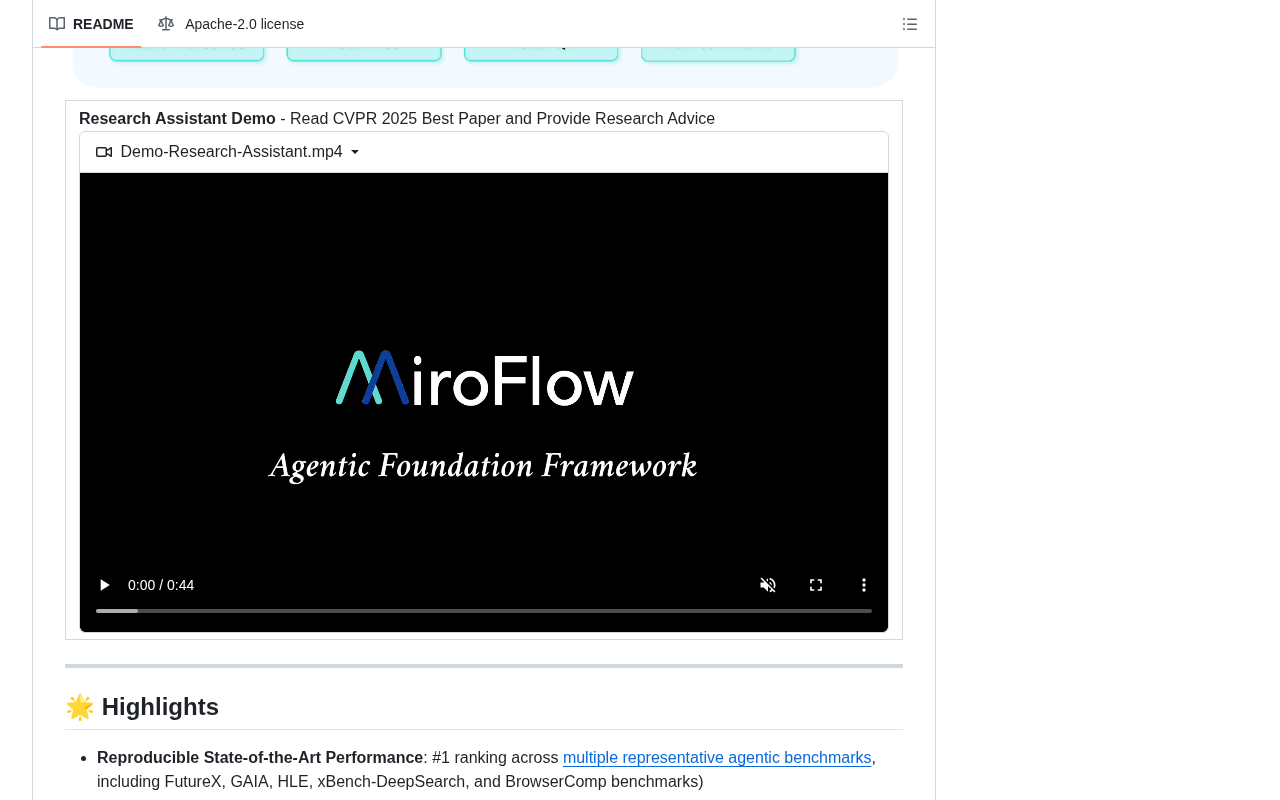
MiroFlow is an open-source AI workflow framework developed by the MiroMindAI team. It has quickly gained traction in the developer community by achieving Top-1 rankings across more than 5 benchmarks. Built on Python, the project features a built-in Web UI for visual workflow design and supports integration with mainstream large language models including MiroThinker, Claude, Kimi, and OpenAI. It has already accumulated nearly 3,000 Stars on GitHub.
An AI workflow framework is a category of software tools specifically designed to orchestrate and manage LLM call chains. In real-world AI application development, a single model call is rarely sufficient for complex business requirements. Developers need to chain together multiple steps — such as data preprocessing, prompt construction, model inference, result post-processing, and conditional branching — into a complete execution pipeline. The core value of a workflow framework lies in abstracting these steps into reusable nodes, defining data flow and execution order between them to enable automated orchestration of complex AI tasks. The rise of such frameworks is closely tied to the rapid improvement of LLM capabilities since 2023 — when models themselves become powerful enough, efficiently combining and scheduling those capabilities becomes the key bottleneck for engineering deployment.
For developers seeking an efficient AI workflow orchestration tool, MiroFlow offers a new option that balances effectiveness with ease of use.
Core Highlights
Top Rankings Across Multiple Benchmarks: More Than Just Marketing Hype
MiroFlow's most eye-catching label is "🏆 Top-1 on 5+ benchmarks." In an era of proliferating AI frameworks, achieving first place simultaneously across multiple authoritative benchmarks indicates that this framework has put genuine effort into inference quality, task completion rates, and overall effectiveness.
Benchmarks in the AI field are standardized evaluation systems that typically include predefined task sets, scoring criteria, and leaderboard mechanisms. Common benchmarks cover multiple dimensions including code generation (e.g., HumanEval, MBPP), mathematical reasoning (e.g., GSM8K, MATH), general knowledge Q&A (e.g., MMLU), and instruction following (e.g., IFEval). For workflow frameworks, benchmark scores reflect not just the capabilities of the underlying model, but also the framework's optimization in prompt engineering, context management, multi-step reasoning orchestration, and more. The same underlying model can perform significantly differently across different frameworks — this is precisely where framework-level engineering optimization delivers value. That said, it's important to note that benchmark scores may not perfectly correlate with real-world production performance, and the risk of over-optimizing for benchmarks (i.e., "benchmark gaming") is worth keeping in mind.
This also means MiroFlow is far from being a simple API wrapper. It has undergone substantial engineering refinement in its underlying workflow orchestration logic, prompt optimization strategies, and model coordination mechanisms. Specifically, prompt optimization refers to systematically improving the prompts fed to LLMs to achieve higher-quality outputs. Common techniques include Chain-of-Thought prompting, Few-shot Learning, Self-Consistency sampling, and automated prompt search. Model coordination mechanisms, on the other hand, involve dynamically selecting the most suitable model for specific steps within a workflow based on task characteristics — some models excel at logical reasoning while others are stronger in creative generation. The goal of coordinated scheduling is to let each model operate in its area of strength, maximizing overall effectiveness. This "mixture of experts" approach to scheduling shares conceptual similarities with MoE (Mixture of Experts) architecture.
For developers who are tired of the many "wrapper" frameworks out there, benchmark scores at least provide a quantifiable reference point.
Multi-Model Support: One Framework Covering Major LLMs
MiroFlow's model ecosystem coverage is quite broad. Currently supported models include:
- MiroThinker: MiroMindAI's proprietary reasoning model, likely the core engine behind its high benchmark scores
- Claude: Anthropic's large language model, notable for long-context processing and safety performance
- Kimi: Developed by Moonshot AI, with Chinese comprehension and generation capabilities among the best in domestic models
- OpenAI: The GPT series, widely recognized as the industry benchmark for overall capabilities
This multi-model integration design is highly practical. Developers can flexibly switch models based on specific task scenarios, or even chain multiple models within a single workflow, allowing different models to handle their respective strengths in a complementary fashion. For example, using Claude for long document summarization followed by GPT for structured output — such combinations can be naturally implemented in MiroFlow.
Out-of-the-Box Web UI: Lowering the Entry Barrier
MiroFlow comes with a built-in visual Web UI, which significantly helps lower the barrier to entry. Developers don't need to write configuration code from scratch — they can build, debug, and run workflows through drag-and-drop and graphical operations.
Low-Code and No-Code AI development platforms represent a major trend in the industry. Dify and Flowise are representative projects in this direction: Dify positions itself as an LLM application development platform, offering end-to-end visual tools from prompt orchestration to application deployment; Flowise builds on the LangChain ecosystem, enabling users to construct LLM workflows through a drag-and-drop interface without writing code. The rise of these platforms reflects the broader trend of AI application development evolving from "programmer-exclusive" to "accessible to everyone." MiroFlow's decision to include a built-in Web UI is a response to this trend, but what distinguishes it from pure low-code platforms is that MiroFlow also retains Python-level deep customization capabilities, attempting to strike a balance between ease of use and flexibility.
This feature is particularly useful for individual developers who need to quickly validate ideas, or for teams where non-technical members participate in AI application design.
Technical Positioning and Competitive Analysis
The AI Workflow Framework Landscape: How MiroFlow Stands Out
The AI workflow framework space is already quite crowded. LangChain holds significant developer mindshare through its first-mover advantage, LlamaIndex is strong in RAG scenarios, and Dify and Flowise have each carved out their niches in the low-code direction.
It's worth explaining RAG (Retrieval-Augmented Generation) in particular, as it is one of the most mainstream technical paradigms in AI applications today. The core idea is to retrieve relevant information from an external knowledge base before the LLM generates an answer, injecting the retrieval results as context into the prompt so the model can respond based on the most up-to-date and accurate information. This approach effectively mitigates LLM "hallucination" problems and knowledge cutoff date limitations. LlamaIndex is a framework that has deeply invested in this technical direction, providing a complete toolchain from data ingestion, index construction, and retrieval strategies to response synthesis — making it particularly suitable for building enterprise-grade knowledge Q&A systems and intelligent document analysis applications.
MiroFlow's choice to use "benchmark scores" as its core differentiator is a strategically sharp move — directly establishing an advantage in the "effectiveness" dimension that developers care about most, rather than competing head-on with established frameworks on feature quantity.
However, while nearly 3,000 Stars and 309 Forks indicate initial community recognition, there is still a noticeable gap compared to leading projects like LangChain. Whether it can sustain growth will depend on three key factors: the vitality of its community ecosystem, the quality and completeness of its technical documentation, and its stability in real production environments.
The Business Logic Behind MiroThinker
One detail worth noting is that MiroFlow's supported model list includes MiroMindAI's proprietary MiroThinker. This reveals that MiroMindAI's business strategy is likely a dual-flywheel model of "open-source framework + proprietary model" — attracting developers with a free, open-source framework and monetizing through paid API calls to its proprietary model.
This business model has deep historical roots in the tech industry. Its essence is building a developer ecosystem and user stickiness through open-source tools, then monetizing through value-added services. Notable success stories include: Red Hat attracting enterprise users through open-source Linux distributions and profiting through enterprise support services; MongoDB establishing market position through its open-source database and driving revenue through cloud hosting services (Atlas). In the AI space, variations of this model are even more common — Meta open-sources the LLaMA series to build ecosystem influence, while Mistral AI open-sources base models while offering commercial API services. MiroMindAI's strategy follows the same playbook, but its success depends on whether the open-source framework can truly build a sufficiently large developer community, and whether its proprietary model can achieve differentiated competition against GPT, Claude, and others on the cost-performance dimension.
This approach is nothing new in the AI industry — Anthropic is also actively building a tool ecosystem while promoting Claude, following the same logic. For users, the key concern is whether MiroFlow's support for third-party models might weaken as commercialization progresses.
Use Cases and Target Audience
MiroFlow is well-suited for the following types of developers and scenarios:
- Developers who need to quickly compare multi-model performance: One framework with access to multiple LLMs, convenient for A/B testing and effectiveness evaluation
- Applications with high inference quality requirements: Benchmark scores demonstrate the framework's investment in effectiveness optimization
- Teams that need visual workflow management: The Web UI significantly reduces communication costs in multi-person collaboration and debugging
- Developers targeting Chinese-language scenarios: Native support for Chinese-optimized models like Kimi, making it more friendly for users in China
Conclusion: Worth Watching, But Still in Wait-and-See Territory
MiroFlow enters the market with the hard power of top rankings across multiple benchmarks, combined with flexible multi-model integration and user-friendly Web UI design, demonstrating what a promising AI workflow framework should look like. For developers who prioritize inference quality and need flexible scheduling across multiple LLMs, this project is worth adding to your watchlist and giving a hands-on try.
But it's important to maintain realistic expectations. As a relatively young open-source project, MiroFlow's long-term stability, community activity, and adaptability in large-scale production environments still need more time and real-world case studies for validation. It's recommended to start with non-critical business scenarios, continuously track the project's iteration pace and community feedback, before deciding whether to adopt it deeply.
Related articles
 Product Reviews
The Programmer's Desk Setup Guide: Building a Workspace That Feels Like Home
Discover how programmers build productive, comfortable workspaces. From multi-monitor setups to ergonomic design, explore the desk philosophy that drives focus and flow.
 Product Reviews
Qoder vs Cursor Real-World Comparison: Which $20/Month AI IDE Is Better?
Hands-on comparison of Qoder vs Cursor AI IDEs: Agent autonomy, human interaction count, and architecture decisions. Qoder needed only 2 interactions vs Cursor's 8.
 Product Reviews
Cursor Cloud Agent Demo: Eliminating Bottlenecks Across the Entire Software Development Lifecycle
Deep analysis of Cursor's Cloud Agent demo showing how cloud VMs, automated test artifacts, and a full-chain control plane systematically eliminate human bottlenecks across the software development lifecycle.