Mister Blocks: Snap a Photo of LEGO Bricks, Let AI Build You a 3D Instruction Manual
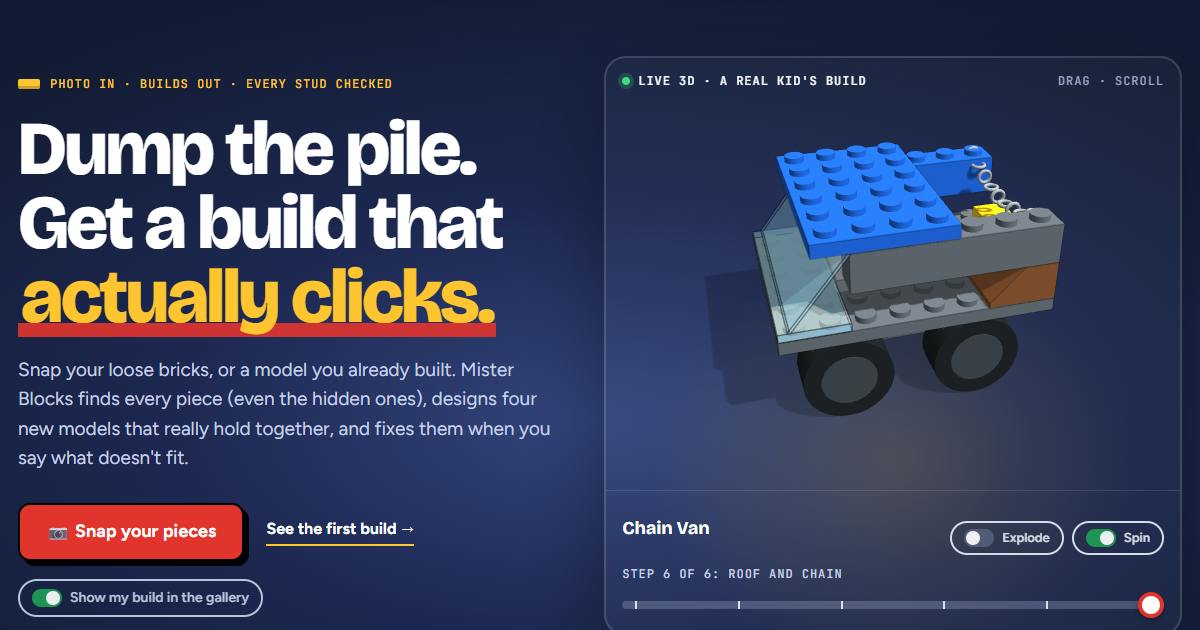
Mister Blocks uses AI to identify existing LEGO parts and generate buildable 3D instructions.
Mister Blocks is the #20 ranked AI tool on Product Hunt, powered by Claude and aimed at parents and children. It lets users photograph LEGO pieces, identify owned bricks, and recommend multiple buildable projects, each with a 3D step-by-step manual supporting rotation, zoom, and printing. Users can also iterate via chat or generate designs from text descriptions. All projects undergo stud-checking to ensure real-world buildability, and free guides work offline. The key to its reliability is the accuracy of stud-checking.
The most common frustration kids face when building LEGO is this: a pile of loose pieces is scattered on the table, but they have no idea how to turn them into a finished creation. Mister Blocks, a new tool ranked #20 on Product Hunt, tries to solve this with AI—take a photo of the LEGO pieces on your table, and it identifies which bricks you actually own and suggests several buildable projects, each accompanied by a 3D step-by-step instruction manual that can be rotated, zoomed, and printed.
Starting from "What You Have" Instead of "What You Want"
Traditional LEGO instructions follow a "design first, find parts later" approach. Mister Blocks flips this: it starts by looking at what you have on hand. This is especially practical for family settings—kids' bricks often come from multiple sets mixed together, and the original instructions are long gone. After uploading a photo, the tool recommends several building projects based on the identified pieces rather than giving just one answer.
If you're not satisfied with the results, you can request modifications directly in the chat—such as changing the design or adjusting the structure. This conversational iteration lowers the barrier to "regenerating" and makes the tool feel more like a playmate and assistant.
The "look at what you have first" approach technically depends on visual recognition of LEGO parts. LEGO bricks come in a vast variety—basic bricks alone span dozens of size and color combinations, plus specialty pieces and Technic elements, making recognition far harder than ordinary object detection. Mister Blocks needs to segment each brick from a cluttered photo, determine its type (e.g., 2x4 brick, 1x2 plate, slope brick) and color, and build a usable parts inventory. The accuracy of this step directly determines whether the recommended projects are feasible—if recognition misses or misidentifies pieces, the generated instructions will lack the parts actually available.
Play Without Parts: Generate Builds from Text Descriptions
When you don't have bricks on hand, Mister Blocks supports generating projects from text descriptions—official examples include a robot dog and a sports car voxel sculpture. This effectively expands the tool from a "parts recycling center" into a creativity generator, suitable as gift inspiration or a source of ideas.
One detail worth noting: the official description emphasizes that every project is "stud-checked," meaning the design is verified to be physically buildable with real bricks—not just a pretty 3D model. Free guides support offline use, which is friendlier for families with unstable internet connections.
"Stud-checked" is a critical constraint in LEGO building: LEGO bricks connect via studs on top and tubes/clips underneath, and every connection point must satisfy physical alignment and load-bearing logic. When AI generates 3D models, it can easily produce visually plausible but physically impossible floating structures or incorrect connections. Stud-checking means the system must simulate each brick's stud positions, connection orientations, and collision relationships to ensure the design is buildable in the real world. This is the core technical threshold that separates "a nice render" from "an executable instruction manual."
Technical Foundation and Product Positioning
Mister Blocks is powered by Claude, with Oleksandr Gamaniuk as the Maker. It earned 83 upvotes and 10 comments on Product Hunt, categorized under Kids, Artificial Intelligence, and Kids & Parenting. The categorization makes clear that its target users are parents and children—not hardcore AFOLs (Adult Fans of LEGO).
This positioning shapes the product's trade-offs: the 3D instructions support rotation, zoom, and printing, showing consideration for the cross-media workflow of "view on screen, then build on the table"; offline guides accommodate scenarios where kids don't have internet access.
AFOL (Adult Fan of LEGO) refers to the adult LEGO enthusiast community, who typically pursue high-fidelity replicas, complex mechanical structures (such as gearboxes and transmissions), and large-scale MOCs (My Own Creations). These users demand extremely high part precision, building techniques, and design freedom, often using professional software like Studio or LDraw for design. Mister Blocks targeting parents and children means it has made trade-offs in project complexity, interaction simplicity, and safety—rather than being a professional design tool for hardcore builders.
Where the Real Value of This Kind of Tool Lies
Part of LEGO's educational value lies in the constructive process of "from parts to creation." AI-generated instructions won't replace that process, but they can reduce the likelihood of getting stuck—when a child stares blankly at a pile of parts, an executable project can get them back into building mode.
From a product perspective, Mister Blocks strings together "recognition—generation—validation—presentation" into a complete pipeline, with stud-checking being the hardest and most critical link. If the validation is accurate, it's not just an inspiration tool but a reliable family building assistant; if validation frequently errs, the credibility of the 3D instructions suffers greatly. Currently, there's no public data on validation accuracy—this is something worth watching going forward.
Who It's For, and Who It's Not For
Good for: Families with lots of mixed loose bricks, younger children, and a need for instant building inspiration; users who want to generate creative designs from text descriptions.
Not ideal for: Players seeking high-fidelity replicas of official sets; advanced users who need complex mechanical structures (such as gear-driven mechanisms)—based on the product description, it leans more toward aesthetic builds than mechanical functional design.
Mister Blocks' approach shows that AI's entry point in children's creative tools isn't necessarily "generating better content"—it can also be "first seeing clearly what you have on hand." This perspective holds reference value for other toy and craft products as well.
One-line Summary
Mister Blocks uses AI to identify existing LEGO parts and generate buildable 3D instructions.
Paragraph Summary
Mister Blocks is the #20 ranked AI tool on Product Hunt, powered by Claude and aimed at parents and children. It lets users photograph LEGO pieces on the table, identify the bricks they actually own, and recommend multiple building projects based on those parts—each with a 3D step-by-step instruction manual that can be rotated, zoomed, and printed. Users can also request modifications via chat or generate projects from text descriptions. All projects are stud-checked to ensure real-world buildability, and free guides support offline use. The article argues that its core value lies in reducing the chance of kids getting stuck staring at a pile of parts, with the accuracy of stud-checking being the key to its reliability.
Related articles

FBI and USDA Hit by Cyberattacks: Critical Infrastructure Security Alarms Sound Again
FBI and USDA reportedly hit by cyberattacks; the FBI was breached for the second time in recent months, this time targeting the National Crime Information Center (NCIC). This article analyzes the incident details, NCIC's strategic value, and common security challenges facing government agencies.
How Do UK Grid Battery Storage Systems Make Money?
How UK grid battery storage makes money: stacking frequency response, capacity market, and wholesale arbitrage revenue, plus operational trade-offs and market risks.
Riemann Hypothesis Formally Verified in Lean? Joint Statement Sparks Heated Debate
The Lean community blog published a joint statement on formal verification of the Riemann Hypothesis, sparking heated discussion on Hacker News with 359 points and 263 comments. This article analyzes the background of Lean and mathlib formal verification, polarized community reactions, and why one should not conclude the Riemann Hypothesis has been proven before reading the original text.