Mistral Large 4 Goes Open Source: A 1T-Parameter European Qwen Challenging DeepSeek

Mistral open-sources the 1T-parameter MoE model Large 4, focused on coding and security, but with high barriers and testing still pending.
Mistral has open-sourced Large 4, a trillion-parameter-class model using a MoE architecture with 1T total parameters and 52B activated parameters, plus a Blackwell-based NVFP4 quantized version weighing about 610G, close in size to a certain Flash version of DeepSeek V4. The model focuses on coding and cybersecurity, going against the trend of vendors restricting security capabilities, with an official coding score of 19.7, close to DeepSeek V4 Flash. The article notes that the flashy 3D front-end demo on the official site relies more on agents and prompt engineering and hardly proves the model's fundamental ability. API pricing is higher than DeepSeek, Playground output length is strictly limited, and current testing conditions are constrained. The 610G weights impose extremely high hardware requirements for local deployment; the author suggests waiting for community feedback and hopes for more medium-sized open-source models that ordinary developers can afford.
Europe Finally Takes a Seat: What Mistral Large 4 Open-Sourced
Mistral has officially open-sourced Large 4, its latest trillion-parameter-class large model. According to Bilibili creator "Kunpeng Dao," this French company—jokingly dubbed the "European Qwen"—has a product lineup highly similar to that of leading Chinese vendors: from small and medium sizes like 4B and 24B, to the 128B Medium-class model, to MoE architectures, OCR, and speech models, with fairly comprehensive coverage. There were previously doubts that its early models were wrappers around Qwen, but that phase is long gone, and Mistral has now delivered a complete self-developed matrix.
The open-sourced Large 4 uses a MoE design with 1T total parameters and 52B activated parameters, and offers an NVFP4 quantized version based on NVIDIA's Blackwell architecture, which the company calls lossless quantization. This version's weights are roughly 610G, putting its size very close to a certain Flash version of DeepSeekAd V4. For local deployment enthusiasts, this is both an exciting and a headache-inducing number—capability on par with top open-source models, but a hardware threshold to match.
MoE (Mixture of Experts) is the mainstream approach for scaling today's large models. It splits the model into multiple "expert" subnetworks, activating only a small portion of them in each forward pass, thereby greatly increasing total parameter count while keeping actual compute cost at the level of the activated parameters. The article's "1T total parameters, 52B activated parameters" is exactly this idea in practice: the model's overall knowledge capacity approaches the trillion-parameter level, but a single inference only invokes the compute corresponding to about 52B parameters. The trade-off is that VRAM must hold all the weights, so total parameters determine the hardware threshold while activated parameters determine running speed—the two need to be understood separately.
NVFP4 is the 4-bit floating-point quantization format that NVIDIA is pushing on its Blackwell architecture. Compared with the common INT4/FP8, it retains the dynamic range of floating-point numbers even at extremely low bit widths, and with Blackwell's hardware support it can significantly compress VRAM usage and boost throughput. The so-called "lossless quantization" usually means precision loss is minimal on official benchmark sets—it does not equal mathematically lossless, and actual results still need community re-testing.
Focused on Coding and Cybersecurity: A Counter-Trend Positioning
Large 4's two flagship directions are coding and cybersecurity. This is rather interesting in the current open-source landscape: several vendors have recently restricted cybersecurity-related capabilities when releasing models, and multiple versions of Kimi and DeepSeek have been reported by users as having weakened security capabilities. Mistral goes the opposite way, releasing security capabilities in full—something rarely seen in the overseas open-source camp.
The official coding score is 19.7, very close to the Flash version of DeepSeek V4—even though Large 4 has over twenty billion more parameters than its counterpart. The creator remains cautious about this: such scores are hard to evaluate in themselves, self-testing on the official site rarely reflects a model's true strength, and leaderboards often don't say much. In security comparisons, Mistral's own score is even slightly lower than that of a certain Flash model version from DeepSeek.

Sober Thinking Behind the Flashy Demo
The official site showcases a rather eye-catching front-end effect: a page with a 3D globe and strong visual impact. But the creator reminds viewers to stay rational—ever since Kimi did a similar demonstration with a self-tuned 3D model, he has had doubts about such demos. Although the official site provides the prompt, ordinary users are unlikely to reproduce it with the same prompt.
The core issue is this: front-end showmanship often reflects not the model's own ability but a whole combination of agents, prompt engineering, and special optimizations. What truly tests a model's ability is having it write a basic task like a Chatbot page from scratch—only if a customer can fully replicate the official demo does it show the model is genuinely strong.

Agent here refers to an automated execution framework built around a large model: the model doesn't just generate code in a single turn but completes complex tasks through multi-turn planning, tool calling, reading and writing files, and running and debugging programs. The fully interactive 3D page in the official demo is often produced by an agent iterating repeatedly, combined with preset prompt templates and front-end scaffolding. This is also why ordinary users find the same prompt hard to reproduce—what's missing is not just model capability but the engineering pipeline, dependency environment, and multi-turn correction mechanisms behind it. When evaluating a model's true level, one should strip away these peripheral boosts as much as possible and use single-turn, tool-free, from-scratch tasks for comparison.
Pricing, Testing, and Reasons to Wait
Large 4 is currently available on the official site and OpenRouter. The official subscription price is in the same tier as ChatGPT Plus, making it a local option for European users, and combined with its open-source nature, it still has some appeal. On API pricing, the input price is noticeably more expensive than DeepSeek, and while the price drops substantially on cache hits, output cost remains high.
The creator ran several tests before recording, and the experience was incomplete—the official Playground severely limits maximum output length, so many of the test scenarios he wanted couldn't be completed at all. He originally wanted to top up and test the API pricing firsthand, but failed due to card issues and couldn't display the pricing page. These limitations mean no final conclusion about the model's capability can be drawn yet.
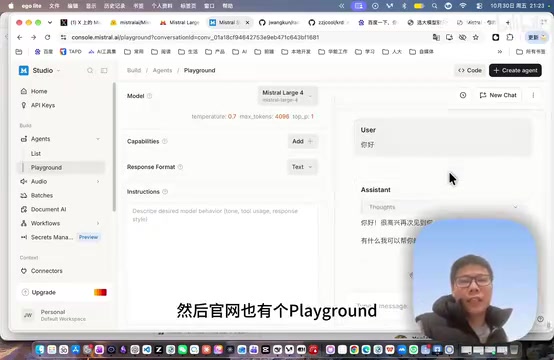
OpenRouter is a relay platform that aggregates APIs from multiple model providers. Developers can call different vendors' models through a unified interface and pay by token. Its value lies in lowering the barrier to side-by-side comparison: without separately registering and topping up accounts with each vendor, you can run the same batch of test questions with the same code. For models like Large 4, where the official Playground has many restrictions and the official API has payment barriers, calling through OpenRouter is often a more realistic path to real testing, and it also makes it more intuitive to compare output quality and cost differences against models like DeepSeek under the same prompts.
Is It Worth Deploying Locally?
The short-term answer leans toward waiting. The 610G NVFP4 weights mean this is not a model ordinary enthusiasts can casually run, and the creator himself admits it's quite a struggle to get it running. His plan: first observe market feedback, and if community testing truly matches the official claim of "the strongest open-source model," then consider local deployment for secondary testing, while also verifying via OpenRouter calls.
From an industry perspective, Large 4's significance goes beyond parameters. The industry has long generally believed that large-model players exist only in China and the US, and Mistral's open-sourcing has given Europe a ticket back in. The creator's attitude is pragmatic: more open-source models are welcome, but he'd rather see sizes ordinary developers can afford—medium models at the 120B, 200B, or even 30B level. The premise is that only when large-model capability is strong enough does it make sense to distill it down to small models. If Large 4's actual performance matches the official claims, a second round of evaluation is worth looking forward to.
Related articles

Medicare Spends $50,000 Treating a Heart Attack but Won't Spend $100 Preventing One: The Mismatch in Healthcare
Medicare pays ~$50,000 to treat a heart attack but won't spend $100 to prevent one. This article unpacks the MedPage Today opinion piece and Hacker News debate on why healthcare payment favors treatment over prevention and the deep causes of incentive misalignment.
Nvidia May Cosign Loan for Nscale's West Virginia AI Data Center
Nvidia is considering cosigning a loan for Nscale's West Virginia AI data center. This article analyzes the signal significance of chip vendors entering data center financing, the risk-sharing logic, and project uncertainties.

Claude Code v2.1.316 Update Analysis: Enterprise Gateway and Multiple Stability Fixes
Claude Code v2.1.316 released: new enterprise gateway pooled group budgets, layered policy mode, subagent effort control, dozens of Shell, network, and session recovery fixes, and Opus 4.8 fast mode deprecated.