Mistral Large 4 Open Weights: Trillion-Parameter MoE, Sharp Gains in Terminal Coding

Mistral open-sources the 1T-parameter MoE model Large 4, with three weeks of RL training driving major coding gains and a focus on low price and token efficiency.
Mistral released the full weights for Large 4, a MoE model with 1 trillion total parameters and 49 billion activated, featuring a 1M-token context window. Compared with the preview three weeks earlier, only three additional weeks of RL training raised terminal coding from 28% to 41% and cut output tokens by 30%. It slightly leads on the change-merge test at 19.7%, roughly ties GLM5.3 on coding but uses 47% fewer tokens, offers low/medium/high reasoning tiers, prices input at $0.7 per million tokens (about one-third of Google Carbon), and uses a modified MIT license allowing commercial use and fine-tuning but requiring a separate agreement for API serving. Its positioning is to control cost with MoE, iterate quickly with RL, and attract large-scale calls with low pricing and tiered reasoning.
French AI company Mistral has released the full model weights for Large 4. This is a mixture-of-experts (MoE) model with a total of 1 trillion parameters, but only about 49 billion are activated per inference, with a context window of 1 million tokens. Compared to the preview version from earlier this month, this release adds only three more weeks of reinforcement learning training, yet shows clear jumps on several key metrics.

A Win for Training Efficiency: Double-Digit Gains from Three Weeks of RL
The most notable result is the terminal coding benchmark: up from 28% in the preview to 41%, a gain of 13 percentage points. Considering training time only increased by three weeks, this improvement shows the reinforcement learning phase is remarkably efficient. Mistral also emphasizes that the new version uses 30% fewer tokens in its output, meaning lower compute cost for completing the same task.
This combination of "short training time, large performance gains" reflects the growing importance of the post-training stage in today's large-model competition. Base capability is certainly key, but how to use RL to shape more practical behavior patterns may be the crucial differentiator.
Reinforcement learning (RL) in the post-training stage of large models usually refers to reinforcement learning from human feedback (RLHF) or reinforcement learning from AI feedback (RLAIF). Its core is to let the model optimize its output policy through trial and error and reward signals, rather than simply imitating training data. Unlike supervised fine-tuning (SFT), RL can perform targeted optimization for specific goals (such as code correctness or answer helpfulness), so it is often used to improve model performance on complex tasks. The "three more weeks of reinforcement learning" mentioned in the article refers to an additional three weeks of RL training after the base model and initial alignment, which typically involves reward model construction, policy gradient updates, and other steps. It is computationally expensive but can bring significant improvements in behavior patterns.
Coding and Change Merging: Roughly on Par with GLM5.3
In the "can the change be merged" test, Large 4 scored 19.7%, only 0.4 percentage points above second place — a very slim advantage. On another coding leaderboard, it is roughly on par with the domestic model GLM5.3, but uses 47% fewer tokens per task.
This means that in high-frequency scenarios such as code generation and modification, Large 4's competitiveness lies more in cost-effectiveness than absolute accuracy. For teams that need to process coding tasks in bulk, improved token efficiency may be more valuable in practice than a few percentage points of accuracy.
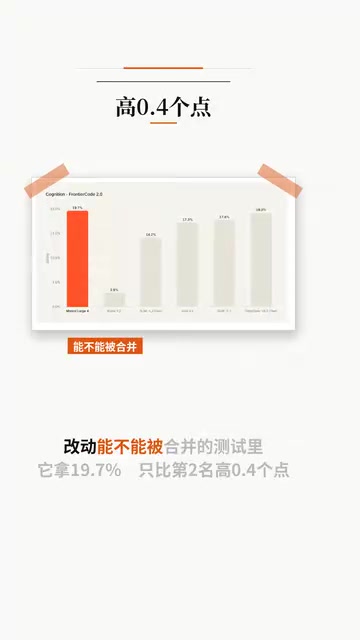
The "can the change be merged" test usually refers to a software engineering scenario where the model generates a code patch based on a problem description, and an automated system or human reviewer judges whether the patch can be accepted and merged into the code repository. This metric comprehensively evaluates code correctness, style consistency, destructiveness to existing code, and whether tests pass, making it closer to the actual development workflow than simple code generation accuracy. A 19.7% merge rate means about one-fifth of the patches generated by the model can be directly adopted, which is competitive under current technical conditions, but the absolute number still reflects that coding tasks remain highly challenging for models.
Reasoning Tiers and Pricing Strategy
Large 4 divides reasoning into low, medium, and high tiers, with the high tier used by default. For simple tasks, users can manually lower the tier to save cost. In terms of pricing, input is $0.7 per million tokens and output is $2.1 per million tokens. This input price is about one-third that of Google Carbon, placing it at a relatively low level among similar models.

Pricing combined with the reasoning-tier design is clearly aimed at large-scale deployment. Development teams can flexibly control costs based on task complexity, rather than paying a uniform high reasoning cost for all requests.
Reasoning tiers refer to the model dynamically adjusting its internal computation or "thinking" depth when generating responses. The high tier may enable a longer chain of thought (CoT) or more internal sampling to improve accuracy on complex reasoning tasks; the low tier shortens the reasoning path to reduce latency and token consumption. This design draws on the idea of "compute optimal," allocating compute according to task difficulty to avoid over-computing on simple problems. Users can manually lower the tier to significantly save cost without affecting basic usability, especially for lightweight tasks such as classification and extraction.
License and Commercial Use: Modified MIT, Separate Agreement for Serving
Large 4 uses a modified MIT license that allows commercial use and fine-tuning, and even lets you sell the model itself. However, if you want to provide an API service based on it, you need to sign a separate licensing agreement. This "open entry, strict exit" licensing structure lowers the barrier to research and product integration on one hand, while preserving Mistral's commercial space at the cloud service layer on the other.

Mistral itself admits that signs of model abuse have already been observed online and that it is tightening guardrails. This is precisely the difficulty of safety governance for open-weight models: once the weights are released, subsequent behavior control can only rely on terms of use and community self-regulation.
The modified MIT license retains the permissive terms of MIT (allowing commercial use, modification, and distribution) while adding extra restrictions on "providing API services." The traditional MIT license allows users to provide software as a service to third parties without additional authorization, but the modified version requires a separate commercial agreement with Mistral if you provide an API or hosted service based on the model. This "open entry, strict exit" structure is becoming popular among open-source models, aiming to balance free community use with the company's commercial monetization. Similar terms also appear in community licenses for models such as Llama, but the MIT base makes it more friendly to commercial integration.
Getting Started Tips
If you want to try it in an API, the model name is "Mistral Large 4." For simple tasks, it is recommended to set the reasoning tier to low, which maintains usability while controlling cost. For complex coding or reasoning tasks, keep the default high tier.
Overall, Large 4's positioning is clear: use MoE architecture to control activated parameters, use RL to rapidly iterate capabilities, and use low pricing and tiered reasoning to attract large-scale calls. It is not comprehensively leading in absolute capability, but it offers a competitive solution in coding efficiency and cost structure. Open weights plus a commercially usable license also add appeal for self-hosted scenarios.
Related articles

Using and Topping Up Claude in China: Three Methods Compared and a Guide to Avoiding Account Bans
A guide to using and topping up Claude in China: compare direct overseas credit card payment, US Apple ID and Android Google Play in-app purchases, and self-service website top-up by barriers, cost, and suspension risk, plus five habits to reduce the chance of a ban.

From ChatGPT Content Restrictions to Eval, Observability, and Guardrail in Practice
Through a hands-on e-commerce order Agent, this article explains the engineering logic behind ChatGPT content restrictions and how Eval, Observability, and Guardrail work together to prevent same-name user data leaks and prompt injection risks.

DeepSeek Open-Sources Super-Agent: An Architecture Deep Dive into the Router and Worker Design of an Always-On Coding Assistant
DeepSeek open-sources the always-on coding agent dsh-superagent, using a separated Router-Worker architecture that balances continuous operation and permission control. This article analyzes its design approach, what the code actually delivers, and the safety debate surrounding autonomous coding assistants, helping developers decide whether it is worth learning from.