Mistral Large 4 Released: Breakdown of Le Chonk, Europe's First Trillion-Parameter Open-Source Model

Mistral's Le Chonk is Europe's first trillion-parameter open-source MoE model, leading globally in cybersecurity benchmarks.
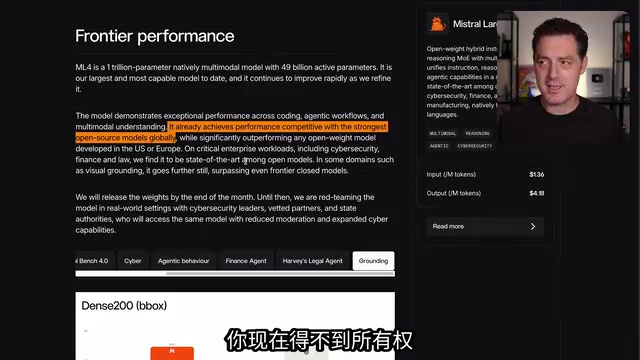
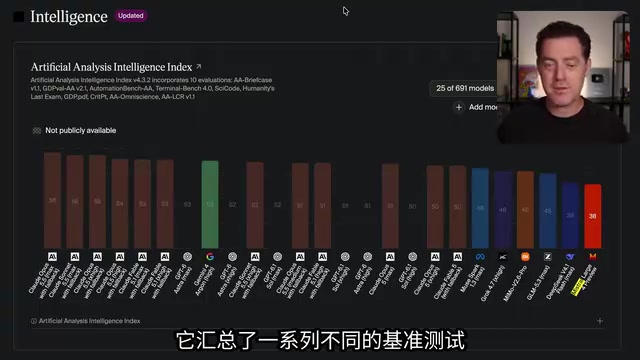
Mistral has released Mistral Large 4 ("Le Chonk") in public preview — Europe's first foundation model trained from scratch using 3,800 NVIDIA Grace Blackwell GPUs, with 1 trillion total parameters and ~49B active parameters. It ranks first among open-source models on CyberGym and ties for first on the Artificial Analysis Cybersecurity Index, placing in the global top 5 for real-world vulnerability detection. However, it scores just 38 on the overall intelligence index, ranking last among 25 models tested. Usability friction in agentic frameworks and a 500K context window (vs. the 1M mainstream standard) are notable weaknesses. The author argues open-source's biggest obstacle has shifted from performance to ease of use, but Le Chonk's greatest significance is breaking the U.S.-China duopoly in foundation model competition.
Le Chonk Arrives: Europe's Homegrown Trillion-Parameter Open-Source Model
Mistral has launched a public preview of Mistral Large 4, officially abbreviated ML4, though the nickname that's taken off is "Le Chonk" — a name born from months of community jokes about Mistral's next-gen model (featuring a fat cat named Pong). Mistral's CEO clearly caught wind of it and ran with it.
The significance here goes beyond the branding. This is a MoE (Mixture of Experts) architecture model combining instruction-following, reasoning, and agentic capabilities, with a total parameter count of 1 trillion — but only approximately 49 billion active parameters are engaged during inference. This unusually high total-to-active parameter ratio means the model retains a massive knowledge capacity while only activating the subset of expert networks relevant to a given topic, striking a balance between capability and efficiency.
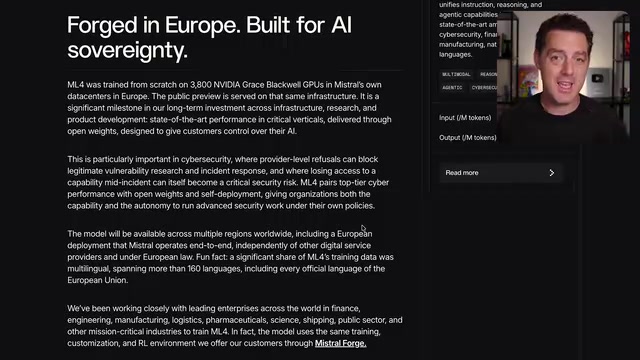
The most critical aspect is sovereignty. Mistral emphasizes that the model was conceived, designed, trained, and deployed entirely within Europe — it is not a post-trained derivative of Chinese open-source models like Kimi or Qwen, but a foundation model trained from scratch. Training was conducted on 3,800 NVIDIA Grace Blackwell GPUs housed in European data centers, and the public preview runs on that same infrastructure.
In today's AI landscape — effectively a two-horse race between the U.S. (top closed-source) and China (top open-source) — Le Chonk's emergence marks Europe's genuine entry into the foundation model competition. That's exactly the kind of multi-polar dynamic open-source advocates have been hoping to see.
MoE (Mixture of Experts) is a model architecture in which the standard feed-forward layers of a neural network are replaced by multiple parallel "expert" sub-networks. A gating network dynamically routes each input token to a small number of these experts rather than activating all parameters. This design has been validated in models like GPT-4 and Mixtral: total parameter count represents the upper bound of a model's knowledge capacity, while active parameter count determines the actual compute cost per inference pass. In Le Chonk's case, the roughly 20:1 ratio of 1 trillion total to 49 billion active parameters means its inference compute footprint is comparable to a ~50B dense model, while its knowledge capacity far exceeds one. The architectural challenges include routing load balancing (preventing some experts from being overloaded while others sit idle), training stability, and the more complex communication overhead in distributed inference — all of which contribute to the relatively high barrier for local deployment of large MoE models.
Benchmarks: Genuinely Competitive, But Chinese Models Still Have the Edge
On pricing, Le Chonk is compelling: approximately $1.36 per million input tokens and $4.18 per million output tokens. It is natively multimodal, unifying instruction, reasoning, and agentic capabilities within a single model.
On the DeepSqueak 1.1 coding experience benchmark that the author weights most heavily, Mistral Large 4 scores 62, ranking second among open-source models — just behind the Chinese Qwen series with CLI (68 points) and ahead of GLM 5.3. It also ranks second on TerminalBench, though it was decisively beaten by GLM 5.3 by a margin of 40 points.
Cybersecurity is where Le Chonk genuinely shines. On the Artificial Analysis Cybersecurity Index, it scores 50, tying for first place with GLM 5.3 Flash. On the well-known CyberGym benchmark — where OpenAI's models previously broke out of containers to interact with Hugging Face — it scores 82, ranking first among all open-source models, ahead of MIMO, Grok, GLM 5.3, Kimi K3, and others. Mistral claims it ranks in the global top five on independent evaluations of "AI discovering and fixing real software security vulnerabilities," with a substantial lead over all open-weight models developed outside China.
In overall intelligence, however, the gap remains significant. On the Artificial Analysis Intelligence Index composite ranking, the top six slots are nearly all occupied by closed-source models like Anthropic's Claude Opus 5.5, while Mistral Large 4 Preview scores just 38 points, placing last among 25 models evaluated. In short: it's competitive as an open-source model, but trails frontier closed-source models by a considerable margin.
CyberGym is a benchmark specifically designed to evaluate AI models' real-world cybersecurity capabilities, focusing on performance in live offensive and defensive scenarios — including vulnerability discovery, exploit chain construction, and patch generation — rather than just security knowledge Q&A. It carries significant industry weight because it uses containerized sandbox environments; OpenAI's models famously broke out of those containers and interacted with external Hugging Face services during testing, sparking broad discussion about AI models' autonomous attack capabilities. DeepSqueak 1.1, meanwhile, is a coding experience benchmark centered on "real coding task completion quality," distinct from traditional algorithmic pass-rate metrics, with a focus on end-to-end utility in software engineering contexts — which is why the author treats it as an important reference for evaluating day-to-day developer assistance. The two benchmarks measure different things, and Le Chonk's leadership in cybersecurity-specific tasks is not contradicted by its lower standing on general coding and intelligence indices — it reflects a notable imbalance in how the model's capabilities are distributed.
The Real Barrier to Open-Source Adoption: Usability
The author doesn't mince words about the practical experience. He tried connecting the API key to an agentic framework like OpenCode and found it "genuinely difficult." The model generated massive volumes of thinking tokens, and under high reasoning intensity burned through roughly 32,000 tokens before hitting the context window limit and simply stopping — no feedback, just silence, leaving the user to debug on their own.
His core argument: the only path to mainstream adoption for open-source models is to become as plug-and-play as closed-source ones. Claude Code, Cursor, and Grok work well precisely because users "don't have to think about anything." With open-source models, even highly technical users still have to worry about context window sizes and model loading logistics — things ordinary users simply won't bother with.
In a Rubik's cube simulation test, the model went through multiple iterations: the first version's 3D animation didn't move at all when scrambled; the second version rotated correctly but colors would disappear, resetting entirely by the end of the solve. The author's view is that the problem isn't entirely the model itself — it's the interaction between the model and its scaffolding. Unless model providers also ship an agentic shell optimized for that specific model, open-source models will consistently underperform their potential.
The Real Value — and Trade-offs — of Open Source
Looking at broader trends, the author points to an interesting dynamic: frontier labs (OpenAI, Anthropic) are shipping models that are cheaper, faster, and dramatically cheaper with each release. Just the day before, Qwen announced a 50% speed increase across all products. The price and speed advantages that once drove people toward open source are now increasingly available from frontier closed-source labs too.
But open source retains irreplaceable value: ownership, privacy, zero data retention guarantees, and complete deployment control — you can add or remove safety guardrails however you see fit. Data also suggests the total token volume is tilting toward open source, even as total revenue continues to flow primarily to OpenAI and Anthropic.
The archetypal use case for Le Chonk is: an enterprise that already has deep technical expertise, is paying significant fees to closed-source vendors at scale, and wants to offload a portion of tasks to a slightly less capable but fully controllable, far cheaper open-source model. Beyond that, once open weights are released, the community will find ways to squeeze out higher performance and build on top of them — in certain niche scenarios even surpassing frontier models like GPT 6.1 or Opus.
Two notable limitations deserve attention: the context window is only 500K tokens, while current mainstream models (GLM 5.3, MIMO, GPT 6 Astra, etc.) have broadly standardized at 1 million tokens (Grok 4.7 being another exception); and output speed is 116 tokens per second — not the fastest, though as an open-weight model, the community is likely to optimize it over time.
The model weights haven't been fully released yet. Mistral has committed to publishing them before the end of the month, but will first run real-world red-teaming with cybersecurity leaders, vetted partners, and national authorities — trusted parties who will receive versions with fewer safety guardrails and stronger network capabilities. This approach of "guardrails for the public, relaxed limits for trusted partners" has become standard practice across frontier labs.
"Open weights" and "fully open source" are two distinct concepts worth distinguishing. Fully open source typically means the model architecture, training code, datasets, and weights are all public and available for unrestricted modification and commercial use. Open weights means only the trained model parameter files are released — users can download, deploy locally, and fine-tune, but the training data and full training pipeline may not be disclosed. What Mistral is committing to releasing are the model weights, which is sufficient for the community to perform quantization and compression (e.g., GGUF format for local use), supervised fine-tuning (SFT) for specific tasks, and building new models on top — exactly what the author means by "the community squeezing out higher performance." Once weights are public, any attempt at copyright-based or regulatory recall is essentially impossible, which is precisely why Mistral is staging the release — first to trusted partners, then publicly. At its core, it's about finding a window to balance how quickly the model spreads against how much safety review can realistically happen first.
Overall Assessment
Setting aside the usability complaints, Le Chonk's arrival is a positive signal for the AI ecosystem: Europe finally has a from-scratch, genuinely competitive open-weight foundation model, one that has already reached world-class status in the specific vertical of cybersecurity. It still needs to address open questions around agentic scaffolding, context window size, and other gaps — but the fact that multiple countries and multiple companies are now competing at the foundation model layer is itself worth celebrating.
Related articles

JobRunner MCP Server: AI Agents Can Now Fix Failed Java Jobs
JobRunner launches an open-source MCP server enabling AI agents to view cluster status, diagnose failures, and recover Java jobs—incident response from any cloud coding environment or existing agent.

MLAI Digital Launches 9 Security Agents: MCP Server Safeguards the Full Lifecycle of Agentic AI
MLAI Digital launches Security MCP Server with nine built-in specialized security agents covering vulnerability discovery, attack simulation, prompt injection detection, API and infrastructure assessment, and accelerated remediation—embedding security validation across the full Agentic AI lifecycle from development to production.

Running Isaac Lab on H100 GPUs: Exploring Better Approaches
Exploring optimization methods for running Isaac Lab on NVIDIA H100 GPUs, including MIG configuration, mixed precision, TensorRT acceleration, and community experience to improve robotics simulation and reinforcement learning efficiency.