Mistral Large 4 Released: Europe's Largest Open-Source Model Takes Aim at the Frontier

Mistral launches a 1-trillion-parameter open-source MoE model to challenge Chinese and US frontier open-weight leaders.
French AI lab Mistral has released its largest open-source model to date, Mistral Large 4, built on a Mixture of Experts (MoE) architecture with ~1 trillion total parameters and ~50 billion activated per token. It supports multimodal (image + text) input and a one-million-token context window, and is positioned as a frontier-level open-weight model excelling in coding agents, cybersecurity, finance, and legal domains. The release is notable for challenging the recent dominance of Chinese labs — DeepSeek, Qwen, Kimi, and GLM — atop open-source leaderboards. Model weights are expected to be released publicly later this month.
Europe's Open-Source Counteroffensive
Mistral has just released Mistral Large 4, officially nicknamed "the Chonk" — and the name is entirely apt. It's a Mixture of Experts (MoE) architecture model with a total of roughly one trillion parameters, activating approximately 50 billion of them per token.
This makes it the largest open-source model Mistral has ever released. For a long time, the French lab kept a relatively low profile at the high end of the model spectrum. Large 4's arrival signals a direct challenge on both parameter scale and capability.
Core Capabilities: Multimodal Input and Million-Token Context
From a technical standpoint, Mistral Large 4 brings several key features. It handles not just text but also image inputs, making it a true multimodal model. Even more striking is its one-million-token context window, enabling it to process extremely long documents, entire codebases, or extended multi-turn conversations in a single pass.
The MoE architecture has become the dominant choice for this generation of frontier models. By activating only a small fraction of the total parameters — roughly 5% — the model maintains strong capabilities while keeping inference costs under control. This "large capacity, low activation" design philosophy is the approach now widely adopted across both open and closed frontier models.
The core idea behind Mixture of Experts (MoE) is to split a model into multiple "expert" sub-networks, with a lightweight "router" dynamically selecting a small number of experts to participate in each inference pass, rather than activating all parameters. This decouples the model's "capacity" (total learnable knowledge) from its "compute" (actual per-inference cost). In Mistral Large 4's case, although total parameters reach one trillion, only around 50 billion are invoked per token — making inference costs comparable to a dense 50B-parameter model. Pioneering use of MoE can be traced back to Google's Switch Transformer (2021), and it has since been adopted by models such as GPT-4 and Mixtral 8x7B, cementing its status as a standard paradigm for building ultra-large language models.
Competing with the World's Strongest Open-Source Models
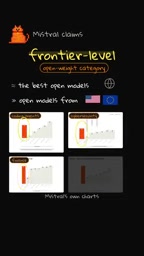
Mistral is positioning this model with considerable confidence. The company describes it as a "frontier-level model in the open-weight category," claiming it can compete with the world's strongest open-source models and outperform any open-source model built by either American or European labs across multiple capabilities.

More specifically, Mistral highlights Large 4's strengths in coding agents, cybersecurity, finance, and legal domains — precisely the high-value verticals that matter most for enterprise adoption. This also hints at Mistral's intent to differentiate itself from competitors in real-world commercial deployment.
Breaking the Chinese Labs' Dominance of Open-Source
One of the most interesting dimensions of this release is the competitive landscape it enters. For some time, the open-weight model space has been largely dominated by Chinese labs — DeepSeekAd, Qwen, Kimi, and GLM have all occupied the top positions on open-source leaderboards.
Against this backdrop, a European lab releasing a frontier-caliber open-source model carries particular symbolic weight. It represents Europe's AI capabilities catching up, and brings new diversity to the global open-source ecosystem. It's also worth noting that this release comes just one day after the US-based Reflection team launched their Beam model — the pace of open-source competition is clearly accelerating.

DeepSeek, Qwen (Alibaba), Kimi (Moonshot AI), and GLM (Zhipu AI) represent a concentrated surge from Chinese AI labs in the open-source space in recent years. DeepSeek-V3 and DeepSeek-R1 attracted widespread international attention with highly competitive reasoning capabilities and relatively low training costs; the Qwen series is known for its comprehensive model family spanning small to large sizes; and GLM-4 and Kimi's long-context capabilities have repeatedly topped open-source rankings. The concentrated emergence of these models caused Chinese labs to dominate the front pages of platforms like Hugging Face from late 2024 into early 2025, prompting the Western community to rethink the geopolitics of open-source AI. Mistral Large 4's entry is one of the few powerful signals Europe has sent in this shifting landscape.
Still in Preview — Weights Coming Later This Month
It's worth noting that Mistral Large 4 is currently in preview, with Mistral stating that the model weights will be officially released later this month. In other words, these impressive performance claims are yet to be independently verified.
For developers and researchers, the real test comes once the weights are publicly available. At that point, the community will be able to evaluate the model across benchmarks and real-world tasks to determine whether it truly lives up to Mistral's frontier-level billing. Regardless of the outcome, the imminent public release of a one-trillion-parameter open-source model from Europe is enough to keep the entire open-source community watching closely.
Related articles

Felix Rieseberg Personal Homepage
Felix Rieseberg's personal homepage sparks attention on Hacker News. This article covers the Slack engineer's technical background, the rise and fall of nativefier, and the value of a developer homepage as a tech calling card.

@ai-sdk/vue 3.0.306 Patch Release Syncs with [email protected] Update
@ai-sdk/vue 3.0.306 released, synced with [email protected]. A routine patch release for the Vercel AI SDK ecosystem with no public API changes; the Vue adapter layer stays version-aligned with the core package.

Gemini 4 Argon API Launches: The Era of Million-Token Output Begins
Google launches Gemini 4 Argon with sparse MoE architecture, up to 1M output tokens, and a 68.90% Vals Index score, available across API, AI Studio, and the Gemini app.