Mistral Large 4 Released: General-Purpose Agents That Deliver Finished Results

Mistral Large 4 targets general-purpose agents with end-to-end workflow execution, but technical details are still pending.
Mistral's Large 4 model is positioned around general-purpose agents, emphasizing the ability to autonomously complete full-chain tasks — from information gathering to finished deliverables — rather than stopping at conversational Q&A. This reflects the industry's broader shift from competing on model parameters and benchmarks toward competing on agent execution capability. The phrase "finished deliverables" is especially significant, implying outputs must meet a directly usable standard, reducing manual post-processing costs for enterprise users. However, official disclosures remain thin, with no benchmark data, context length, or tool-calling details released yet. Whether the real-world agent capability lives up to the marketing claims will require further technical documentation and independent evaluation.
Mistral Large 4: From Information Gathering to Finished Deliverables
Mistral's newly launched Large 4 model is positioned at its core as a driver for general-purpose agents. According to official descriptions, these agents can autonomously gather information across complex workflows and ultimately produce finished deliverables ready for direct use. This marks a shift in the model's role — from simple conversational Q&A toward closed-loop task execution.
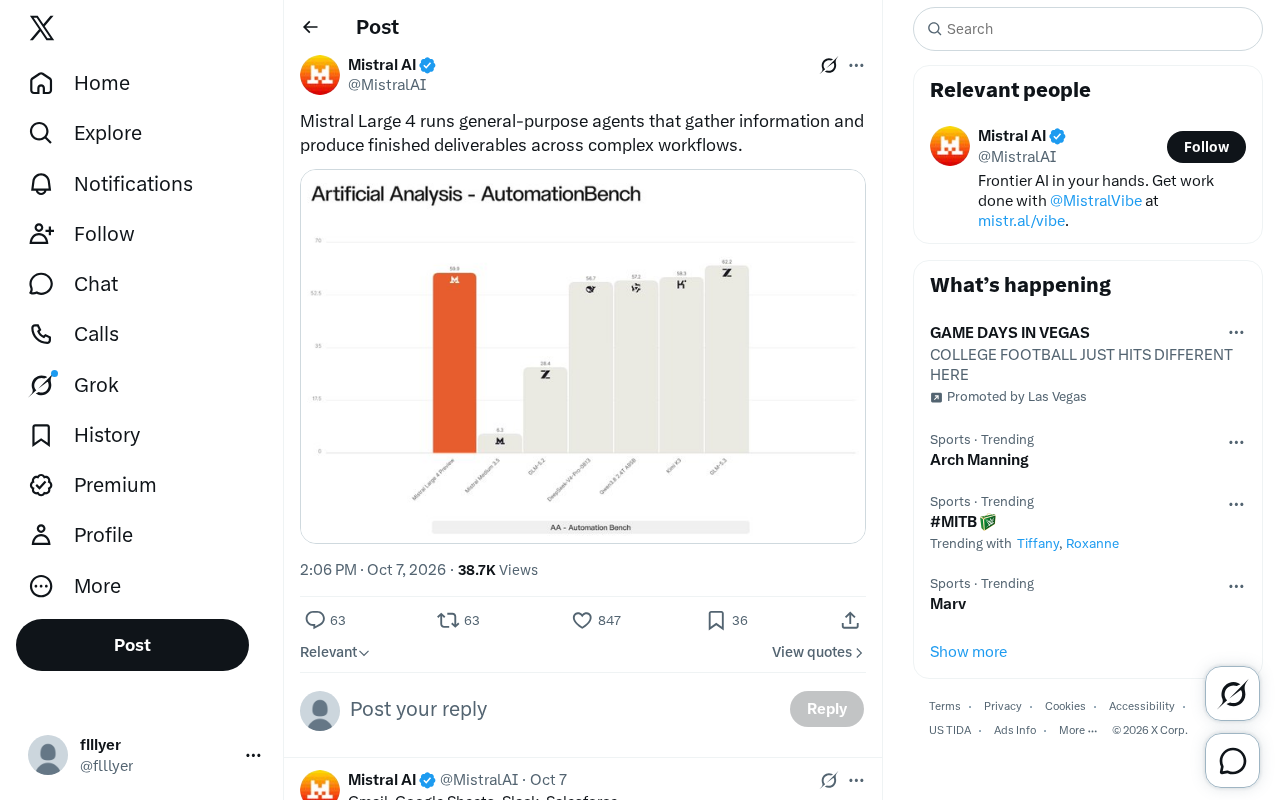
From this concise but information-dense announcement, Mistral is emphasizing not a single standout capability, but end-to-end workflow coverage — meaning an agent can take on a task, move through stages of research, synthesis, and generation, and deliver a complete result.
Why "General-Purpose Agent" Is the Key Phrase
From Single Tasks to Cross-Process Workflows
Over the past year, the competitive focus among LLM vendors has been shifting from "model parameters and benchmark scores" toward "agent execution capability." The term general-purpose agent emphasizes adaptability across diverse complex workflows, rather than being confined to a specific vertical. Mistral Large 4's pairing of "information gathering" with "produce finished deliverables" points directly at two critical phases of agent work: acquiring inputs on the front end, and generating outputs on the back end.
The core challenge of agent execution lies in closing the loop across plan → call → feedback: the model must decompose a high-level goal into subtasks, invoke external tools (such as search, code interpreters, and file I/O) during execution, and dynamically adjust subsequent steps based on intermediate results. This is fundamentally different from traditional single-turn Q&A — a single turn only requires generating text once, whereas an agent workflow may involve dozens of tool calls and state evaluations. The industry has developed several technical approaches in this direction, including OpenAI's Function Calling, Anthropic's Tool Use, and prompting paradigms like ReAct (Reasoning + Acting). Mistral has supported function calling in its API since 2024, and the release of Large 4 suggests further investment in the stability of multi-step task execution.
"Finished Deliverables" Sets a Higher Bar
The phrase "finished deliverables" is worth noting. It implies that outputs are no longer rough drafts or scattered suggestions, but results that are ready to use and deploy — such as a complete report, a structured proposal, or a formatted document. For enterprise users, this type of capability has real value in reducing manual post-processing, allowing the model to handle longer stretches of a task end-to-end.
Potential Impact on Developers and Enterprises
For teams looking to build automated pipelines, a model that can span the full arc of "research → processing → delivery" can significantly reduce the engineering overhead of stitching together multiple tools. The traditional approach often requires multiple tools and repeated calls to chain a workflow together, whereas the goal of a general-purpose agent is to consolidate these steps into a single model-driven process.
As a leading European open-model vendor, Mistral's model iterations are closely watched by the developer community. The Large series is positioned as a high-performance flagship line, and if Large 4 delivers meaningful improvements in agent execution and long-workflow stability, it will offer a compelling new option for enterprise-grade agent applications.
What to Keep in Perspective
The official information currently available is fairly sparse — only a high-level description of the model's positioning, with no disclosure yet of specific benchmark results, context length, tool-calling mechanisms, or other technical details. There is often a gap between marketing language around "general-purpose agents" and real-world deployment: autonomous execution of complex workflows places extremely high demands on a model's planning ability, error recovery, and tool coordination. How well these capabilities actually perform remains to be verified through more detailed technical documentation and independent third-party testing.
Evaluating a model's agent capabilities typically relies on specialized benchmarks such as SWE-bench (testing autonomous code repair), GAIA (testing multi-step real-world task reasoning), and τ-bench (testing tool-call accuracy). These benchmarks are far more reflective of a model's performance in real automation scenarios than general text generation evaluations. Mistral has not yet published Large 4's scores on these benchmarks, nor has it disclosed the maximum context window size — a critical factor for agent workflows that need to process large volumes of retrieved information. Once the official technical report or independent evaluations are available, these are the key metrics to watch.
Summary
Mistral Large 4's announcement centers on "general-purpose agents" and "finished deliverables," reflecting the broader industry evolution from competing on raw model capability toward competing on agent application performance. Its real-world value will depend on stability and output quality in genuinely complex workflows. Developers are advised to wait for the official technical details and independent benchmark results before drawing firm conclusions.
Related articles

How Big Can Stars Really Get? The Physical Limits of the Largest Stars
Red supergiants are the largest stars by volume, with radii up to 2,000 times the Sun, engulfing the inner solar system. But there is no precise upper limit on stellar size—models predict up to 15,000 solar radii. The most massive blue stars are far smaller than red supergiants—biggest and heaviest are two different things.

Apple HomeView Smart Display Full Feature Breakdown: Wall-Mount or Desktop, $299
Apple launches HomeView, a $299 smart display with wall-mount and desktop options, 12MP camera for facial recognition, smart home control, music playback, and recipe step-by-step cooking. Full breakdown of watch faces, apps, privacy, and cooking integration.

Where Did the Promised New Studio Go? Craft Computing Answers After Five Years
Craft Computing's host responds to viewer questions: the new studio promised five years ago was shelved as construction costs soared from $30,000 to $75,000, and was replaced by a 168-square-foot garage conversion.