Mistral Large 4: The Top AI Model for Cybersecurity?

Mistral positions Large 4 as a top cybersecurity AI, but independent benchmarks are needed to back the claim.
French AI company Mistral has positioned its flagship model Large 4 as one of the world's most capable AI systems for cybersecurity, signaling a broader shift toward high-value vertical specialization in the LLM race. The move targets clear commercial opportunities in threat detection, code auditing, and security operations. Mistral's European identity also gives it a compliance edge under GDPR and the EU AI Act when selling into sensitive sectors. However, the "world's best" claim remains marketing language until supported by public benchmark scores and independent third-party evaluations.
Mistral Large 4 Takes Aim at Cybersecurity
French AI company Mistral recently claimed that its flagship model, Mistral Large 4, is one of the most capable AI models in the world for cybersecurity. This positioning signals a broader shift in the large language model race — moving beyond general-purpose conversation and code generation toward specialized, high-value verticals. Cybersecurity, a mission-critical domain for enterprises and government agencies alike, is fast becoming a new battleground for leading AI vendors.
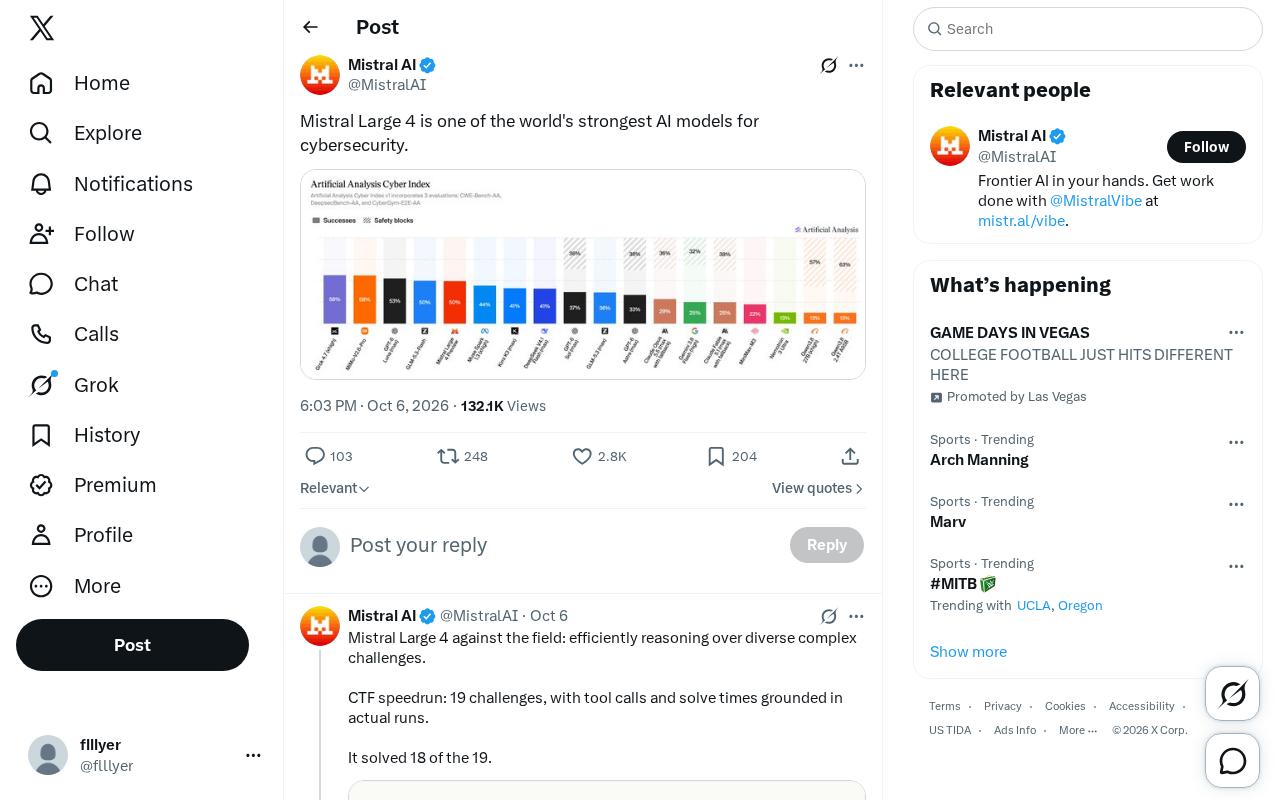
Based on public information, Mistral is leaning into cybersecurity as a core differentiator — a deliberate move to stand apart from OpenAI, Anthropic, Google, and other rivals. Rather than chasing top scores on general benchmarks, emphasizing deep expertise in a high-stakes vertical is often a more effective way to win enterprise customers with specific procurement needs.
Why Cybersecurity Has Become a New Battleground for AI Models
Cybersecurity is a domain with exceptionally high demands for accuracy, reasoning, and real-time responsiveness. The potential applications for AI models are broad, including:
Threat Detection and Analysis
Large models can help security analysts rapidly parse massive volumes of logs, identify anomalous behavior patterns, and correlate alerts from multiple sources — significantly reducing mean time to detect. As attack techniques grow increasingly sophisticated, this kind of automated analysis capability is becoming more valuable by the day.
Vulnerability Identification and Code Auditing
Models with strong code comprehension can scan source code, flag potential vulnerabilities, and suggest remediation steps — creating direct value for DevSecOps workflows.
DevSecOps (Development, Security, and Operations) is an engineering philosophy that embeds security practices throughout the entire software development lifecycle. The goal is to trigger security checks automatically at the code commit stage, rather than conducting a concentrated audit just before launch. In the traditional model, security and development teams operate in silos, and vulnerabilities are often discovered only after a product ships — at enormous remediation cost. AI-powered code auditing tools can act as a "security guard" within CI/CD pipelines, scanning every commit in real time for common vulnerability types such as SQL injection, buffer overflows, and hardcoded credentials, then explaining the risks and fixes in plain language to lower the learning curve for developers. Products like GitHub Copilot Autofix and Snyk Code have already made inroads here. If Mistral can demonstrate an edge in code reasoning and vulnerability semantic understanding, it stands to enter a market segment with well-established procurement budgets.
Security Operations Support
From writing detection rules and generating incident response playbooks to automating security report drafting, AI models can significantly reduce the repetitive workload on security teams — freeing up human expertise for higher-value decisions.
Because the commercial value in these use cases is clear and quantifiable, a model that performs exceptionally well on cybersecurity metrics has a natural path onto enterprise procurement shortlists.
What Mistral's Differentiated Positioning Actually Means
As one of Europe's most closely watched AI startups, Mistral has built its reputation on open weights and competitive price-to-performance ratios. Positioning Large 4 as a top-tier cybersecurity model reflects a strategic choice to build moats through vertical expertise rather than competing head-on across general capabilities.
For the European market in particular, data sovereignty and compliance requirements are especially prominent. A homegrown vendor offering strong cybersecurity capabilities may carry a meaningful trust advantage over overseas alternatives when selling into sensitive sectors like government, finance, and critical infrastructure. This is simultaneously a technical selling point and a geopolitical and regulatory differentiator.
That said, a single line of positioning in a press release is not sufficient to fully assess real-world capability. Cybersecurity is an adversarial domain — model performance must be validated through authoritative third-party evaluations, live red-blue team exercises, and real deployment case studies. Claims like "one of the world's best" are marketing language first and foremost; concrete benchmark data and independent testing are what ultimately matter.
The EU AI Act, which formally took effect in 2024, is the world's first comprehensive AI regulatory framework. It imposes strict requirements around transparency, explainability, and data governance for "high-risk AI systems" — including applications in critical infrastructure security and law enforcement — with fines of up to 7% of global annual turnover for violations. At the same time, GDPR restrictions on cross-border data transfers naturally push European government and financial institutions toward vendors that offer on-premises or EU-based deployment. As a French company with model training and inference infrastructure located within the EU, Mistral is better positioned to satisfy these compliance requirements out of the box. In actual procurement decisions, this kind of compliance eligibility often functions as a hard gate rather than a nice-to-have.
What to Watch Going Forward
Based on the information available today, several angles are worth tracking:
- Benchmark transparency: Will Mistral publish specific scores on cybersecurity-relevant benchmarks, such as vulnerability detection or malicious code analysis?
- Dual-use risk: Powerful cybersecurity capabilities can equally be exploited for offensive purposes. How will the company balance capability openness with safeguards against misuse?
- Enterprise deployment cases: Are there real customers running Large 4 in production environments and generating measurable security outcomes?
Overall, Mistral Large 4's push into cybersecurity is a microcosm of the broader trend toward specialized, domain-specific AI. For practitioners following AI applications in security, this development is worth monitoring — but independent data and third-party evaluations should carry more weight than vendor claims.
There is currently no single authoritative benchmark for evaluating AI cybersecurity capabilities. Relevant evaluations in this space include NYU CTF Bench (focused on automated Capture the Flag challenge solving), CyberSecEval (released by Meta, testing exploit capabilities), and MalwareBench (focused on malicious code analysis). Each has a different emphasis, and all have a gap relative to real-world attack-defense scenarios — solving lab challenges is not the same as handling zero-day vulnerabilities or APT campaigns. If Mistral wants to substantiate its claim as the strongest cybersecurity model, performance on these public benchmarks will be the primary reference point. Independent red team assessments from organizations like SANS or CrowdStrike tend to carry significantly more credibility than vendor-conducted self-evaluations.
Related articles

Chain of Thought Isn't Just for AI: How Humans Can Use CoT to Improve Thinking Quality
Chain of Thought isn't just a prompt trick for large models. Starting from a Hacker News discussion, this article analyzes why CoT works for human thinking too, breaks down actionable ways to transfer it, and highlights the key differences between human CoT and machine CoT.
Cloudflare Teams Up with OpenAI: Closi…
Cloudflare Teams Up with OpenAI: Closing the Loop from Vulnerability Discovery to Defense with AI
Cloudflare uses OpenAI Daybreak to investigate security vulnerabilities and generate reviewable remediation plans, while developers use Codex to boost coding efficiency and quality.

Orca Multi-Agent Orchestration in Practice: A Guide to Parallel Collaboration with Claude and Codex
Orca is Stable AI's free open-source agent workbench supporting 34 agents like Claude Code and Codex in parallel. Learn its Git worktree isolation, multi-model orchestration, and mobile management.