Mistral Open-Sources Trillion-Parameter Large 4, OpenAI Codex Rolls Out Four New Features

Mistral's trillion-param Large 4, Codex updates, Google Embedding Gemma 2, and Pentagon dropping Claude headline a packed AI week.
This briefing covers early October's major AI developments: Mistral's ~1T-parameter native multimodal open-source model Large 4; Google's Nano Banana 2.1 image upgrades and open-source Embedding Gemma 2 for on-device retrieval; OpenAI Codex's rolling updates including free code review; Claude's Google Workspace integration with human-in-the-loop approvals; Tencent's Prism and Octop open-source releases; DeepSeek and Moonshot AI funding rounds; SpaceX's StarMind space computing plan; the Pentagon reportedly dropping Claude over autonomous weapons policy; Meta AI agent privacy concerns; and both OpenAI and Google advancing AI-assisted mathematical research with expert verification.
The pace of AI updates remained relentless in early October. From Mistral's trillion-parameter multimodal model to OpenAI's rolling Codex updates, and a wave of open-source and commercial moves from Google, Tencent, and Anthropic — this edition of the morning briefing is packed with signal. Here are the key threads worth following.
Model Layer: Mistral Pushes the Open-Source Ceiling, Google Upgrades Image and Retrieval Capabilities
Mistral has released Large 4, a natively multimodal model with approximately 1 trillion parameters. It's already available via API, with model weights scheduled for release by the end of the month. The company claims the model excels in tasks like cyber defense — though as with most vendor self-assessments, independent third-party validation is still needed. The gap between benchmark scores at launch and real-world performance remains a persistent issue across the industry.
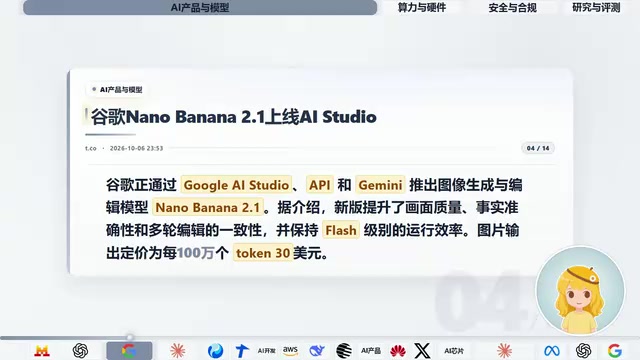
Google has also been busy. Nano Banana 2.1 is now live on AI Studio, the API, and Gemini, with improvements to image quality, text accuracy, and consistency across multi-turn edits. Image output is priced at $30 per million tokens. For developers building image generation and editing pipelines, the improvement in multi-turn editing consistency addresses a genuine pain point.
Perhaps more noteworthy for localized deployment scenarios is the open-sourcing of Embedding Gemma 2. It supports offline on-device retrieval of text, images, video, and audio — and in tests on the Pixel 11 Pro, multimodal retrieval used approximately 567MB of memory. This marks a meaningful step toward on-device semantic search with practical resource requirements, offering a cloud-free option for privacy-sensitive use cases.
Native multimodal models differ fundamentally from earlier "stitched-together" multimodal approaches. The latter typically connect a separate visual encoder (like CLIP) to a language model via an adapter layer, keeping image and text processing largely separate at the architectural level. Native multimodal architectures, by contrast, incorporate multiple modalities from the pretraining stage, enabling the model to form joint cross-modal semantic representations. This translates to stronger coherence on tasks requiring deep image-text reasoning — such as debugging code from a circuit diagram or interpreting error logs from a screenshot. At roughly 1 trillion parameters, Mistral Large 4 enters the same competitive tier as GPT-4o and Gemini Ultra. The promise to open the weights also means the community can fine-tune and self-host the model — a far more significant contribution to the open-source ecosystem than API-only access.
On-device semantic retrieval has long been bottlenecked by resource constraints. Traditional semantic search encodes text or multimedia content into high-dimensional vectors (embeddings) and retrieves similar content via approximate nearest neighbor (ANN) algorithms — a pipeline that typically requires running large encoder models on cloud servers. Embedding Gemma 2 compresses this capability to run offline on a phone within 567MB of memory, leveraging a combination of quantization, knowledge distillation, and other model compression techniques. For privacy-sensitive domains like medical records, legal documents, or personal journals, local semantic retrieval means intelligent search without uploading data to the cloud — a direct commercial advantage in regions with strict data compliance requirements like GDPR.
Product Layer: Codex Rolls Out Updates, Claude Deepens Integration with Office and Startup Ecosystems
OpenAI's rolling Codex update plan entered its second day, shipping four features at once. The most talked-about addition is automatic code review — free and not counted against usage quotas — along with meeting notes integration. The Decisions API also entered public beta. Shortly after the free review feature dropped, user Tibo launched a poll about quota resets, though whether a full reset is coming remains unclear. Community debates around quotas and pricing often reveal more about real user needs than the features themselves.
Anthropic's Claude is accelerating its push into workplace collaboration. Claude is now integrated with Google Docs, Sheets, and Slides — it can read content in the file sidebar and assist with edits, and users can open these files directly within Claude. Every change requires user approval before taking effect. This "human-in-the-loop" approval design is central to deploying enterprise AI assistants in a way that balances efficiency with control.
Anthropic also expanded its Claude for Startups program, opening it to early-stage companies that meet founding or funding timeline requirements. Members can receive up to one year of Claude Team access and $7,000 in product and API credits. Meanwhile, Atlassian announced an expanded partnership with OpenAI, planning to connect advanced AI models with internal company knowledge to support team planning, development, and delivery workflows.
Open-Source Layer: Tencent Releases Multiple Projects, Mirage Bridges Video Production Workflows
The open-source spotlight this week falls on Tencent. Tencent Hunyuan, in collaboration with Fudan University and Zhejiang University, has open-sourced Prism — with code and model weights now available under an MIT license. By reducing redundant computation during high-resolution training, Prism achieves approximately 2.5× speedup for joint training of native 2K video and audio generation. Teams sensitive to training costs will find this worth exploring.
Tencent also open-sourced Octop, a multi-user AI workspace that supports independent accounts and multiple agents. Conversations and files are isolated between accounts, the whole stack can be launched on your own hardware with a single command, and it integrates coding agents and group chat tools.
Mirage's open-sourced Tesseract suite includes an Adobe project converter, enabling AI assistants to generate Premiere and After Effects project files and import existing projects for continued editing. While still early-stage with compatibility gaps to close, it points toward an interesting direction: AI that doesn't just render finished video, but generates editable project files — keeping creative control in the user's hands.

Capital and Infrastructure: DeepSeek Raises More, SpaceX Eyes Space-Based Computing
On the capital front, reports indicate DeepSeekAd's latest funding round is nearing close at a scale of at least 80 billion RMB — above the originally targeted ~50 billion RMB — with Tencent and CATL reportedly among the key investors. Separate reports suggest an IPO is planned for early 2027. Moonshot AI (月之暗面) is also said to have completed its final pre-IPO private funding round at a valuation of approximately $50 billion, with plans for a Hong Kong listing in Q1 2027 targeting up to $5 billion in proceeds. All of this is reported and has not been officially confirmed.
On the compute and hardware side, one blogger claims Huawei is building and testing an Atlas 950 super-node equipped with 256,000 accelerator cards, with the goal of enabling one million processors to work in coordination — though this claim also lacks independent verification.
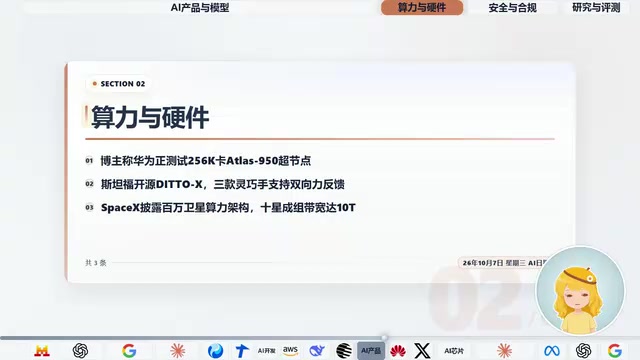
SpaceX has disclosed a space-based computing initiative called StarMind, proposing a constellation of one million satellites, with roughly 10 satellites forming a cluster connected by approximately 10 Tbps of inter-satellite bandwidth to handle larger AI workloads collaboratively. The system doesn't exist yet. Moving data centers into orbit remains a long-horizon concept, but it reflects how the compute race is extending toward physical limits.
Safety and Boundaries: Pentagon Drops Claude, Privacy Concerns Mount
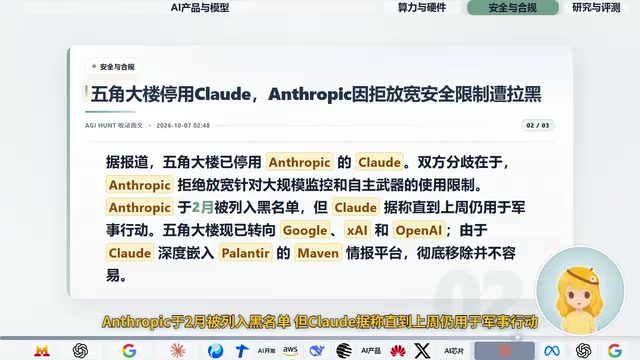
AI safety and usage boundaries emerged as another undercurrent this cycle. Reports indicate the Pentagon has discontinued use of Anthropic's Claude, with disagreements centering on restrictions around mass surveillance and autonomous weapons. Anthropic was reportedly blacklisted in February, yet Claude is said to have remained in use for military operations until last week. The Pentagon has reportedly shifted to Google, xAI, and OpenAI. Because Claude was deeply embedded in intelligence platforms, full removal is not straightforward — exposing a structural tension between AI vendors' stated values and the operational demands of government clients.
Meanwhile, Time magazine reported that Meta's AI agents are quietly building detailed profiles of users, raising fresh privacy concerns. Given that Meta already holds vast amounts of social data, what additional information these agents collect — and how it's used — remains to be clarified.
"Human-in-the-Loop" is a core governance principle in AI system design: requiring human review and approval before an AI executes consequential actions. Claude's Google Workspace integration — requiring user confirmation for every edit — is a direct implementation of this principle. The contrasting paradigm, "Human-out-of-the-Loop" autonomous systems, sits at the heart of the Pentagon–Anthropic rift. Autonomous weapons systems imply that AI can make strike decisions without human intervention, something Anthropic's usage policies explicitly prohibit. This dispute reveals a broader, structural conflict: the ethical guardrails built into commercial AI models are often fundamentally at odds with the military's demands for autonomy and speed. As AI capabilities grow, this tension will intensify, not ease.
Frontier: AI-Assisted Math Research Enters the Empirical Stage
The development most worth tracking over the long term is AI's role in mathematical research. OpenAI has begun publicly sharing mathematical research results from its internal frontier models, claiming that since training began in late August, the model has solved or advanced more than a hundred long-standing open problems across multiple mathematical domains. Before publication, the team consulted an independent panel of math advisors to establish rigorous protocols for verification, attribution, and disclosure.
Google Research has introduced a multi-agent system in which several Gemini-based agents collaborate to explore open mathematical problems. The system has produced new results on five publicly known open problems, with the proofs verified by domain experts. The fact that both companies are independently pushing AI into serious mathematical research — and both emphasizing expert verification — provides a traceable, real-world test of model reasoning depth that goes far beyond benchmark scores.
AI's role in mathematics is shifting from "problem-solving tool" to "research collaborator." Previous benchmarks for AI math ability (like MATH or AIME competition problems) tested performance on problems with known answers. Advancing "long-standing open problems" requires higher-order capabilities: conjecture generation, counterexample search, and proof construction. The multi-agent framework for exploring open problems is particularly noteworthy: different agents can take on roles like "conjecturer," "prover," and "refuter," narrowing the search space through internal debate — a structural analogy to how mathematical communities actually work. The emphasis on expert verification also reflects a current reality: models still produce "hallucinated proofs" that are formally structured but logically flawed, and human mathematicians remain an indispensable quality check.
Summary
This briefing captures several converging trends in the AI industry: open-source models are pushing in two directions simultaneously — toward trillion-parameter scale and toward on-device deployment; coding and office assistants like Codex and Claude are iterating rapidly on both features and ecosystem integrations; and controversies around safety boundaries, privacy, and military applications are a persistent reminder that expanding technical capabilities keep running into governance limits. For developers, Mistral Large 4, Embedding Gemma 2, and Tencent's open-source releases are all worth hands-on testing as soon as possible.
Related articles

Chain of Thought Isn't Just for AI: How Humans Can Use CoT to Improve Thinking Quality
Chain of Thought isn't just a prompt trick for large models. Starting from a Hacker News discussion, this article analyzes why CoT works for human thinking too, breaks down actionable ways to transfer it, and highlights the key differences between human CoT and machine CoT.
Cloudflare Teams Up with OpenAI: Closi…
Cloudflare Teams Up with OpenAI: Closing the Loop from Vulnerability Discovery to Defense with AI
Cloudflare uses OpenAI Daybreak to investigate security vulnerabilities and generate reviewable remediation plans, while developers use Codex to boost coding efficiency and quality.

Orca Multi-Agent Orchestration in Practice: A Guide to Parallel Collaboration with Claude and Codex
Orca is Stable AI's free open-source agent workbench supporting 34 agents like Claude Code and Codex in parallel. Learn its Git worktree isolation, multi-model orchestration, and mobile management.