Mistral Welcomes Design Talent: A Design Upgrade for Mission-Critical AI

Mistral brings in design team New Material, elevating design as a core competitive advantage for mission-critical AI.
Mistral announced that design team New Material has joined and proposed "bringing design to mission-critical AI." The article notes that mission-critical scenarios like financial risk control, industrial scheduling, and medical assistance demand far more from AI than answering ability, involving interface and process design such as confidence presentation, anomaly alerts, and human-takeover paths. Mistral was previously known for open-source models, efficient inference, and the European sovereign AI narrative; bringing in design expertise fills in product usability and completeness, addressing real concerns of business leaders in enterprise procurement. The article sees this as a signal of LLM competition shifting from "the model is the product" to "the model plus the product," though team size, scope, and timeline remain undisclosed.
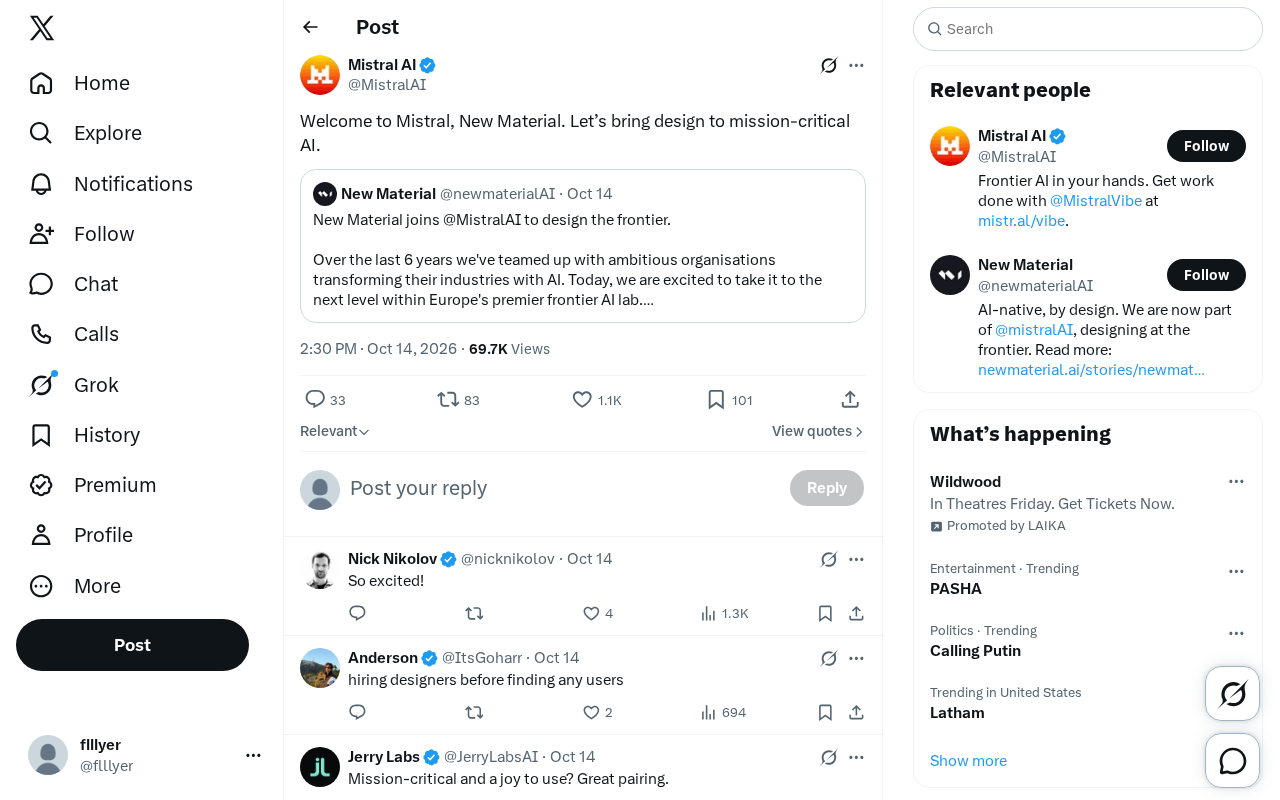
Mistral posted a short but telling message on social media: welcoming New Material aboard and explicitly stating "Let's bring design to mission-critical AI." No product launch, no funding figures—yet it reveals something easily overlooked about this European LLM company: it is elevating design to a position as important as model capability.
Why "Mission-Critical AI" Needs Design
Mission-critical scenarios demand far more from AI than simply "being able to answer." In fields like financial risk control, industrial scheduling, medical assistance, and security operations, errors carry high costs. Users under pressure need to quickly judge whether AI output is trustworthy and actionable. This means the interface cannot be just a chat box with a send button—it must handle a range of design problems: confidence presentation, anomaly alerts, human-takeover paths, and more.
By bringing design to the table now, Mistral signals that it is not targeting generic chat scenarios but enterprise deployments that must be embedded in business processes and bear real responsibility. Model capability is the entry ticket; design determines whether AI can be truly trusted and used long-term.
Mission-critical is a term from systems engineering and operations, referring to systems whose interruption or failure causes major business loss, safety risks, or even physical harm—think air traffic control, power grid dispatch, financial clearing, and medical life-support equipment. Such systems generally follow a "fail-safe" principle in design, requiring redundancy, observability, and clear human-takeover mechanisms. Introducing LLMs into these scenarios means AI is no longer an optional辅助 tool but a responsible node in the process. Therefore, beyond accuracy, attention must be paid to output interpretability, uncertainty quantification, and audit trails—exactly what UI/UX design must carry, and the substantive meaning behind the phrase "bringing design to mission-critical AI."
Who New Material Is, and What Mistral Is Filling In
From public information, New Material is a team known for design and product experience, contrasting with the common path of new model companies that "stack parameters first, patch experience later." Mistral's prior public image leaned more technical: open-source models, efficient inference, and the European sovereign AI narrative. Bringing in a design team adds two dimensions to that narrative: "usability" and "product completeness."
This is not just a nice-to-have. When enterprises procure AI, decision-makers are often not algorithm engineers but business leaders. They care about whether operations are intuitive, whether errors are traceable, and whether permissions are clear. A design team fills exactly the layer that technical teams tend to overlook.
Sovereign AI is a high-frequency term in recent European policy and industry circles, referring to a country or region maintaining autonomous control over models, compute, data, and governance to avoid critical infrastructure depending on external technology suppliers. Mistral is often seen as a representative company of the European sovereign AI narrative, and its open-source model strategy partly serves this goal. For enterprise customers, sovereign AI concerns not only compliance and data residency but also directly affects procurement decisions: mission-critical systems often require auditability, local deployment, and replaceable supply chains. Understanding this context is key to why Mistral emphasizes "mission-critical"—it simultaneously addresses the dual needs of regulatory compliance and the high-end enterprise market, and design capability is the final link that turns these technical promises into usable products.
An Underestimated Industry Signal
As LLM competition enters its second half, capability gaps between models are converging while product experience gaps are widening. Several leading companies are expanding design and product teams, and Mistral's message is a microcosm of the same trend: moving from "the model is the product" to "the model plus the product."
For developers, this means that future integration with Mistral may bring more interfaces designed around enterprise workflows, clearer error feedback mechanisms, and more complete deployment guidance. For competitors, it is a reminder—the barrier to the mission-critical market has never been just about benchmarks.
Worth Watching but Still Unclear
The message did not disclose New Material's team size, specific scope of responsibilities, or a timeline for the first collaborative output. How design will collaborate with model training, and whether a dedicated product line for mission-critical scenarios will be launched, remain open questions. What is certain is that Mistral has placed design in a strategic position, and subsequent moves are worth tracking.
For enterprise users, the real question to ask is: as AI enters critical processes, do your existing interface and process designs deserve the model's capabilities? Mistral clearly believes the answer requires dedicated design expertise to complete.
One-line Summary
Mistral brings in design team New Material, elevating design as a core competitive advantage for mission-critical AI.
Paragraph Summary
Mistral announced that design team New Material has joined and proposed "bringing design to mission-critical AI." The article notes that mission-critical scenarios such as financial risk control, industrial scheduling, and medical assistance demand far more from AI than model answering ability, involving interface and process design issues like confidence presentation, anomaly alerts, and human-takeover paths. Mistral was previously known for open-source models, efficient inference, and the European sovereign AI narrative; bringing in design expertise fills in the dimension of product usability and completeness, addressing the real concerns of business leaders in enterprise procurement. The article sees this as an industry signal of LLM competition shifting from "the model is the product" to "the model plus the product," though team size, scope of responsibilities, and a timeline for the first output remain undisclosed.
Related articles

Testing the 350K-Star REA in an Isolated Environment: 4-Second Install, but Watch Out for Two Pitfalls
Isolated lab test of the 350K-star open-source reverse-engineering tool REA: 4-second install, 15 seconds to list a screenshot tool's outbound addresses, 565 communication channels mapped, while exposing two pitfalls—user-level settings writes and 31 high-risk tool permissions—plus three safety rules.
Reverse Engineering + AI Agents: The T…
Reverse Engineering + AI Agents: The Technical Truth Behind Cloning Adobe Apps in Weeks
A developer used AI Coding Agents for reverse engineering to build 7 open-source Adobe alternatives in weeks. We explore how it works, the MCP Server that hit 100K stars in 6 days, and the real technical and legal limits.
MCP Protocol Explained: How AI Agents Connect to External Tools
What is MCP (Model Context Protocol)? From APIs and Function Calling to MCP's three-layer architecture, this article explains how AI Agents connect to external tools like calendars and email, and reveals two major security risks—prompt injection and tool poisoning—along with four protection principles.