MIT Launches 'MIT for America' Initiative: Reshaping STEM Education Across the U.S. with AI

MIT launches 'MIT for America,' covering K-12 to community college with a focus on math, making, and constructive AI use.
MIT has unveiled the 'MIT for America' initiative, targeting learners from kindergarten to community college — an unusually broad scope for university outreach. It sets three priorities: math, making, and the constructive use of AI, positioning AI as a creativity amplifier rather than an answer generator, in line with MIT Media Lab's 'learning by making' philosophy. The article frames this as a strategic response to the U.S. STEM pipeline problem, especially for community college students.
America's shortcomings in STEM education are evolving from a "talent problem" into a "national security problem." MIT's newly launched "MIT for America" initiative seeks to respond to this challenge with a systematic program spanning K-12 through community college, and one keyword stands out in particular — the constructive use of AI.
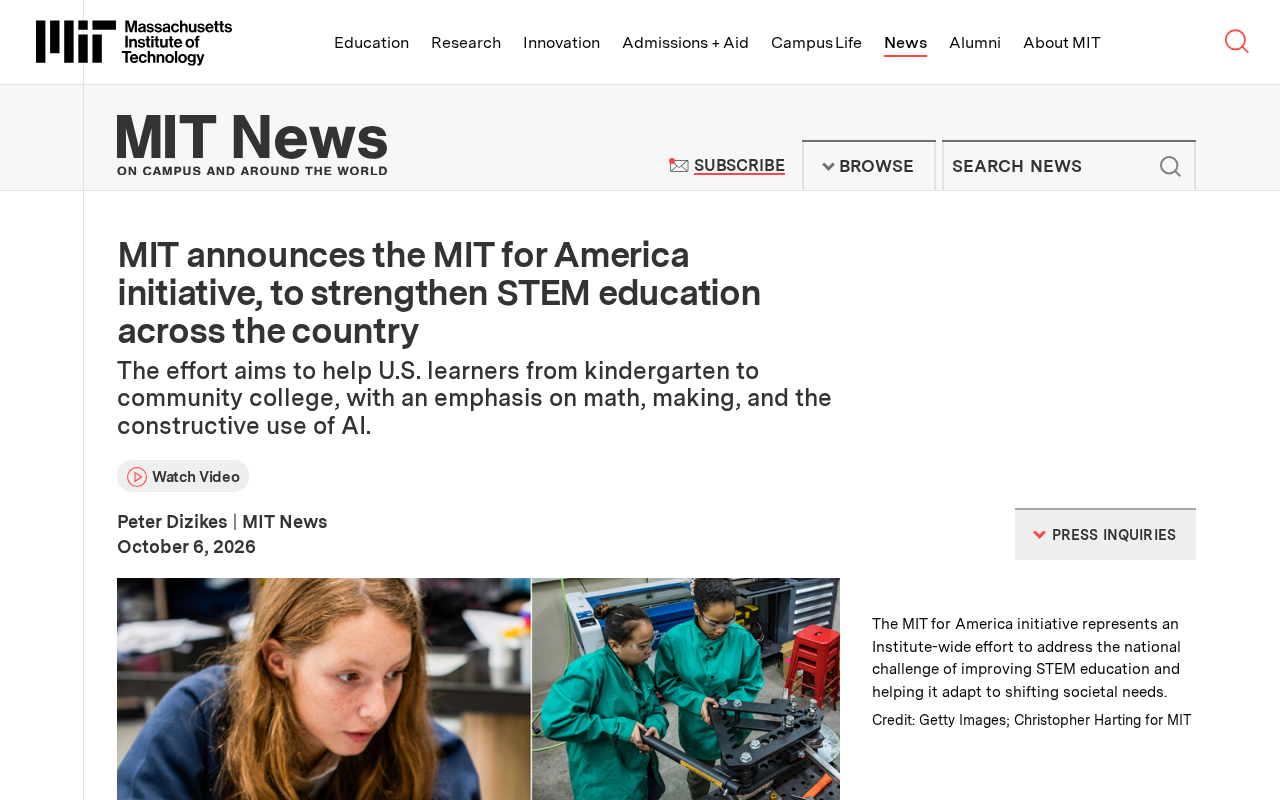
An Educational Intervention Covering All Age Groups
According to MIT's official announcement, "MIT for America" targets an extraordinarily broad audience: learners from kindergarten all the way to community college are included. This kind of full-pipeline coverage is uncommon among education projects launched by U.S. universities — most outreach programs at top universities focus on high-achieving high school students, whereas MIT clearly wants to do something more foundational this time.
The initiative identifies three core teaching priorities: math, making, and the constructive use of AI. Placing "making" alongside math and AI shows that MIT does not intend to turn AI education into pure software training, but rather emphasizes the combination of hands-on work and physical creation.
Why the "Constructive Use" of AI?
The phrase "constructive use of AI" deserves close reading. Current discussions about AI entering schools mostly cluster around two extremes: either worrying that students will use AI to cheat, or championing AI's ability to personalize instruction. MIT has chosen a middle but more specific position — teaching students to treat AI as a construction tool rather than an answer generator.
This aligns closely with MIT's own educational philosophy. MIT Media Lab has long advocated the idea of "learning by making," and AI's role here is more like a tool that amplifies creativity. For community college students, this positioning is especially practical: what they need is not abstract AI theory, but AI skills that can be directly applied to work and production.
Learning by Making is an educational philosophy long championed by MIT Media Lab, with its core tenets rooted in constructionism learning theory: when learners create tangible artifacts that can be seen, discussed, and shared by others, knowledge is internalized far more deeply than through passive lecture-based instruction. Representative practices of this philosophy include the Scratch programming platform developed by Professor Resnick's team, as well as various maker courses combining sensors, 3D printing, and programming. Within this framework, AI is viewed as a "programmable creative material" — students use it to generate code, control robots, and assist with prototyping, rather than simply extracting answers. The deeper intent is to help students understand AI's operating logic and limitations, thereby developing critical usage skills, rather than being shaped in reverse by the tool.
The Signal Significance of Universities Engaging in Basic Education
Top research universities extending into the basic education stage is essentially a direct response to the "talent pipeline" problem. The U.S. has long faced pressure in international rankings in math and science, and community colleges — as entry points for large numbers of first-generation college students and minority students — directly affect the diversity of higher education and the labor supply through the quality of their STEM education.
MIT's entry into this field with its own brand and resources may not change systemic structures in the short term, but the signal it sends is clear: educational equity in the AI era cannot wait until college to be addressed.
More implementation details of the initiative have not yet been fully disclosed, including funding scale, partner institution lists, and specific rollout timelines. But based on the directions already revealed, this looks more like a long-term commitment than a one-off PR move.
STEM pipeline is a common metaphor in education policy: it treats each stage — from K-12 enrichment, undergraduate training, to graduate study and employment — as a continuous conveyor chain, where leakage at any segment reduces the number of people ultimately entering STEM careers. Research shows that leak points often occur during the middle-to-high school transition (declining interest in math) and at the community college transfer stage. Community colleges are especially critical — they serve large numbers of first-generation college students, low-income families, and minority students, yet completion rates for STEM majors after transferring to four-year universities are relatively low. Therefore, upstream intervention (early intervention) is seen as a high-leverage means of improving overall STEM output and diversity, which explains why MIT chose to extend across the full pipeline from kindergarten to community college, rather than serving only students who have already shown promise.
One-line Summary
MIT launches the "MIT for America" initiative covering K-12 through community college, focusing on math, hands-on making, and the constructive use of AI.
Paragraph Summary
MIT has released the "MIT for America" education initiative, targeting learners of all ages from kindergarten to community college — an unusually broad scope for a university outreach program. The initiative establishes three core teaching priorities: math, making, and the constructive use of AI. "Constructive use" is interpreted as a middle-ground position distinct from both cheating concerns and personalized-learning advocacy, emphasizing AI as a creativity amplifier and construction tool rather than an answer generator — consistent with MIT Media Lab's "learning by making" philosophy. The article argues that top research universities extending into basic education is essentially a strategic response to America's STEM pipeline problem, with particular attention to community colleges as entry points for first-generation and minority students. Specific funding, partners, and timelines have not yet been announced.
Related articles

@ai-sdk/vue 3.0.306 Patch Release Syncs with [email protected] Update
@ai-sdk/vue 3.0.306 released, synced with [email protected]. A routine patch release for the Vercel AI SDK ecosystem with no public API changes; the Vue adapter layer stays version-aligned with the core package.

Gemini 4 Argon API Launches: The Era of Million-Token Output Begins
Google launches Gemini 4 Argon with sparse MoE architecture, up to 1M output tokens, and a 68.90% Vals Index score, available across API, AI Studio, and the Gemini app.

DukaanAI: Turning Product Photos into Inventory Lists with Open-Source AI
DukaanAI is an AI inventory tool for small retailers that turns product photos into inventory entries using the open-source Gemma 3 model, with local inference, editable fields, and CSV export.