MIT Lincoln Laboratory Hosts Roadshow for National Security Commission on Emerging Biotechnology

MIT Lincoln Laboratory hosts the National Security Commission on Emerging Biotechnology roadshow, spotlighting Massachusetts' defense biotech ecosystem.
MIT Lincoln Laboratory recently hosted a roadshow for the National Security Commission on Emerging Biotechnology, focusing on Massachusetts' defense biotechnology ecosystem. The state boasts a dense network of universities, hospitals, biotech startups, and defense contractors, forming a complete chain from basic research to application. The Commission aimed to understand the local industrial base, research capabilities, and talent pool. The article notes that biotechnology's dual-use nature requires closer coordination among policymakers, research institutions, and enterprises, with Lincoln Laboratory serving as a key hub connecting the technological frontier to national security needs.
MIT Lincoln Laboratory recently hosted a roadshow event for the National Security Commission on Emerging Biotechnology, focusing on the current state and prospects of Massachusetts' defense biotechnology ecosystem.
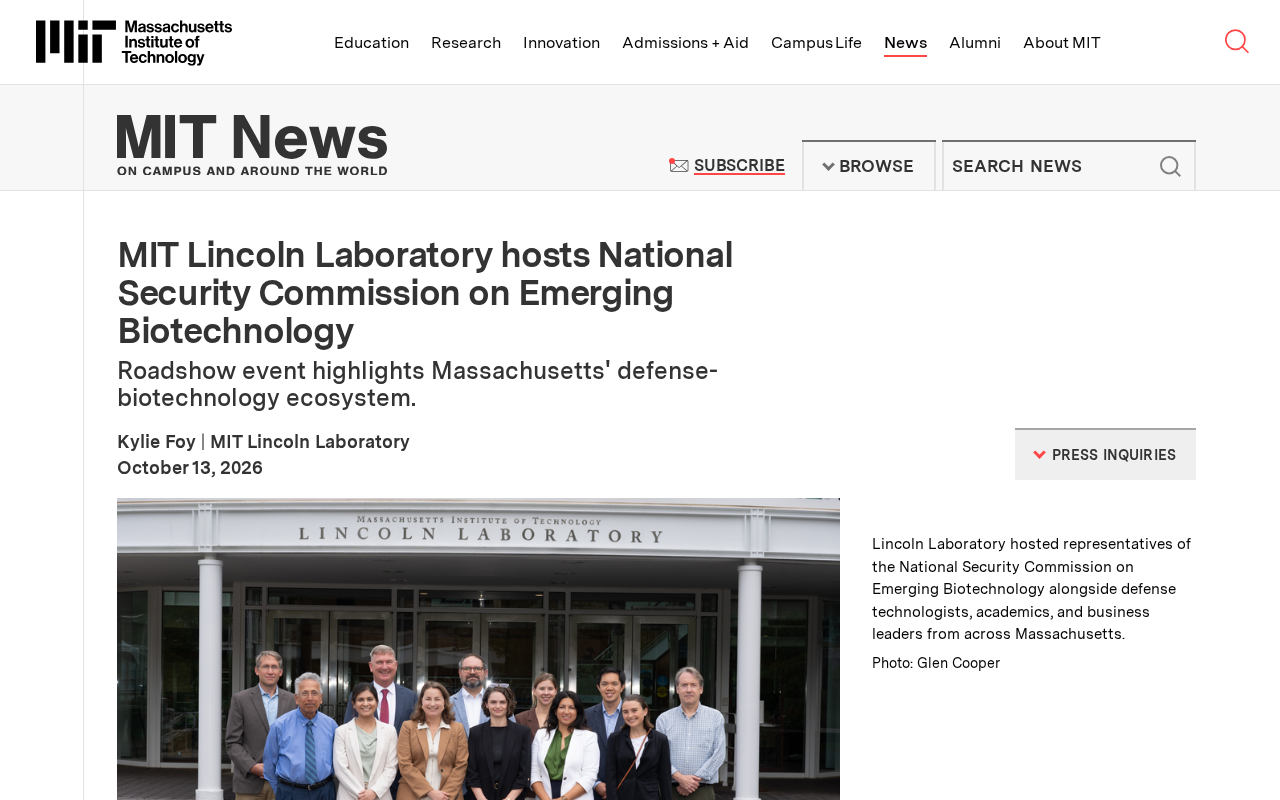
Event Background and Core Topics
Emerging biotechnology is transforming healthcare, materials, agriculture, and even national defense at an unprecedented pace. The core goal of the Commission's roadshow was to gain an in-depth understanding of Massachusetts' industrial base, research capabilities, and talent pool in defense biotechnology.
As a federally funded research and development center, MIT Lincoln Laboratory has long served national security needs. Its involvement in interdisciplinary biotechnology reflects the defense innovation system's emphasis on cutting-edge biological capabilities.
The National Security Commission on Emerging Biotechnology is a bipartisan independent commission established by the U.S. Congress under the Fiscal Year 2022 National Defense Authorization Act. Composed of multiple commissioners appointed by Senate and House leaders, its mandate is to assess the impact of the intersection of artificial intelligence and biotechnology on U.S. national security and to recommend policies on legislation, regulation, investment, and talent. The Commission focuses on issues including biomanufacturing, biosecurity of data, dual-use risks of synthetic biology, and U.S. bioeconomy competitiveness. Its reports and roadshow activities often directly influence subsequent congressional legislative agendas and federal budget allocations.
MIT Lincoln Laboratory, established in 1951, is a representative institution within the federally funded research and development center (FFRDC) system. Operated by MIT and primarily funded by the Department of Defense, it has long undertaken national-level missions in air defense systems, cybersecurity, and intelligence analysis. In recent years, Lincoln Laboratory has expanded its research scope into the interdisciplinary fields of biosurveillance, biodefense, and biosecurity, leveraging its accumulated expertise in sensors, signal processing, and systems engineering to support defense biotechnology from prototype validation to system integration—making it an important window for the Commission to understand the regional ecosystem.
Massachusetts' Defense Biotechnology Ecosystem
Massachusetts has a dense concentration of universities, hospitals, biotechnology startups, and defense contractors, forming a complete chain from basic research to applied translation. The roadshow highlighted several key characteristics of this ecosystem:
- Tight coupling between academia and industry: Institutions such as MIT and Harvard provide a continuous stream of fundamental discoveries and talent for biotechnology.
- Defense demand as a driver: Platforms like Lincoln Laboratory channel civilian biotechnology achievements toward national security applications.
- Capital and policy support: In-state venture capital and federal programs jointly support early-stage technology validation.
This ecosystem makes Massachusetts a key node in U.S. defense biotechnology innovation.
Defense biotechnology generally refers to biology-related technologies developed for national security needs, encompassing biological threat detection and diagnostics, vaccine and medical countermeasure development, biomanufacturing and supply chain resilience, soldier health and performance enhancement, and preventing synthetic biology from being used for adversarial purposes. Unlike traditional biomedical research, defense biotechnology emphasizes rapid response, deployability, and reliability in contested environments, and must comply with dual-use export controls and biosecurity reviews. Massachusetts is regarded as a key node because it possesses world-class basic research institutions, a mature biopharmaceutical industry, and an active venture capital network simultaneously, enabling laboratory discoveries to advance relatively quickly to engineering and productization stages—capabilities that defense scenarios require.
Implications for the Integration of National Security and Biotechnology
The Commission's roadshow was not merely a regional survey but also reflects national-level attention to the governance and strategic positioning of emerging biotechnology. The dual-use nature of biotechnology—which can be used for both medical protection and potential adversarial purposes—requires policymakers, research institutions, and enterprises to establish closer coordination mechanisms.
Lincoln Laboratory's role as host demonstrates that federally funded R&D centers are becoming key hubs connecting the technological frontier with security needs. In the future, similar roadshows may drive more cross-agency collaboration and investment decisions.
Dual-use is a core concept in biotechnology governance, referring to the fact that the same technology or research outcome can serve civilian medical, agricultural, and industrial purposes while also potentially being diverted for military or malicious uses. As the cost of tools such as gene synthesis, gene editing, and AI-assisted protein design drops dramatically, the barriers to acquiring and modifying biological materials continue to lower, expanding biosecurity risks from state actors to non-state actors and even individuals. This requires governance mechanisms to strike a balance between promoting innovation and preventing misuse, through means including biosecurity reviews, synthetic nucleic acid order screening, export controls, laboratory biosafety level management, and transparency-building under international convention frameworks. The Commission's roadshow activities are a concrete manifestation of this governance need at the regional level, aimed at identifying capability gaps and policy friction points in the industrial and research ecosystem to inform federal-level strategic planning.
Related articles

Workbuddy for Absolute Beginners: How a Desktop AI Agent Fits Into Real Workflows
A beginner's guide to the Workbuddy desktop AI agent: installation, claiming credits, file management, and building automated workflows—compared with CodeX for fit and cost, helping professionals shift from AI question-askers to AI managers.

OpenAI's New Agent Stack: Computer Use, Decisions API, and Ultra-Fast Workflows
OpenAI Dev Day unveiled a new agent stack: Computer Use outperforms humans, Decisions API delivers ultra-low-latency classification via Luna, Agents API opens the same Computer Use capabilities, and GPT-6.1 Sol costs only one-seventh of Astra. Core updates, benchmark data, and developer insights.

Liang Wenfeng Open-Sources DeepInfo Inference Framework, Takes On U.S. Ban
DeepSeek open-sources its DeepInfo inference framework after its models, featuring GPU/CPU cross-pipelining, small-model prediction with large-model verification, and full Huawei Ascend and NVIDIA chip support—facing the U.S. federal ban head-on. This article analyzes its significance for AI deployment and open-source strategy.