MIT Proposes CW-Net: Making Autonomous Driving AI Decision-Making Explainable and Predictable
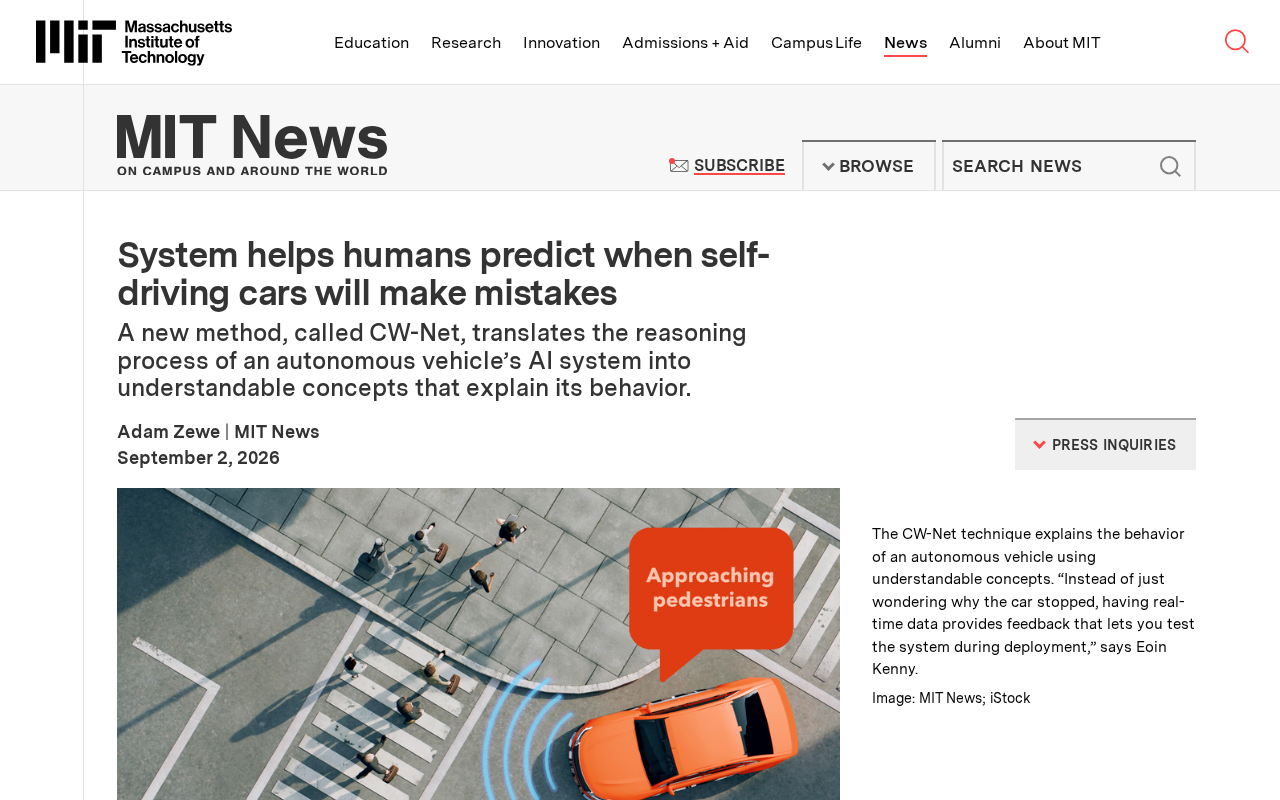
MIT's CW-Net makes autonomous driving AI decisions transparent and predictable through concept-based reasoning
MIT's CW-Net addresses the black box problem in autonomous driving by translating AI decision-making into human-understandable concepts. Based on Concept Bottleneck Models, it reveals what the system perceives, how factors influence decisions, and which conditions trigger errors—enabling proactive failure prediction rather than reactive analysis.
The Black Box Problem in Autonomous Driving: Why AI Decision-Making Lacks Transparency
The safety of autonomous vehicles has always been a focal point of public concern. While current mainstream deep learning systems perform well in most driving scenarios, their decision-making process remains a "black box" to humans—we cannot predict when they will make mistakes, nor can we easily understand why they make specific decisions.
The Technical Nature of the Deep Learning Black Box Problem
Deep learning models, especially Convolutional Neural Networks (CNNs) and Transformer architectures, typically contain millions or even billions of parameters. These parameters are automatically adjusted through backpropagation algorithms during training, forming highly nonlinear feature representations. While models can extract complex patterns from raw sensor data (such as camera images and LiDAR point clouds) and make decisions, their internal computational processes lack intuitive semantic meaning for humans. The activation value of a neuron or the numerical values in a weight matrix cannot be directly mapped to human-understandable concepts like "pedestrian detected" or "vehicle distance too close." This gap between feature space and concept space is the root of the black box problem.
This opacity has become a significant obstacle to the large-scale commercialization of autonomous driving technology. Imagine a specific scenario: you're sitting in an autonomous vehicle, and the system suddenly makes a maneuver that makes you uneasy, but you can neither understand its reasoning nor predict whether it will make a fatal error in the next moment. This is precisely the core challenge facing current autonomous driving technology—lack of explainability.
What is CW-Net: MIT's Concept-Based Warning Network
MIT researchers proposed CW-Net (Concept-based Warning Network) as an innovative solution to this dilemma. The core breakthrough of this system lies in its ability to transform the complex reasoning process inside autonomous driving AI systems into human-understandable semantic concepts, thereby clearly explaining the vehicle's behavioral logic.
Theoretical Foundation of Concept Bottleneck Models
CW-Net is based on the idea of Concept Bottleneck Models (CBM). CBMs are a class of explainable machine learning architectures whose core lies in introducing a "concept layer" between the input and output layers, mapping high-dimensional feature space to human-understandable concept space (such as "pedestrian present," "lane lines clear," "vehicle ahead decelerating"). This intermediate representation layer acts as an "information bottleneck," forcing the model to reason through explicit semantic concepts rather than direct end-to-end mapping from raw pixels to control commands. This design sacrifices some model capacity but gains decision process transparency—humans can inspect the activation states of the concept layer to understand what the model "sees" and "bases its decisions on."
How CW-Net Works
CW-Net doesn't simply record what the AI did, but delves into the underlying logic of decisions, answering three key questions:
- What key elements did the system identify? For example, pedestrians ahead, lane markings, traffic light status, etc.
- How do these elements influence the final decision? What are the weights and combinations of various factors.
- Which combinations of conditions are more likely to lead to erroneous judgments? Exposing the system's weak points in advance.
Through this conceptualized expression, human operators can identify potential failure patterns in advance, rather than waiting until after an accident to analyze.
From Post-Hoc Analysis to Proactive Prediction
Technical Significance of Failure Mode Prediction
Traditional post-hoc analysis relies on already-occurred accident data, retracing the decision chain through crash recorders (similar to black boxes). But this approach has serious limitations: rare accident scenarios are difficult to fully cover, and it can only provide lessons after losses have already occurred. The failure mode prediction proposed by CW-Net belongs to proactive safety—by analyzing decision boundaries and uncertainty distributions in concept space, identifying which concept combinations (such as "nighttime + rain + pedestrian wearing dark clothing") are more likely to trigger misjudgments. This is equivalent to systematically discovering the model's weaknesses before simulation or actual deployment, allowing targeted supplementation of training data or adjustment of model architecture.
The greatest value of this approach lies in its predictability. Traditional post-hoc analysis can only tell us "what happened," while CW-Net can help humans predict "when mistakes might occur." This capability opens up entirely new possibilities for human-machine collaboration in safety-critical scenarios.
The Practical Significance of Explainable AI for the Autonomous Driving Industry
Transforming AI decision-making processes into explainable concepts is not just academic progress, but has profound impacts on multiple aspects of the autonomous driving industry.
Regulatory Compliance and Safety Certification
Regulatory Frameworks and Explainability Standards
Autonomous driving regulation in major global markets is shifting from performance testing to systematic safety demonstration. The EU's UN R157 regulation and China's "Guidelines for Access Management of Intelligent Connected Vehicle Production Enterprises and Products" both emphasize algorithmic transparency and auditability. However, existing deep learning systems struggle to meet the requirement to "prove the system is safe in all scenarios." Explainable AI technology provides a new approach for regulation: rather than enumerating all possible scenarios, prove that the system's reasoning logic conforms to safety principles—for example, proving that the system does consider key factors like pedestrian priority and maintaining safe distances. This principle-based argumentation may become an important direction for future regulatory certification.
When the decision-making process of autonomous driving systems can be audited and verified, regulatory agencies can more effectively assess their safety and establish more scientifically sound admission standards. Explainability provides a technical foundation for industry standardization.
Safety Redundancy Mechanisms
Autonomous Driving Levels and Explainability Requirements
SAE (Society of Automotive Engineers) divides autonomous driving into six levels from L0 to L5. Level 3 (conditional automation) requires the system to fully control the vehicle under specific conditions but must be able to request human takeover in time; Level 4 (high automation) requires no human intervention within the Operational Design Domain (ODD). In L3 scenarios, the system needs to predict its own capability boundaries in advance and alert the driver; in L4 scenarios, remote monitoring personnel need to understand system decisions to handle edge cases. Both levels pose urgent demands for explainability—the system must not only "know how to drive" but also "explain clearly why it drives this way."
Human drivers or remote monitoring personnel can intervene in time when the system is about to make a mistake, forming an effective safety redundancy mechanism. This is particularly important in L3 and L4 autonomous driving—the system can issue warnings in an understandable way before requiring human takeover.
Accelerating System Iteration and Optimization
Development teams can use the explainable feedback provided by CW-Net to quickly locate weak points in AI models and make targeted improvements to training data and algorithm architecture, rather than blindly increasing data volume or stacking model complexity. This significantly improves R&D efficiency.
Building Public Trust
When passengers can understand the decision-making logic of autonomous driving systems, both acceptance and trust in the technology will significantly increase. Transparency is the foundation for building public trust and a prerequisite for large-scale adoption of autonomous driving.
Toward a Safer Autonomous Driving Future
CW-Net represents an important development direction in the autonomous driving field: shifting from solely "pursuing performance" to simultaneously "pursuing reliability and explainability." In today's era of increasingly powerful AI technology, we need not only systems that can make correct decisions, but systems that can explain their reasoning processes and be understood and trusted by humans.
Cognitive Alignment in Human-Machine Collaboration
Effective human-machine collaboration requires establishing common ground—both parties having a consistent understanding of the current situation. In autonomous driving scenarios, if the system misclassifies an object ahead as a cardboard box rather than a pedestrian, but the human driver identifies it as a pedestrian, this cognitive discrepancy will lead to delayed takeover timing or operational conflicts. Explainable systems expose intermediate reasoning processes (such as displaying "system identifies as static obstacle, confidence 65%"), allowing humans to promptly discover cognitive biases and correct them. This transparency not only improves safety but also reduces the cognitive load on human monitors—monitoring personnel don't need to maintain constant high alertness, but rather focus attention when the system indicates uncertainty.
This research from MIT also conveys a deeper philosophy: the ultimate goal of autonomous driving is not to completely replace human drivers, but to establish deeper understanding and collaboration between humans and machines. Only when AI can explain its thought process using human-understandable concepts can we truly achieve a safe, reliable, and trustworthy autonomous driving experience.
Related articles

Enterprise-Level Agent Development: Six Core Competencies for Interview Success
Deep dive into core interview topics for enterprise-level Agent development, covering streaming interruption handling, high-concurrency architecture, multi-tenant isolation, observability, and other engineering challenges to help AI large model job seekers build complete capability systems.

Deep Learning on Brain DICOM Datasets: A Guide to Choosing Between 2D and 3D Approaches
Comprehensive guide to choosing between 2D, 2.5D, and 3D CNN approaches for brain DICOM medical imaging deep learning. Covers ADNI dataset preprocessing workflows including resampling, registration, and skull stripping.

AI Fatigue: Why Do Learners Feel More Lost as AI Gets Stronger?
As AI crushes top human competitors in math proofs and programming contests, how should tech learners cope with AI fatigue and career anxiety? This article analyzes the nature of capability squeeze and provides a rational framework for addressing AI anxiety.