MIT Supply Chain Sustainability Report: Commitments Hit Record High, Governance Lags Behind

MIT report shows corporate supply chain sustainability commitments at all-time high, but lagging governance and external disruptions are hindering delivery.
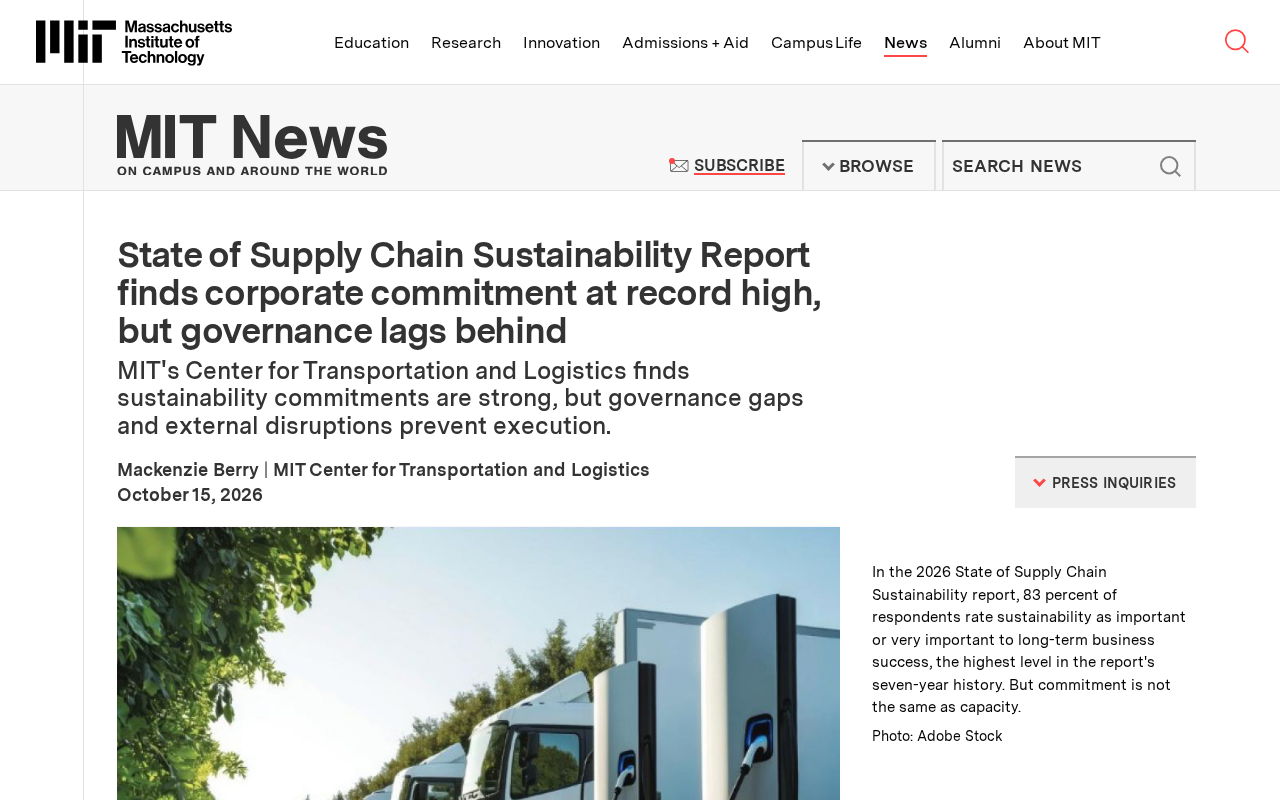
The MIT Center for Transportation and Logistics' "State of Supply Chain Sustainability" report reveals a core contradiction: corporate commitments to supply chain sustainability have reached an all-time high, but the ability to translate commitments into actionable plans has not kept pace. The problem is not willingness but governance architecture—many organizations lack clear accountability mechanisms, cross-functional coordination processes, and quantifiable assessment systems. The report also notes that geopolitical tensions, raw material price volatility, and logistics disruptions quickly shift corporate priorities, causing sustainability agendas to be shelved. Calling governance the "missing link," the report argues effective governance requires at least three elements: clear accountability structures, processes embedded in daily operations, and incentives linked to financial metrics.
The MIT Center for Transportation and Logistics' "State of Supply Chain Sustainability" report shows that corporate commitments to supply chain sustainability have reached an all-time high, but lagging governance capabilities and external disruptions are hindering these commitments from being realized.
The Gap Between Commitment and Execution
The report's core finding points to a contradiction: corporate leadership is more vocal than ever about supply chain sustainability, but the ability to translate commitments into actionable plans has not kept pace.
This gap is not driven by lack of will. A growing number of companies are putting supply chain sustainability on their strategic agendas, publicly setting emission reduction targets, requiring suppliers to disclose carbon data, and even writing ESG metrics into procurement contracts. The problem lies in governance architecture—many organizations lack clear accountability mechanisms, cross-functional coordination processes, and quantifiable performance assessment systems, leaving sustainability goals stuck at the slideware level.
The MIT research team points out that the governance gap manifests in several specific dimensions: Who is responsible for the supply chain carbon footprint? When sustainability goals conflict with cost control, how are decision priorities set? What is the exit mechanism when suppliers fail to meet standards? These questions still have no clear answers in most companies.
ESG is the abbreviation for Environmental, Social, and Governance—three dimensions first proposed by the UN Global Compact in 2004 to measure the sustainability and social impact of business operations. In the supply chain context, E (Environmental) typically corresponds to carbon emissions, resource consumption, and waste management; S (Social) covers labor rights, supplier compliance, and community impact; G (Governance) involves decision-making mechanisms, accountability structures, and information disclosure. In recent years, ESG metrics have been increasingly written into procurement contracts and supplier evaluation systems, becoming hard thresholds for buyers screening partners. But the difficulty of implementing ESG lies in the fact that tensions often exist among the three dimensions—for example, reducing carbon emissions may drive up costs (E vs. financial conflict), while strengthening supplier audits may lengthen delivery cycles (S vs. operational conflict). This is precisely why governance mechanisms need to intervene and coordinate.
External Disruptions: The "Invisible Killer" of the Sustainability Agenda
Beyond internal governance issues, the report also highlights the impact of external disruptions on sustainability execution. Geopolitical tensions, raw material price volatility, logistics interruptions, and other sudden events can rapidly change corporate priorities. When supply chain "survival" becomes the primary concern, "sustainability" is often temporarily set aside.
This priority shift is understandable in the short term, but costly in the long run. The report suggests that companies that completely abandon their sustainability agendas during crises often need to spend significantly more to rebuild supplier trust and compliance systems afterward. Once sustainability is treated as a "nice-to-have" rather than "infrastructure," it is easily sacrificed under pressure.
Supply Chain Resilience refers to the ability of a supply chain to quickly recover and maintain operations after disruptions. It is listed alongside sustainability as one of the two core issues in current supply chain management, but the two often compete for resources in practice. Pursuing resilience means increasing inventory, developing multi-source procurement, and building redundant capacity—measures that tend to drive up costs and increase carbon footprints. Pursuing sustainability tends toward streamlining suppliers, optimizing logistics, and reducing waste—which may sacrifice some flexibility. The "priority shift" mentioned in the MIT report is essentially a dynamic trade-off between resilience and sustainability. The research community generally believes the long-term solution is not choosing one over the other, but integrating both into a unified risk governance framework—for example, achieving both risk diversification and localized emission reduction through supplier diversification, or enhancing both transparency and response speed through digital carbon tracking.
Why Governance Is the Critical Bottleneck
The report calls governance the "missing link," because governance is the only channel connecting commitments to results. Without governance, commitments are just PR statements; with governance, commitments can be translated into procurement standards, supplier evaluation dimensions, and investment decision criteria.
Specifically, effective supply chain sustainability governance requires at least three elements: a clear accountability structure (who is responsible for what), processes embedded in daily operations (rather than standalone "sustainability programs"), and incentive mechanisms linked to financial metrics. The report's data shows that companies possessing all three elements have significantly higher achievement rates for their supply chain sustainability goals than those with only good intentions.
Scope 3 Emissions is the category of indirect emissions defined in the GHG Protocol, referring to all emissions generated upstream and downstream in a company's value chain, including raw material procurement, supplier production, logistics and transportation, product use, and end-of-life disposal. For most companies, Scope 3 emissions account for over 70% of their total carbon footprint, making them the core target of supply chain sustainability management. However, governing Scope 3 emissions is extremely difficult: data is scattered across hundreds or thousands of suppliers, calculation methodologies are inconsistent, verification costs are high, and companies have no direct control over these emission sources. This is the deeper reason why the MIT report emphasizes the governance gap—without clear accountability structures and data collection mechanisms embedded in procurement processes, Scope 3 emission targets are nearly impossible to achieve. Current mainstream approaches include requiring suppliers to disclose according to unified standards, using industry databases for estimation, and incorporating carbon data into supplier admission and assessment systems.
Practical Implications for Businesses
For companies currently advancing supply chain sustainability transformation, this report delivers several pragmatic signals.
First, do not postpone governance building until "after the strategy is clear." Governance itself is part of the strategy—a strategy without governance is just a wish list. Second, external disruptions should not be a reason to abandon sustainability, but rather a litmus test for whether sustainability is truly embedded in operations. Finally, supplier management is the key battleground for governance implementation—what to require of suppliers, how to verify, and what to do when they fall short—the quality of answers to these three questions directly determines the credibility of commitments.
This MIT report does not provide simple answers, but it clearly points in one direction: the next breakthrough for supply chain sustainability is not at the commitment level, but at the governance level. Whoever fills this gap first will be able to turn sustainability from a cost center into a competitive advantage.
Related articles

Chain of Thought Isn't Just for AI: How Humans Can Use CoT to Improve Thinking Quality
Chain of Thought isn't just a prompt trick for large models. Starting from a Hacker News discussion, this article analyzes why CoT works for human thinking too, breaks down actionable ways to transfer it, and highlights the key differences between human CoT and machine CoT.
Cloudflare Teams Up with OpenAI: Closi…
Cloudflare Teams Up with OpenAI: Closing the Loop from Vulnerability Discovery to Defense with AI
Cloudflare uses OpenAI Daybreak to investigate security vulnerabilities and generate reviewable remediation plans, while developers use Codex to boost coding efficiency and quality.

Orca Multi-Agent Orchestration in Practice: A Guide to Parallel Collaboration with Claude and Codex
Orca is Stable AI's free open-source agent workbench supporting 34 agents like Claude Code and Codex in parallel. Learn its Git worktree isolation, multi-model orchestration, and mobile management.