MLOps Multi-Environment Architecture: A Detailed Guide to the Dual Lifecycles of Systems and Models

MLOps has two separate lifecycles: system CI/CD across environments, and model training-promotion in production.
This article explains why MLOps engineers get confused about multi-environment architectures by revealing the two distinct lifecycles at play: the software system lifecycle (validated through traditional CI/CD across dev/test/uat/prod) and the model lifecycle (trained and promoted primarily in production-grade environments). It clarifies that pre-production environments exist to test whether the MLOps system works correctly, while production is where real models are born using complete data.
A Question That Puzzles Many MLOps Engineers
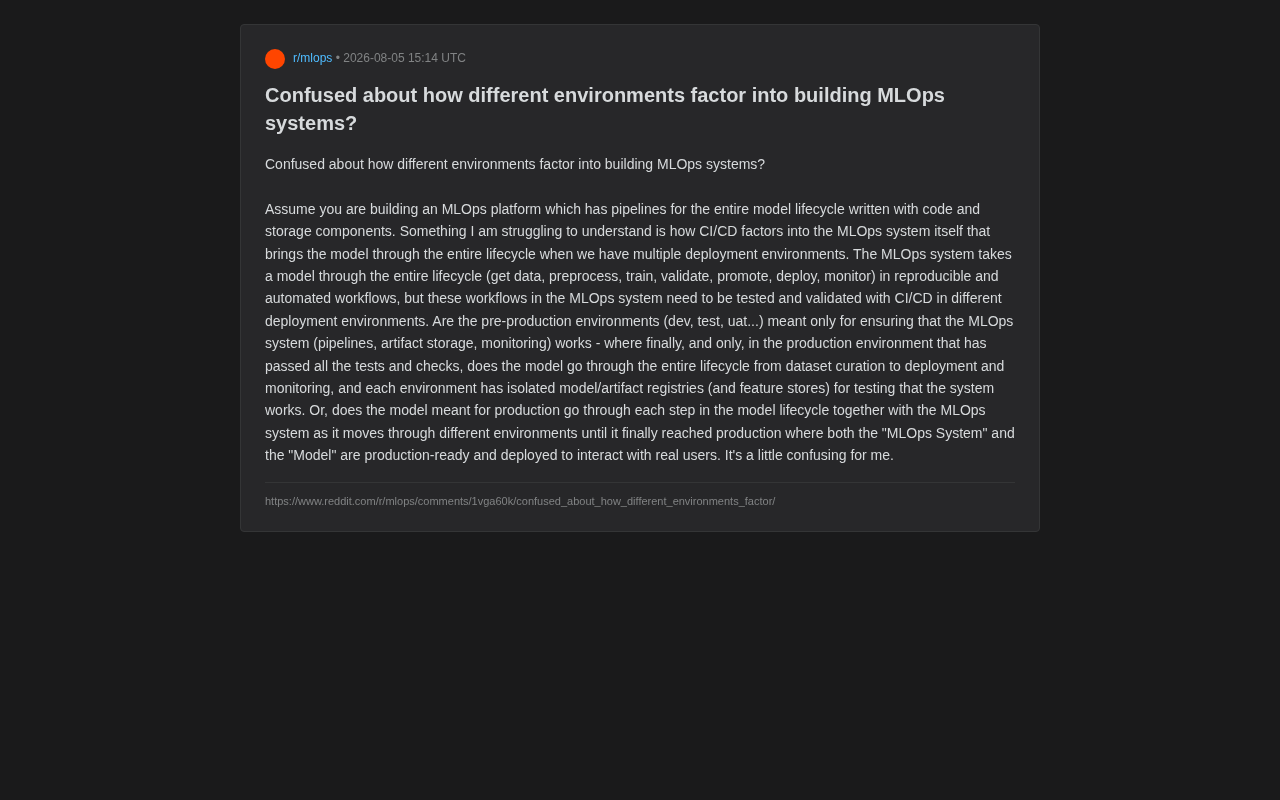
In the MLOps community on Reddit, an engineer raised a question that seems basic but actually touches the core of MLOps architecture: When we build an MLOps platform covering the entire model lifecycle, how exactly do CI/CD and multiple deployment environments (dev, test, uat, prod) work together?
CI/CD (Continuous Integration/Continuous Deployment) is a core practice in modern software engineering. Continuous Integration refers to developers frequently merging code into the main branch, with each merge triggering automated builds and tests; Continuous Deployment automatically releases tested code to production. Multi-environment deployment (dev/test/uat/prod) is the standard pattern for enterprise software delivery: the dev environment enables rapid developer iteration, the test environment runs automated test suites, the UAT (User Acceptance Testing) environment lets business stakeholders verify that features meet requirements, and the prod environment faces end users. Each environment typically has independent infrastructure, databases, and configurations, forming a progressive quality gate system.
This confusion is extremely common. He described: The MLOps system is responsible for automating the complete process of "acquiring data, preprocessing, training, validation, promotion, deployment, monitoring" while ensuring reproducibility. But these workflows themselves need to be tested and validated through CI/CD across different environments. So the question becomes—are the environments used to test the MLOps system itself, or does the model also need to go through the complete lifecycle in each environment along with the system?
The essence of this question is that many people don't realize there are two independent yet intertwined lifecycles in MLOps: the software system lifecycle and the model lifecycle. Clarifying the relationship between these two is the first step in designing a sound MLOps multi-environment architecture.
Two Types of Code, Two Lifecycles
The MLOps System Itself Is a Software Product
First, a key insight must be established: The pipelines, orchestration logic, storage components, and monitoring configurations of an MLOps platform are all essentially software code. They follow traditional software engineering DevOps practices.
An MLOps platform typically includes several key components: orchestration engines (such as Apache Airflow, Kubeflow Pipelines, Prefect) define and schedule the execution order and dependencies of workflows; Feature Stores (such as Feast, Tecton) uniformly manage and serve machine learning features, ensuring consistency between feature computation logic during training and online inference; Model Registries (such as MLflow Model Registry, Weights & Biases) record model versions, metadata, lineage, and approval status; Artifact Stores hold binary resources produced by training such as model weight files and dataset snapshots. Together, these components form the infrastructure layer for models from development to production.
This means that when you modify training pipeline code, update feature engineering logic, or adjust deployment scripts, these changes need to go through the standard CI/CD process: unit testing, integration testing, then validation in the dev environment, testing in the test environment, user acceptance in the UAT environment, and finally promotion to production.
In this lifecycle, the purpose of environments is to verify "whether the system runs correctly." You run a small-scale dataset through the pipeline in the dev environment to confirm the pipeline doesn't error out; in the staging environment, you test performance and resource consumption with near-production data volumes. The models and data used at this point are often sampled and simplified—the goal isn't to produce a usable model, but to ensure the infrastructure itself is reliable.
The Model Is an Artifact Produced by the System
The other lifecycle belongs to the model itself: from dataset curation, training, validation to promotion and deployment. A model is not "code"—it is an artifact produced when the MLOps system runs.
Understanding the essential difference between model artifacts and traditional software artifacts is crucial. In traditional software, artifacts (such as Docker images, JAR packages) are deterministic—identical source code through an identical build process necessarily produces functionally identical artifacts. But model artifacts are fundamentally different: even with completely identical training code and hyperparameter configurations, different datasets will produce entirely different model weights and prediction behaviors. This means model quality depends not only on code correctness but is deeply tied to the quality, scale, and timeliness of training data. A model trained on sampled data explores the parameter space far less thoroughly than one trained on the complete dataset, and its capture of statistical features is less comprehensive. Therefore, models produced in the dev environment have no production value from a statistical standpoint—they can only prove that the training pipeline's code logic is correct.
The questioner's core confusion lies precisely here—he conflated "testing the system" and "producing models" within the same environment promotion logic. In reality, a mature MLOps architecture should distinguish between: the system's CI/CD promotion and the model's training-promotion process as two different mechanisms.
Mainstream Practice: Production Is Where Models Are Born
So returning to the two assumptions in the original question, which one is closer to real production practice?
The answer is closer to the first assumption, but with corrections. In mainstream industry practice:
-
The primary purpose of pre-production environments (dev/test/uat) is to validate the MLOps system itself—whether pipelines can run end-to-end, whether artifact stores can read and write correctly, whether monitoring can trigger alerts, whether feature stores are consistent. These environments typically use isolated model registries, artifact stores, and feature stores, performing smoke tests with small-scale or anonymized data.
-
Models intended for production complete their full training and validation in the production environment (or production-grade data pipelines). Because only the production environment has complete, real, and current data. A model trained with sampled data in a dev environment has weights that are meaningless for production.
In other words, you don't let "the same model artifact" be carried along with the system from dev→test→uat→prod. A model trained in dev only proves that "the training pipeline works." Once the system itself passes CI/CD validation across all environments and is deployed to production, the model's complete lifecycle (data curation→training→validation→deployment→monitoring) is truly executed once in the production-grade environment, producing the model that serves real users.
Model Promotion: The Important Middle Ground
Reality is often more complex than a binary division. Some teams introduce the concept of "model promotion": training candidate models with production data in a staging environment, then after a series of offline evaluations and shadow deployment tests, promoting the model artifact from the staging registry to the production registry. At this point, what moves is the trained model binary file, not a retraining.
Shadow Deployment is a strategy for evaluating new models without affecting production traffic: the new model receives exactly the same live requests as the current production model and generates predictions in parallel, but these results are not returned to users—they're only used for offline comparative analysis. Related approaches include Canary Release, which routes a small portion of production traffic (e.g., 5%) to the new model while observing whether latency, error rates, or business metrics show degradation; and A/B Testing, which compares different model versions' impact on user behavior and business revenue through random traffic splitting. These strategies form a progressive validation system for models from candidate to full production service and are core risk-reduction mechanisms in model promotion pipelines.
This approach is common in scenarios requiring strict model governance and compliance audits. In regulated industries such as finance, healthcare, and insurance, Model Governance is a regulatory requirement. For example, the U.S. Federal Reserve's SR 11-7 guidance requires financial institutions to perform independent model validation, continuous monitoring, and periodic review; the EU AI Act imposes transparency, explainability, and human oversight requirements on high-risk AI systems. These compliance needs directly impact MLOps architecture design: every model training, evaluation, and promotion must leave a complete audit trail, including data versions used, training hyperparameters, evaluation metrics, and approver records. In this context, the model registry is not just a technical tool but a carrier of the compliance evidence chain.
The model promotion mechanism gives models their own "promotion pipeline," but this pipeline is decoupled from the system code's CI/CD—system code deployment and model artifact promotion are triggered and validated independently.
How to Design a Clear MLOps Environment Architecture
Clearly Separate the Two Delivery Processes
When designing, it's recommended to plan with two independent lines of thinking:
- System Delivery Pipeline (CI/CD for code): Changes to pipeline code, orchestration, and configuration follow the standard software promotion path, using lightweight data to verify functional correctness in each environment. Triggers are typically code commits (git push) or pull requests, with validation methods including pipeline unit tests (verifying transformation logic with mock data sources), integration tests (end-to-end execution verifying component interactions), and infrastructure tests (verifying resource quotas and permission configurations).
- Model Delivery Pipeline (CD for models): Model training, evaluation, and promotion have their own trigger conditions (such as new data arrival, scheduled runs, or performance degradation triggering retraining) and validation gates (such as accuracy thresholds like AUC/F1, fairness checks, latency constraints, model size limits). The quality gates in this pipeline are oriented toward model quality rather than code correctness.
Environment Resource Isolation Principles
Each environment should have isolated model registries, artifact stores, and feature stores to prevent test data from polluting production or production models from being accidentally used in testing. This is also the correct intuition mentioned by the questioner. Specifically, isolation should cover the following dimensions: compute resource isolation (preventing test tasks from preempting GPU resources for production training), data isolation (production data should not be directly exposed to development environments—use anonymized or synthetic data when necessary), network isolation (preventing accidental cross-environment data flows), and identity and permission isolation (developers should not have direct access to operate the production model registry).
Remember the Core Principle
Pre-production environments validate "whether the system can reliably produce models," while the production environment is where "truly usable models are actually produced." Models don't need to go through the complete lifecycle in every environment—only the system needs to prove in each environment that it can handle that lifecycle.
Conclusion
The reason MLOps is confusing is precisely because it simultaneously manages two fundamentally different types of assets: "code" and "data/models." DevOps thinking habits make people instinctively try to stuff everything into the same environment promotion pipeline, but the special nature of models—dependence on real data, need for independent evaluation, large artifact sizes—dictates that they must have their own lifecycle logic.
Clarifying the distinction between the "system lifecycle" and the "model lifecycle," and enabling them to collaborate through clear interfaces (such as model registries), is the key starting point for building a maintainable MLOps platform. The next time you face a question like "should the model be trained in every environment," simply return to this basic framework: ask yourself whether the object being validated is the system or the model, and the answer becomes clear.
Related articles

Workbuddy for Absolute Beginners: How a Desktop AI Agent Fits Into Real Workflows
A beginner's guide to the Workbuddy desktop AI agent: installation, claiming credits, file management, and building automated workflows—compared with CodeX for fit and cost, helping professionals shift from AI question-askers to AI managers.

OpenAI's New Agent Stack: Computer Use, Decisions API, and Ultra-Fast Workflows
OpenAI Dev Day unveiled a new agent stack: Computer Use outperforms humans, Decisions API delivers ultra-low-latency classification via Luna, Agents API opens the same Computer Use capabilities, and GPT-6.1 Sol costs only one-seventh of Astra. Core updates, benchmark data, and developer insights.

Liang Wenfeng Open-Sources DeepInfo Inference Framework, Takes On U.S. Ban
DeepSeek open-sources its DeepInfo inference framework after its models, featuring GPU/CPU cross-pipelining, small-model prediction with large-model verification, and full Huawei Ascend and NVIDIA chip support—facing the U.S. federal ban head-on. This article analyzes its significance for AI deployment and open-source strategy.