Mmory: A Private Voice Memory App on iPhone

Mmory is a private voice memory app for iPhone with on-device transcription and Q&A.
Mmory is an iPhone app from Product Hunt positioned as "private voice memory," created by Dhruv Dadoo. Its core proposition is that every thought you speak stays only on your iPhone—speech transcription and Q&A both happen locally rather than in the cloud. This dual localization turns privacy from a product promise into an architectural constraint, reducing users' concerns about data breaches. In interaction, Mmory uses voice as the primary entry point and AI as a semantic retrieval method: users can record thoughts casually and later retrieve them by asking questions, closer to how humans naturally recall memories. The product is positioned not as an all-purpose AI assistant but as a local-first tool for a limited scenario, suited to creators, developers, and privacy-sensitive users. It earned 64 upvotes and ranked 14th on Product Hunt, with community feedback showing the local-first direction resonates with some users—though potential limitations like device performance and cross-device sync remain to be observed.
In an era where AI apps are blooming everywhere, most products emphasize the power of cloud-based large models—but one product from Product Hunt has chosen the completely opposite direction. Mmory is an iPhone app positioned as a "private voice memory" tool. It earned 64 upvotes and ranked 14th on Product Hunt, created by developer Dhruv Dadoo. Its core proposition is crystal clear: every thought you speak stays only on your iPhone.
What It Is in One Sentence
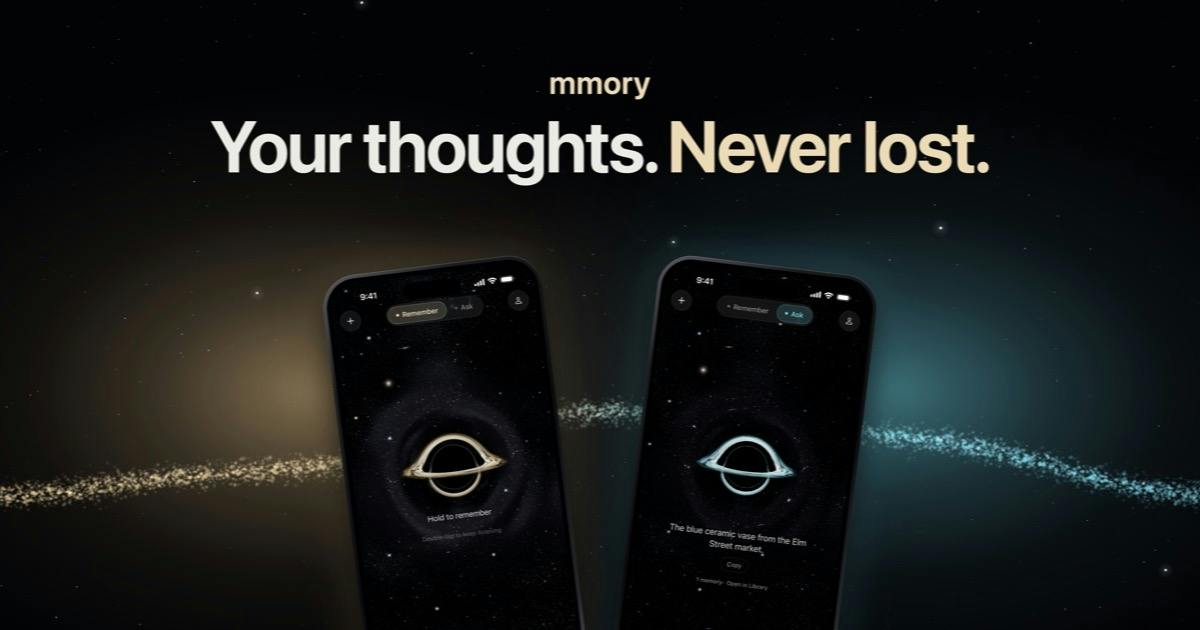
Mmory's official description can be broken into two actions: speak a thought, then ask about it later. You can record something via voice or keyboard input, then retrieve it later by asking a question. Both speech transcription and question-answering happen locally on the iPhone, rather than taking a round trip through cloud servers.
This sounds simple, but it addresses a real pain point: many note-taking and AI assistant apps default to uploading data to the cloud for processing, leaving users with almost no control over "who heard my voice and where it's stored." Mmory reclaims processing to the device, turning privacy from a product promise into an architectural constraint.
The Privacy Boundary of Local Processing
"Transcription and answers happen on the iPhone"—the most critical information in this product description is dual localization: transcription is local, and question-answering is local too. This stands in sharp contrast to mainstream industry practices.
For a "voice memory" product, localization isn't just about compliance. Voice notes naturally contain highly private personal thoughts, to-dos, and emotional fragments. Once uploaded to the cloud, they involve a chain of risks: storage duration, secondary use, data breaches. When processing happens entirely on-device, users' psychological burden around data drops significantly, and they're more willing to speak candidly.
You may not have noticed that localization usually means sacrificing some model capability or response speed. The source material doesn't disclose what model Mmory uses or specific performance data, but judging from its positioning, it has chosen the trade-off path of "adequate understanding capability + stronger privacy guarantees" rather than pursuing maximum reasoning power.
On-Device AI refers to running AI models directly on user devices (such as phones or PCs) for inference, rather than sending data to cloud servers. Its core advantages include: privacy protection (data never leaves the device), low latency (no network round trips), offline availability, and reduced bandwidth costs. Implementing on-device AI typically relies on model compression techniques such as quantization (converting floating-point weights to low-precision integers), pruning (removing redundant parameters), and knowledge distillation (using a large model to guide training of a smaller one). In recent years, dedicated hardware like Apple's Neural Engine and Qualcomm's Hexagon has provided computational support for on-device AI, enabling tasks like speech transcription and semantic search to run locally on phones in real time. Mmory's "dual localization" is a typical application of on-device AI in privacy-sensitive scenarios.
Voice-First Note Interaction
Mmory is listed under three Product Hunt categories: Notes, Artificial Intelligence, and Audio. This combination reveals its interaction logic: voice is the primary entry point, AI is the retrieval method.
Traditional note apps require users to first organize their language, then categorize and archive, with retrieval relying on keyword matching. Voice memory reverses the order—speak casually first, then retrieve it later through semantic questions. This model is closer to how human memory naturally works: we usually remember "I think I mentioned some idea last week," not the exact wording.
Who It's For
For creators accustomed to voice memos, developers who need to quickly capture inspiration, and users who care about data privacy, tools like this offer more value than general-purpose cloud note apps.
Semantic Search is a search method based on vector embeddings. It doesn't rely on literal keyword matching; instead, it maps both queries and documents into a high-dimensional vector space and finds semantically relevant content by computing vector similarity. Unlike traditional inverted indexes, semantic search can understand synonyms, context, and intent. For example, if a user asks "that idea I mentioned last week," the system can match relevant recordings even if the word "idea" never appears in them. Implementing semantic search typically requires an embedding model to convert text into vectors, combined with a vector database for nearest-neighbor search. Running semantic search on-device means both the embedding model and the index are stored locally, further strengthening privacy guarantees.
Product Differentiation from Cloud AI Assistants
Mmory isn't trying to replace full-featured AI assistants. Its product philosophy is closer to "deep optimization for a limited scenario": not universal Q&A, but a closed loop for storing and retrieving personal memories.
This positioning makes sense in today's landscape. As large model capabilities converge, differentiation often comes from scenario selection and data boundaries. Local-first is emerging as a recognizable product direction, and Mmory applies it to the specific category of voice notes. 64 upvotes is hardly explosive attention, but it shows the direction resonates with some users.
Potential Limitations
Local processing means device performance becomes the ceiling for experience. Cross-device sync, long-term memory capacity, and similar issues also need answers from the product. These aren't disclosed in the available material and are areas that warrant future observation.
Local-First is a software architecture philosophy that emphasizes keeping data and application state primarily on the user's device for storage and processing, with the cloud serving only as an optional sync or backup mechanism. Its core principles include: data ownership belongs to the user, offline availability, and collaboration resolved through sync protocols (such as CRDTs). Local-first naturally aligns with privacy protection because data doesn't leave the device by default. This philosophy is increasingly popular in apps handling sensitive personal data, such as notes, to-dos, and password managers. Mmory's application of local-first to voice memory scenarios is a concrete embodiment of this trend.
Summary
Mmory defines its trade-offs in one sentence: privacy-first, voice-first, local-first. For a personal memory tool, this combination is logically coherent. It may not suit everyone, but for users who consider "I don't want it recorded in the cloud" a hard requirement, Mmory offers a clear choice.
Related articles
 Tech Frontiers
Gemini Omni 1.2 Flash: AI Video Moves Toward Draft-Style Editing
Google's Gemini Omni 1.2 Flash update enables conversational, draft-style editing of the same video—swap scenes while keeping products, adjust lighting while keeping characters. Clips up to 15s, 720p costs 30% less than the previous Flash—ideal for e-commerce ads, previs, and short-asset production.

Codex Tutorial: One-Command Install and Run Your First Task
Codex tutorial: one-command install and run your first task. Covers the four Codex forms, sandbox and approval guardrails, AGENTS.md and MCP configs, cloud network policy, and the iron rule of human review—everything you need to get started with this autonomous coding agent.
 Tech Frontiers
Localix: An Open-Source Agentic Development Environment with Multi-Model and Local AI Integration
Localix is an MIT open-source Agentic Development Environment (ADE) supporting seamless Claude Code plugin loading, multi-model cloud and local execution, Mini Apps extensions, and agent context management—an open AI collaboration workbench for developers.