Mochi: A Chrome Extension That Puts a Pixel Cat in Your Browser Tabs

Mochi is a Chrome extension that places a quiet, animated pixel cat on every browser tab.
Mochi is a minimalist Chrome extension that displays a small animated cat on every browser tab. With 20 locally stored cat designs, drag-and-drop positioning, zero data collection, no accounts, no ads, and fully open-source code, it prioritizes privacy and simplicity. Reaching #10 on Product Hunt, Mochi reflects growing user demand for emotional warmth over relentless productivity in digital life.
When Your Browser Needs a Touch of Warmth
In an age of productivity tool overload, nearly every new browser extension promises to boost your efficiency: faster tab management, smarter bookmark organization, more precise time tracking. But on Product Hunt, a Chrome extension called Mochi takes the opposite approach — it doesn't help you do anything. It simply places an animated little cat on your browser tabs.
Product Hunt is one of the world's most influential tech product discovery platforms, founded by Ryan Hoover in 2013, where dozens of new products compete daily for visibility through the community's upvote mechanism. The platform's community has long favored productivity tools and SaaS products, so the fact that a purely emotional extension could climb the rankings sends a signal worth paying attention to.
Mochi's positioning is remarkably restrained. Its developer, KOUSTAV ROY, states explicitly in the description: this is not a productivity tool, not a tracker, and not a notification machine. It's just a cat that quietly keeps you company while you browse the web. With this counter-trend simplicity, Mochi climbed to #10 on the Product Hunt daily leaderboard, earning 90 upvotes.
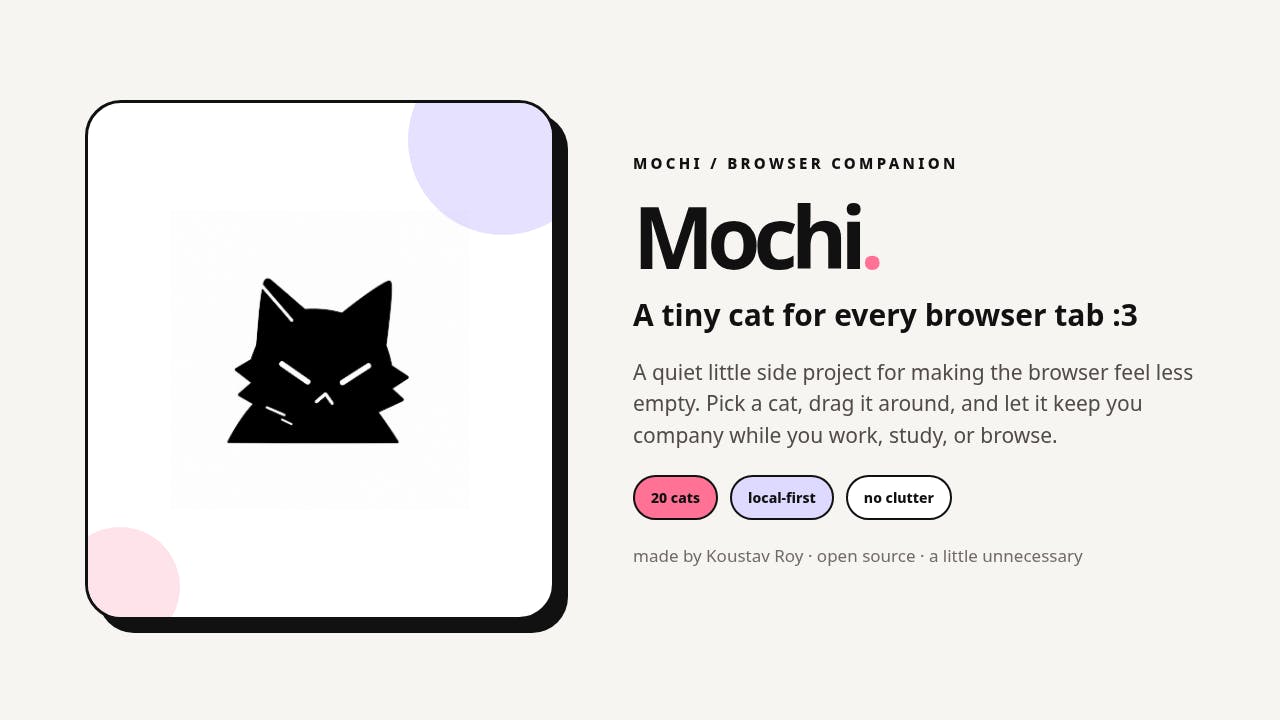
Mochi's Core Feature: An Animated Cat in Your Tabs
Functionally, Mochi's core is utterly pure: it displays a small, animated cat on every browser tab you open.
20 Locally Stored Cat Designs to Choose From
Users can pick from 20 preset cat designs. All assets are stored locally, meaning they load without an internet connection and generate zero additional network requests. This is remarkably rare in today's extension ecosystem. The Chrome Web Store is the world's largest browser extension marketplace, hosting over 180,000 extensions, but a large number of them quietly fetch remote resources or even upload data in the background. In recent years, security researchers have discovered multiple extensions with over a million downloads secretly collecting users' complete browsing histories and selling them to data brokers. Even earlier, the popular extension The Great Suspender was injected with malicious code by its new owner and was ultimately force-removed by Google. Chrome's extension permission model allows extensions to access the content of every webpage a user visits, meaning that once authorized, an extension can theoretically read sensitive information like banking pages and email content. It's against this backdrop that Mochi's purely local operation feels especially refreshing.
Drag-and-Drop Positioning, Consistent Across Tabs
Mochi lets you drag the cat to any position on the page, and it "remembers" that position — when you switch to another tab, the same cat appears in the same spot. This consistency creates a sense of continuous companionship, as if the cat truly lives in your browser rather than being a sticker that reappears from scratch with every refresh.
This design echoes a long tradition of digital pet companionship. Back in the 1990s, Bandai's Tamagotchi took the world by storm, proving that humans have a natural tendency to form emotional connections with virtual characters. Microsoft's built-in Office assistant Clippy, the "Rising Antivirus Lion" and QQ Pet penguin familiar to Chinese internet users — all formed part of a generation's digital memories. Mochi can be seen as an elegant continuation of this lineage in the modern browser environment — it doesn't require you to feed, clean, or interact with it. It simply exists quietly.
Privacy First: A Design Philosophy of Zero Data Collection
Beyond its features, what's most commendable about Mochi is its privacy stance. The developer explicitly lists what the extension does not do:
- No accounts: Install and use immediately — no registration or login required
- No analytics: Collects zero usage data
- No ads: Never pushes any commercial content
- No remote data: Everything runs locally with no server communication
This checklist is almost a "rare quality" in the browser extension space. In recent years, multiple incidents of browser extensions secretly collecting browsing history, injecting ads, or even selling data have steadily eroded user trust. Mochi's thorough "zero collection" design eliminates the trust problem at its root.
Going further, Mochi is an open-source project hosted on GitHub. Open source means the software's source code is publicly available — anyone can view, audit, copy, and modify it. For software that touches user privacy, this provides a "don't trust, verify" mechanism — users don't have to rely solely on the developer's verbal promises to judge whether the software is safe; they can confirm through code review. GitHub, the world's largest code hosting platform with over 100 million developer users, enables the community to participate in project improvement through Issue and Pull Request mechanisms, forming a transparent collaborative development model. It's worth noting, however, that open source doesn't automatically equal secure — whether the compiled version distributed on the Chrome Web Store matches the GitHub source code still requires additional build verification processes to confirm. But the combination of open source and local operation at least turns "don't be evil" from a slogan into a verifiable fact.
Emotional Value: An Underestimated Product Dimension
Mochi's popularity reflects, to some degree, an emerging user need — people are growing tired of digital lives that constantly push, remind, and quantify.
This fatigue has deep theoretical roots. The concept of the "Attention Economy" was proposed by Nobel laureate Herbert Simon in 1971: an abundance of information leads to a scarcity of attention. In the mobile internet era, this theory has been pushed to its extreme — the average smartphone user receives 50 to 80 push notifications per day, with every app competing for screen time. The resulting "Digital Fatigue" has become a widely discussed social phenomenon. The World Health Organization classified "occupational burnout" in the International Classification of Diseases in 2019, and continuous digital stimulation is considered a significant factor accelerating this trend. In recent years, the Digital Minimalism movement has gained traction, with Cal Newport's book of the same name becoming a bestseller, reflecting a deep rethinking of over-quantified, over-optimized digital lives.
Every notification competes for our attention. Every productivity app subtly implies we're "not trying hard enough." Against this backdrop, a little cat that demands nothing and simply exists quietly provides a scarce form of emotional buffering. It doesn't solve any practical problems, but it adds a touch of warmth to your screen.
Products with this kind of "usefulness of the useless" are not isolated cases. From desktop pet software to various ambient apps (like white noise apps simulating fireplace sounds or rain, or laid-back collection games like Neko Atsume), emotional companionship has always been a quiet but resilient undercurrent in digital products. Mochi's cleverness lies in seamlessly embedding this companionship into the scenario users engage with most frequently — the browser tab — making the cat a natural part of everyday browsing rather than a standalone app you have to deliberately open.
Lessons from a Small but Beautiful Product
Mochi is a textbook case of a "small but beautiful" product. It has no grand vision, no complex feature matrix, and no ambition for monetization. It does one small thing and does it purely, cleanly, and reassuringly.
For indie developers, Mochi offers a sample worth reflecting on:
- Restraint itself is a form of design. Refusing to add features sometimes requires more courage and judgment than piling them on. This aligns with Dieter Rams' principle of "Less, but better" — in software engineering, every additional feature means another layer of complexity, another potential security risk, and another maintenance burden.
- Privacy can be a core selling point. When the industry routinely crosses boundaries, "collecting nothing" becomes a differentiating advantage. With the rollout of privacy regulations like the EU's GDPR and California's CCPA, as well as Apple's ATT framework restricting app tracking, user privacy awareness continues to grow. "Privacy first" is moving from a niche philosophy to mainstream consensus.
- Emotional value has a real market. Users are willing to invest in products that simply make them feel better, even if they aren't "practical." Psychological research shows that small positive stimuli in work environments (such as seeing cute images) can briefly boost focus and emotional state — a study from Hiroshima University in Japan found that after viewing cute animal pictures, subjects performed better on tasks requiring concentration.
Of course, Mochi has its natural limitations. Its target user base is relatively niche, and its path to monetization is unclear. As a free, open-source project, it's more of an expression of the developer's personal interest than a commercial product. But it's precisely this lack of ulterior motive that makes it feel especially genuine.
Conclusion
In an era where everyone wants to make you more efficient, Mochi chooses to make you just a little bit happier. It doesn't promise to change how you work — it simply provides a quiet companion cat in the moments between writing code, browsing the web, and drafting documents.
Perhaps that's exactly why it resonated with the Product Hunt community — we don't always need more powerful tools. Sometimes we just need a little tenderness that has nothing to do with efficiency.
Related articles

Python 3.15 New Feature: Is the sentinel Type Better Than None?
Python 3.15 adds the sentinel type, using named unique sentinel objects to replace None and bare object(), resolving confusion among missing values, explicit emptiness, and invalid input while avoiding type hint failures.

Deep Learning's Three Architectures and the Universal Approximation Theorem: A Complete Guide to MLPs, CNNs, and Transformers
Explaining the inductive bias differences among MLP, CNN, and Transformer, the existence meaning of the Universal Approximation Theorem (UAT), and the role of Taylor expansion in approximation analysis, while clearing up common misconceptions.

GitLab Emergency Patch Release: Analysis of Critical Security Fixes
GitLab releases critical patch 19.5.1, sparking 355 points of discussion on Hacker News. This article analyzes the background, upgrade steps for self-hosted instances, and verification points to help DevOps teams respond quickly to security updates.