Model Suddenly Got Worse? Reddit Discusses the Truth Behind Troubleshooting and How Long It Takes

Reddit practitioners share the real causes and troubleshooting time behind sudden model performance drops, plus engineering practices to speed up diagnosis.
The article reviews a Reddit discussion on "how long it took to find the cause after a model suddenly got worse." It identifies high-frequency triggers such as schema changes, feature pipeline failures, label errors, deployment configuration mistakes, and upstream data drift, with approximate troubleshooting times ranging from several hours to 2-7 days. These problems are insidious because the model throws no error and only silently degrades. The author proposes four improvements: data quality monitoring and alerting, data version control, shadow models or canary releases, and the habit of "checking data first, then the model," emphasizing that observability tools and checklists can significantly reduce mean time to repair.
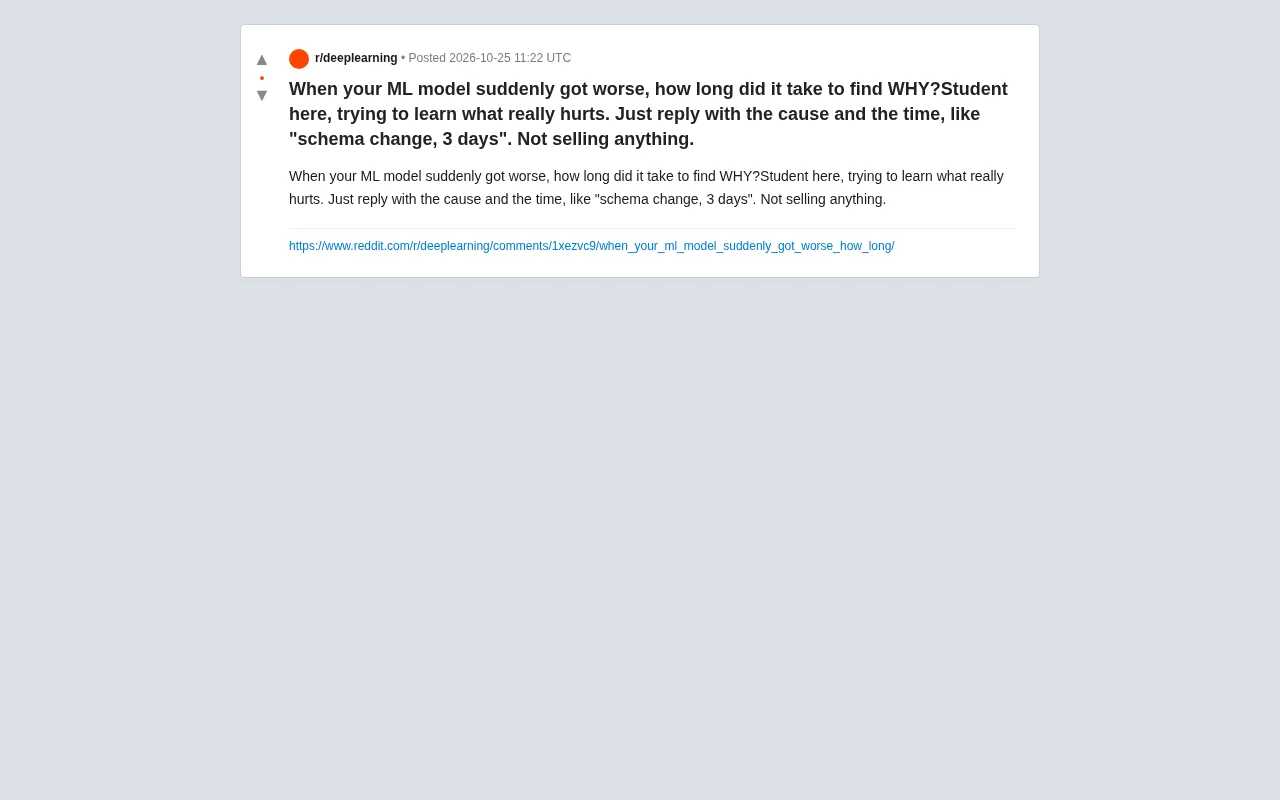
A sudden performance drop after a model goes live is a nightmare every machine learning practitioner may encounter. Recently, a student on Reddit posted a question: "When your ML model suddenly got worse, how long did it take to find out WHY?" He asked people to reply in the format "cause + time," for example "schema change, 3 days." The post quickly sparked heated discussion, with many practitioners sharing their personal experiences. This article organizes these real cases and distills practical approaches for troubleshooting model performance degradation.
Why Do Models "Suddenly" Get Worse?
Before discussing specific cases, it helps to understand the common triggers for a sudden drop in model performance. From data pipelines to online serving, a tiny change in any link in the chain can trigger a cascading reaction. The causes that appear most frequently in the Reddit replies include: schema changes, feature pipeline failures, upstream data distribution drift, label errors, and deployment configuration mistakes. What these problems share is that they are highly insidious—the model won't throw an error; it will only silently get worse.
Schema Changes: The Most Insidious Killer
Multiple commenters mentioned that schema changes are one of the most time-consuming causes to troubleshoot. For example, a field's type changes from integer to string, or a column name is modified by an upstream team, causing feature extraction to fail silently. Because no exception is thrown, the model still outputs predictions, but accuracy has already dropped significantly. Some practitioners said that locating this type of problem takes an average of 2-5 days, because data snapshots need to be compared layer by layer.
Feature Pipeline Failures and Data Drift
Feature pipeline failures are equally common. One reply described how an aggregated feature stopped updating because a scheduled job failed, and the model's performance dropped sharply within hours. Troubleshooting took about 1 day, and the issue was ultimately found by monitoring feature freshness. Data drift is even trickier—the input distribution gradually shifts and model performance slowly deteriorates, but "suddenly getting worse" is often the manifestation of drift accumulating to a critical point. Some users reported that identifying the root cause of drift took nearly a week.
Data drift and concept drift are often used interchangeably, but they point to different failure mechanisms. Data drift means the distribution of input features (P(X)) changes while the relationship between features and labels (P(Y|X)) remains unchanged; concept drift means (P(Y|X)) itself changes, that is, the same input starts to correspond to different correct outputs. The former can usually be detected by monitoring the statistical distance between the input distribution and the training distribution (such as PSI, KL divergence), while the latter can only be captured with labeled online evaluation. In practice, most cases of "suddenly getting worse" are the result of data drift accumulating near the model's decision boundary and then being exposed all at once, so monitoring should cover both feature distribution and prediction distribution. Looking only at accuracy often lags by days or even weeks.
Real Cases: Causes and Troubleshooting Time Statistics
Although the post did not provide complete reply data, typical scenarios can be summarized from the visible discussion. The table below summarizes some of the causes mentioned in the replies and the approximate troubleshooting time:
| Cause | Troubleshooting Time |
|---|---|
| Schema change | 2-5 days |
| Feature pipeline interruption | 1 day |
| Label error | 3 days |
| Deployment configuration error | Several hours |
| Upstream data distribution drift | 5-7 days |
These numbers reveal a harsh reality: a model can get worse in just a few minutes, but finding the root cause often takes days. Especially when a team lacks robust data monitoring and version tracking, troubleshooting is like looking for a needle in a haystack.
How to Shorten Troubleshooting Time?
From these experiences, several practical suggestions can be distilled. First, establish data quality monitoring with real-time alerts for the freshness, distribution, and schema of key features. Second, implement data version control to ensure that every model training and inference can be traced back to the corresponding data snapshot. Third, deploy shadow models or canary releases so that old and new model performance can be compared quickly. Finally, cultivate the troubleshooting habit of "check the data first, then check the model"—most problems lie on the data side, not in the algorithm itself.
Monitoring and Observability
Several senior practitioners in the replies emphasized that investing in observability tools can significantly shorten mean time to repair (MTTR). For example, perform end-to-end tracing of feature pipelines and record statistical summaries for each feature, with alerts triggered immediately once they deviate from the baseline. One team reduced troubleshooting time from days to hours by introducing the monitoring capabilities of a feature store.
A feature store is an intermediate layer between data pipelines and models that centrally manages offline computation, online serving, and metadata for features. Its key value lies in maintaining a traceable definition, computation logic, update frequency, and statistical summary for each feature, so that training and inference use the same feature definition, thereby eliminating "training-serving skew." When model performance declines, feature store monitoring can directly answer three questions: when was this feature last updated, whether its online value is consistent with its offline value, and whether its statistical distribution deviates from the baseline. This is precisely the technical foundation that enabled the team in the replies to compress troubleshooting time from days to hours—problem localization changed from "digging through logs layer by layer" to "checking the feature health dashboard."
Establish a Troubleshooting Checklist
Another effective practice is to maintain a troubleshooting checklist: check the schema, feature freshness, label distribution, deployment configuration, and upstream dependency status. Going through the checklist item by item can help avoid missing common pitfalls. One commenter said the checklist helped reduce average troubleshooting time from 3 days to less than 1 day.
Canary release and shadow model are two complementary deployment validation methods. A canary release first exposes the new model to a small portion of real traffic (such as 1%-5%), isolating risk while comparing its core metrics with the old model; a shadow model does not take on real decisions but instead feeds online traffic to the new model at the same time, only recording its predictions and comparing them with the production model. Both can transform "discovering degradation after launch" into "discovering differences before launch or early after launch." Note that if monitoring only covers final business metrics, the small-traffic sample in the canary stage may not be enough to trigger statistically significant alerts, so more sensitive proxy metrics such as prediction distribution and feature distribution should also be compared, and reasonable sample sizes and confidence intervals should be set for the comparison.
Conclusion
When a model suddenly gets worse, finding the cause is often more time-consuming than fixing it. The discussion on Reddit shows that schema changes, feature pipeline failures, and distribution drift are the main culprits, with troubleshooting time ranging from several hours to a week. By strengthening data monitoring, version control, and establishing troubleshooting checklists, teams can significantly shorten this painful process. For students and beginners, understanding these real pain points is more valuable than simply tuning parameters.
One-line Summary
Reddit practitioners review the real causes and troubleshooting time behind models suddenly getting worse, and offer engineering practices for shortening localization time.
Paragraph Summary
The article organizes a Reddit discussion about "how long it took to find the cause after a model suddenly got worse," summarizes high-frequency triggers such as schema changes, feature pipeline failures, label errors, deployment configuration mistakes, and upstream data drift, and gives approximate troubleshooting time ranges: deployment configuration errors take only several hours, while schema changes and distribution drift often take 2 to 7 days. The author points out that these problems share a highly insidious trait—the model does not throw errors and only silently gets worse—and without monitoring and version tracking, troubleshooting is like looking for a needle in a haystack. Accordingly, four improvement directions are proposed: establish data quality monitoring and alerting, implement data version control, adopt shadow models or canary releases, and cultivate the habit of "checking data first, then the model." The article also emphasizes that observability tools and troubleshooting checklists can significantly reduce mean time to repair.
Related articles

The Founder's Dual Perspective: Aim for the Stars While Sweeping the Streets
Starting from a YouTube startup advice clip, this article explores how founders can balance a grand vision with basic execution, analyzing the dual perspective of 'aiming for the stars' and 'back to basics' in the context of AI startups.

AI Can Write Code but Can't Run Systems? A Founder Breaks Down the Real Bottlenecks of Ops Automation
AI coding is getting stronger, so why is ops automation struggling? Grepr CEO and investor discuss syntax vs. semantics and code vs. real-world distribution, revealing how AI SRE should enter the market.

Is a Million-Dollar SaaS Not Enough? Startup Logic Has Changed in the AI Era
Former Plaid CTO shuts down a near-million-dollar tax product to pivot to AI assistant Town. Insights on startup logic in the AI era: network effects, neutral models, agent economy.