Modelstamp: Adding Integrity Verification and Environment Drift Detection to ML Model Persistence

Modelstamp adds integrity verification and environment drift detection to ML model save/load workflows.
Modelstamp is a lightweight open-source tool that wraps the familiar ML model save/load workflow with SHA-256 integrity checks, dependency drift reporting, and optional HMAC authentication. It fills the gap between bare pickle files and full MLOps platforms, helping teams detect when environment changes might silently break model behavior—without requiring additional infrastructure.
An Overlooked Machine Learning Engineering Problem
In machine learning engineering practice, saving and loading models seems straightforward—one line of joblib.dump(), one line of joblib.load(), and you're done. But behind this routine operation lurks a long-overlooked risk: when you load a saved model in a different dependency environment, the results can be unpredictable.
This is not an exaggeration. The official scikit-learn model persistence documentation explicitly warns that loading models under different dependency versions than those used during training is "unsupported" behavior, and recommends that developers record the original training environment. The problem is that this recording process still relies heavily on manual effort—model files and their environment information remain separate, and the standard pickle/joblib workflow never verifies during loading whether "this model file still matches its original environment record."
To understand the severity of this problem, you need to understand the underlying mechanics of pickle/joblib serialization. Python's pickle protocol is essentially an "instruction sequence"—it stores not only data but also opcodes for how to reconstruct objects. This means a carefully crafted pickle file can execute arbitrary Python code during deserialization (such as calling os.system). joblib is a commonly used serialization tool in the scikit-learn ecosystem that still relies on the pickle protocol underneath, only adding memory-mapping optimizations when handling large NumPy arrays. This security characteristic means that "loading model files from untrusted sources" is inherently high-risk behavior—a separate security concern from whether the file has been tampered with.
It's precisely this gap between "recording and verification" that gave rise to the open-source tool Modelstamp.
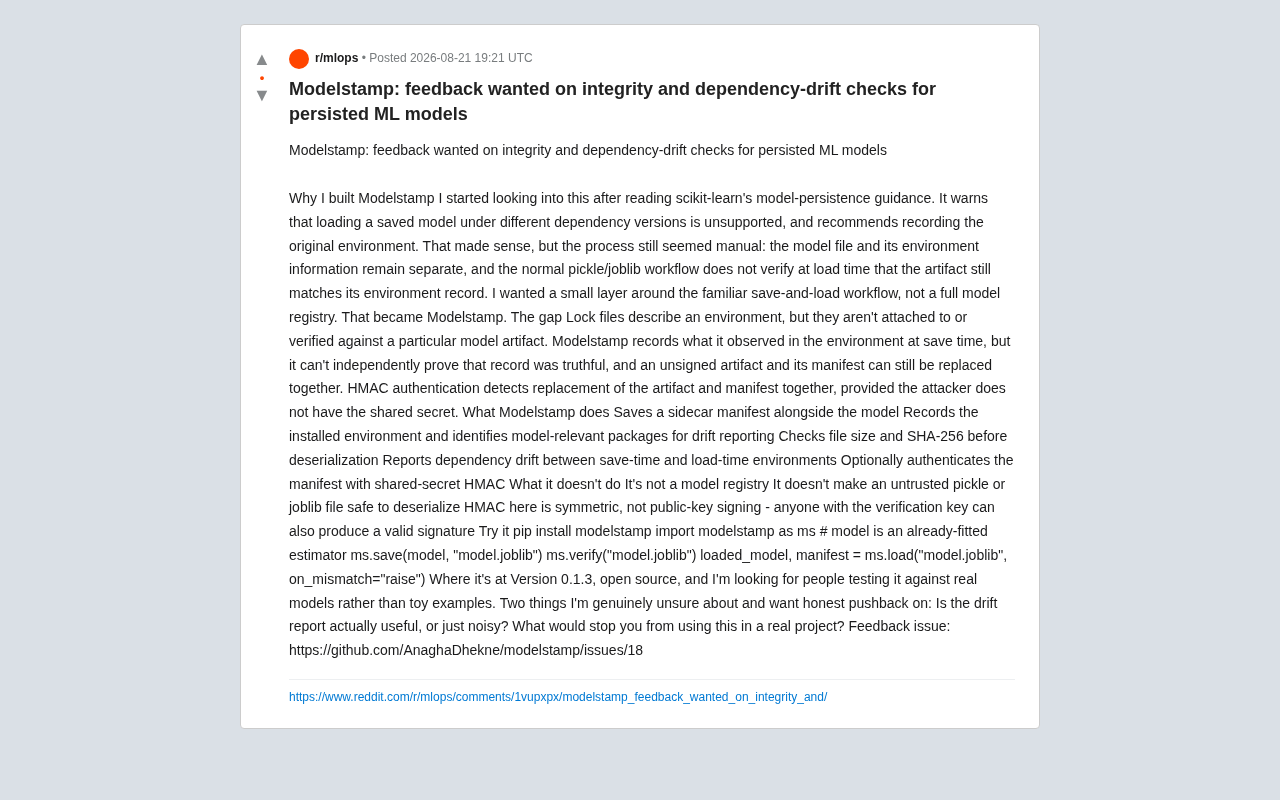
Modelstamp's Design Philosophy and Comparison with Existing Solutions
The author candidly explained their design motivation on Reddit: they didn't want a massive model registry, but rather a lightweight wrapper around the familiar "save-load" workflow.
Limitations of Existing Solutions
You might not have noticed, but the author has a remarkably clear understanding of the boundaries of existing toolchains:
- Lock files (such as
requirements.txt,poetry.lock) can describe an environment, but they aren't "attached" to a specific model artifact and cannot perform validation against a particular model. - Modelstamp records the "environment state observed at save time," but it cannot independently prove that this record itself is authentic.
- An unsigned artifact and its manifest file can still be replaced as a pair by an attacker.
To address the last point, Modelstamp introduces HMAC authentication based on a shared secret: as long as the attacker doesn't have the shared key, replacement of both the artifact and manifest can be detected.
The Fundamental Difference Between HMAC and Digital Signatures
It's worth understanding HMAC's security model in depth here. HMAC (Hash-based Message Authentication Code) is based on symmetric keys: both communicating parties share the same key, the sender uses it to generate a message authentication code, and the receiver uses the same key to verify it. Its security assumption is that "only legitimate parties know the key." Public-key digital signatures (such as RSA, EdDSA), on the other hand, are based on asymmetric key pairs: the private key signs, the public key verifies, and anyone holding the public key can only verify signatures but cannot forge them. In supply chain security scenarios, asymmetric signatures allow any third party to verify artifact provenance without sharing a secret—this is the core advantage of solutions like Sigstore and GPG. Modelstamp's choice of HMAC represents a trade-off between "lightweight" and "security strength"—it's suitable for integrity verification within a single team but not for trust propagation across organizations.
The Ecosystem Niche Difference Between Model Registries and Lightweight Tools
Mature solutions like MLflow Model Registry, Weights & Biases, and DVC provide comprehensive model version management, experiment tracking, lineage graphs, and deployment integration, but their adoption costs are correspondingly high—requiring backend storage setup, metadata database configuration, and team workflow adjustments. For ML teams of 5-20 people, or scenarios with limited model counts but diverse deployment environments, the ROI of these heavyweight solutions often doesn't add up. Modelstamp fills exactly the gap between "bare pickle files" and "full MLOps platforms": it requires no additional infrastructure, doesn't change existing serialization habits, and merely adds a layer of verifiable metadata at the file level.
Modelstamp Core Features in Detail
From a feature design perspective, Modelstamp takes a "less is more" approach, focusing on a few clearly defined core capabilities:
Five Core Capabilities
- Sidecar manifest: Saves a record file alongside the model file rather than intruding into the model itself.
- Environment snapshot and relevant package identification: Records the installed environment and identifies key dependency packages related to the model for subsequent drift reporting.
- Pre-deserialization integrity verification: Checks file size and SHA-256 hash before actually loading the model.
- Dependency drift reporting: Compares environmental differences between save time and load time, explicitly informing developers which dependencies have changed.
- Optional HMAC authentication: Authenticates the manifest via a shared secret.
SHA-256's Role in Integrity Verification
The SHA-256 used in the third capability is a cryptographic hash function from the SHA-2 family with a 256-bit output length, featuring collision resistance (the computational cost of finding two different inputs producing the same hash is extremely high) and preimage resistance (deriving the original input from a hash value is infeasible). In Modelstamp's context, SHA-256 ensures that the model file hasn't been accidentally modified or corrupted during transmission after saving. However, it's important to note that hashing alone doesn't provide source authentication—an attacker can replace a file and simultaneously update the hash value, which is precisely why Modelstamp additionally offers the HMAC option to bind the manifest to a key.
Minimalist Usage
The entire user experience is deliberately designed to stay close to the native workflow:
pip install modelstamp

import modelstamp as ms

# model is a trained estimator
ms.save(model, "model.joblib")
ms.verify("model.joblib")
loaded_model, manifest = ms.load("model.joblib", on_mismatch="raise")
With parameters like on_mismatch="raise", developers can decide whether to throw an exception or merely issue a warning when verification fails—this flexibility is quite friendly for production environment integration.
Modelstamp's Capability Boundaries: What It Explicitly Does NOT Do
The value of a mature tool often shows in its honesty about its own boundaries. The author specifically emphasized three "non-goals" of Modelstamp:
- It is not a model registry and does not take on heavyweight responsibilities like version management or model lineage tracking.
- It cannot make an untrusted pickle/joblib file safe to deserialize. This point is particularly important—pickle deserialization inherently carries arbitrary code execution risks, and Modelstamp's hash verification can only ensure "the file hasn't been modified," not that "the original file itself is safe."
- The HMAC here uses symmetric encryption, not public-key signatures. This means anyone holding the verification key can also generate valid signatures. This is fundamentally different from asymmetric digital signatures (like GPG) and requires extra caution in multi-party collaboration or supply chain scenarios.
This clear articulation of security boundaries actually enhances the tool's credibility—it doesn't overstate its capabilities.
Community Feedback and Key Questions to Be Validated
Modelstamp is currently at version 0.1.3, open-source and encouraging the community to test it on real models (not toy examples). The author raised two questions they "genuinely aren't sure about" and hope to receive honest criticism on:
- Is the dependency drift report actually useful, or is it just noise?
- What factors would prevent you from using this in a real project?
These two questions hit right at the heart of such tools. The value of drift reports depends heavily on the "signal-to-noise ratio"—if every minor environment change triggers a flood of warnings, developers will quickly learn to ignore them; but if it can precisely identify key dependency changes that truly affect model behavior, then it serves as a genuine guardrail.
The Real Impact of Dependency Drift on Model Behavior
Why is "dependency drift" not a theoretical problem but a real engineering risk? Libraries like scikit-learn frequently adjust default algorithm parameters, random number generation strategies, or internal data structures in minor version updates. For example, scikit-learn 0.22 renamed the default split criterion for decision trees from 'mse' to 'squared_error', and NumPy 1.19 changed the default random number generator (from MT19937 to PCG64). These seemingly minor changes can lead to: errors during deserialization due to mismatched attribute names, numerical drift in model inference results (especially amplified layer by layer in ensemble methods), or silent changes in preprocessing pipeline behavior. Even more insidious, some changes won't trigger exceptions but merely produce subtle deviations in predictions—these "silent errors" are extremely difficult to locate in production environments and often aren't discovered until business metrics show anomalies.
Why Lightweight MLOps Tools Like This Deserve Attention
As MLOps matures, the industry's attention has largely focused on the "big pieces"—training pipelines, feature stores, model serving. Meanwhile, the integrity and environment consistency of model artifacts themselves has become an easily overlooked weak link.
Modelstamp's approach—"adding a verification layer to familiar workflows with minimal intrusion"—represents a pragmatic engineering philosophy. It doesn't try to reshape the entire ecosystem but precisely patches a specific crack. For small and medium teams that haven't yet adopted a complete model registry system but worry about "models behaving incorrectly after environment changes," such lightweight tools may be exactly what they need.
Of course, whether it can move beyond the "lab" into real production ultimately depends on community testing feedback—especially the practicality of drift reports and strategies for handling the fundamental issue of pickle security. Interested developers are encouraged to contribute their firsthand experience on the feedback issue (#18) on GitHub.
Key Takeaways
Related articles

Chain of Thought Isn't Just for AI: How Humans Can Use CoT to Improve Thinking Quality
Chain of Thought isn't just a prompt trick for large models. Starting from a Hacker News discussion, this article analyzes why CoT works for human thinking too, breaks down actionable ways to transfer it, and highlights the key differences between human CoT and machine CoT.
Cloudflare Teams Up with OpenAI: Closi…
Cloudflare Teams Up with OpenAI: Closing the Loop from Vulnerability Discovery to Defense with AI
Cloudflare uses OpenAI Daybreak to investigate security vulnerabilities and generate reviewable remediation plans, while developers use Codex to boost coding efficiency and quality.

Orca Multi-Agent Orchestration in Practice: A Guide to Parallel Collaboration with Claude and Codex
Orca is Stable AI's free open-source agent workbench supporting 34 agents like Claude Code and Codex in parallel. Learn its Git worktree isolation, multi-model orchestration, and mobile management.