Modox AI Agent Update: HTML Flowcharts, Software Copyright Docs & One-Click Web App Generation

Modox AI agent gains HTML flowcharts, software copyright docs, and one-click web app generation in its latest update.
Modox, an academic AI agent developed by a Bilibili content creator, has rolled out four major upgrades driven by user feedback: HTML flowchart generation, software copyright document support, improved Word format stability, and one-click full web application generation — expanding from an academic writing tool into a general-purpose AI writing and development assistant.
The Continuous Evolution of an Academic AI Agent
In an era of ever-proliferating AI applications, Modox — an academic AI agent built by a Bilibili content creator — is iterating at a near-daily pace. Since launch, the developer has been flooded with user feedback that converges on one core request: make Modox capable of writing everything, not just math modeling papers and academic essays.

This push from vertical use cases toward general-purpose capability reflects a broader trend in AI writing tools: users are no longer satisfied with single-task assistance. They want an all-in-one writing assistant that covers multiple document types and output formats. This latest Modox update is a direct response to exactly that demand.
Four Core New Capabilities Explained
According to the developer, this update centers on two key directions: output diversity and format stability — delivering four major upgrades in the process.
HTML Flowchart Generation
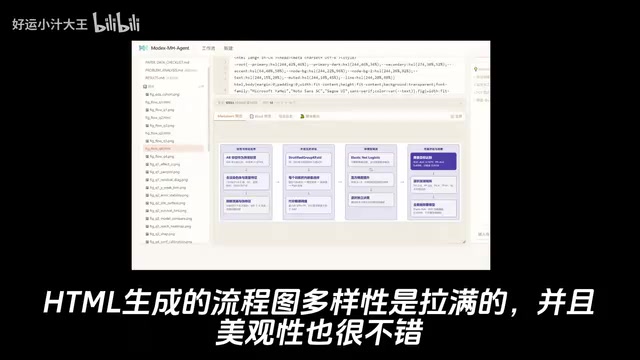
The first new feature is HTML-based flowchart generation. Unlike traditional desktop diagramming tools (such as Visio or Edraw), web-based flowcharts leverage SVG vector graphics, CSS animations, and JavaScript interactivity. Common implementation approaches include libraries like mermaid.js, D3.js, and jsPlumb — all of which can be embedded directly into web pages or documents with consistent cross-platform rendering.
For Modox, this capability marks a leap from "generating text" to "generating runnable visual outputs." Users no longer need to master any diagramming software — simply describe the logic of a process, and the agent produces a polished, well-structured flowchart, significantly lowering the barrier for presentations and documentation.
Software Copyright (软著) Document Support
The second update targets users who need to apply for software copyright registration in China. Managed by the China Copyright Protection Center, the application requires a standardized set of materials including source code excerpts (first 30 pages + last 30 pages), a software description document, and a user manual — all with strict formatting requirements and fixed templates.
For individual developers and students, this is a classic "high-repetition, low-creativity" task that is notoriously time-consuming. Software copyright certificates are also important credentials for science and technology competitions and corporate IP protection, making demand for this feature substantial. By adding support for this use case, Modox meaningfully extends AI assistance into the domain of professional certification documentation.

Significantly Improved Word Format Stability
The third update focuses on engineering reliability. The root cause of Word document formatting instability lies in the complexity of the underlying OOXML standard used by the .docx format — paragraph styles, nested tables, headers, and footers are all precisely described by XML nodes, making it easy for AI-generated output to suffer from style inheritance errors or missing nodes, resulting in broken layouts and lost formatting.
Common engineering solutions include using structured write operations via libraries like python-docx, or adopting template injection to avoid formatting reconstruction from scratch. Modox's targeted improvements in this area likely involve low-level changes to its output pipeline — the kind of invisible infrastructure optimization that users don't notice until the problems disappear. These unglamorous engineering fixes are often what determines whether a tool can be used reliably over the long term.
One-Click Web Application Generation
The fourth update is arguably the most ambitious: support for one-click project generation that produces a full-stack web application. This falls squarely within the AI-assisted low-code/no-code (LCNC) development space — closely aligned with the direction of products like Vercel v0, Bolt.new, and Lovable that have exploded in popularity recently. The core capability is translating natural language requirements into deployable frontend or full-stack code.
By integrating this into an academic and documentation tool ecosystem, Modox signals that it has built substantial code generation and project scaffolding capabilities under the hood. The product is evolving from a "writing assistant" toward an "intelligent development assistant," expanding its scope from "writing documents" to "writing code and shipping products."
User Feedback as the Engine: The Core Advantage of Small Teams
What's equally notable is the product iteration philosophy behind Modox. The developer openly acknowledges that nearly all of this update came directly from user feedback, and emphasizes: "Without you all, there would be no Modox as it exists today."
This user-feedback-driven approach is the classic path toward achieving Product-Market Fit (PMF) — a concept coined by venture capitalist Marc Andreessen to describe the state where a product precisely satisfies genuine market demand. For AI tools in particular, the ability to rapidly transfer large model capabilities to new use cases dramatically compresses the PMF validation cycle.
A small team's short decision chain means the loop of "receive feedback → assess priority → develop and ship" can be compressed to days or even hours. This is highly representative of the solo developer AI application space, with advantages across three key dimensions:
- Authentic demand signals: Feedback comes directly from real usage scenarios, avoiding feature bloat driven by internal assumptions;
- Extremely high iteration velocity: Short decision chains enable near-daily release cadences;
- Strong community cohesion: Users actively participate in shaping the product, creating genuine emotional connection and organic word-of-mouth.
That said, this model carries its own risks. As user requests expand from "write my thesis" to "write everything," the product's scope keeps growing — the developer himself jokingly acknowledges this could cause Modox to "super-evolve into an all-purpose writing agent." How to maintain output quality across all vertical use cases while continuing to expand horizontally will be the central challenge Modox must navigate going forward.
Small and Fast: A Growth Story for Solo-Developer AI Apps
This Modox update illustrates how an AI writing tool driven by a single developer can grow rapidly through high-frequency iteration and community co-creation. Starting from academic writing, it has progressively expanded into software copyright documents, HTML flowcharts, and now full web application generation — exploring a viable path of "vertical entry, horizontal expansion."
This trajectory closely mirrors the current trend in Agent engineering: deep focus on a specific vertical builds engineering capability and user trust, while generalization extends naturally from that foundation rather than starting from scratch.
For observers tracking real-world AI application development, Modox is a case worth following closely. It reflects both users' strong appetite for general-purpose AI writing capability and offers a broader lesson: in an era where large model capabilities are increasingly commoditized, a product's true differentiation may no longer rest solely on the underlying model — but more on how deeply it serves specific use cases and how quickly it responds to user feedback.
Related articles
Insufficient Source Material: A Tweet With No Substantive Content
A single tweet reading 'Available until the goblins notice.' with two unexpanded links provides no substantive content to write an article from.
Google Jules AI Coding Assistant: A Quick Look at an Open-Source Practice Repo
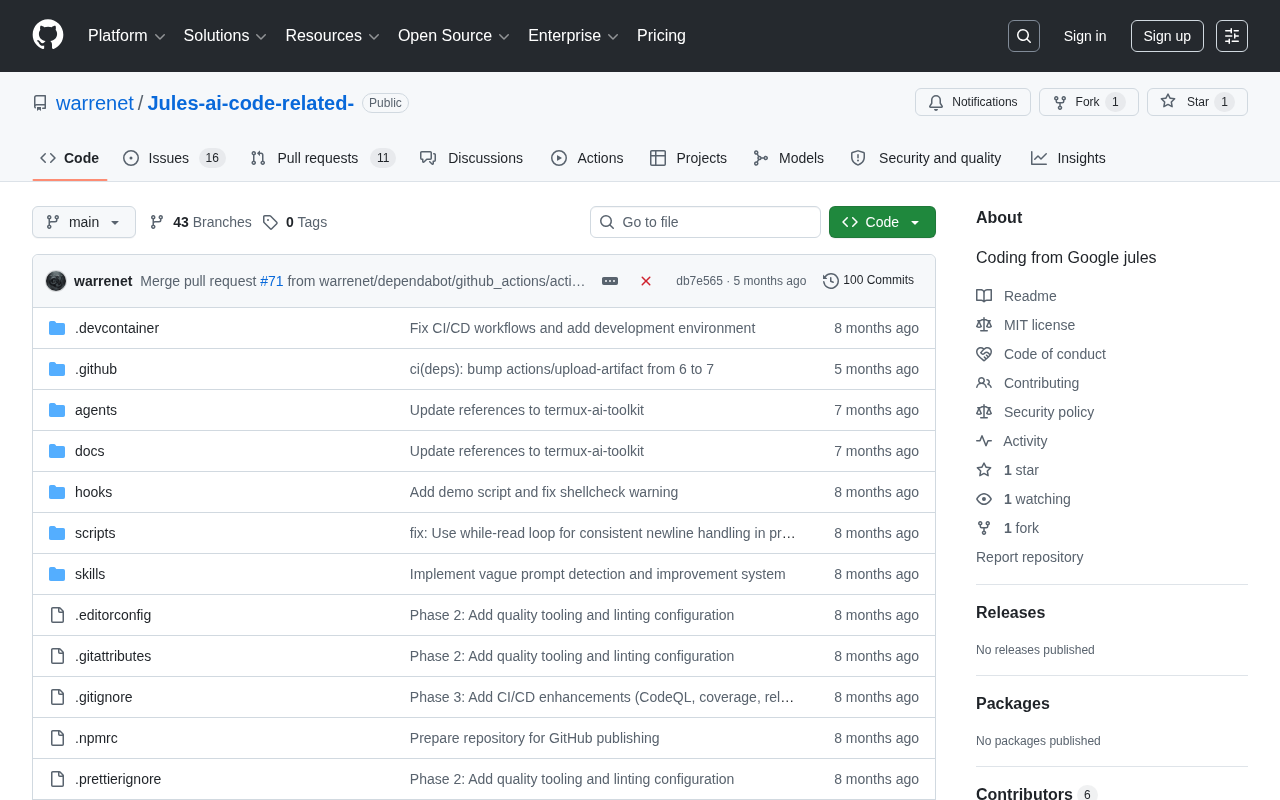
A look at a small GitHub repo centered on Google Jules, an autonomous AI coding agent. Explores what Jules does, the repo's practical value, and how to evaluate early-stage AI tool projects.
GitHub Project Overview: prateek0221/jules — Critically Lacking Information
The GitHub repo prateek0221/jules has only 1 star, no code, and no README. We review available info and provide background on Google's Jules AI coding agent.