Modular Boarding Concept: Could Aviation Ever Adopt 'Container-Style' Cabins?

A viral Reddit joke about modular aircraft cabins sparked a surprisingly rigorous engineering debate.
A Reddit post pitching a modular "container cabin" concept triggered a surprisingly substantive aviation engineering discussion. The central question: if modular cabins saved 20 minutes per boarding cycle across 6 daily segments, could that translate to ~18% more flights per aircraft per day? Commenters unpacked the trade-offs: the bottleneck may lie in seating itself, not the jet bridge; safety certification and weight-and-balance requirements make true hot-swap modularity impractical; and airports would face steep infrastructure costs. The industry's real answer — lifecycle passenger-to-freighter conversion — balances feasibility, safety, and economics far better than any hot-swap scheme. The thread is a reminder that radical efficiency ideas must survive scrutiny across weight, cost, safety, and infrastructure before they're viable.
A Serious Discussion Behind an Absurd Headline
A Reddit post that sparked widespread debate proposed what seemed like a ridiculous idea under a provocative title: what if an aircraft's cabin could be loaded and unloaded like a shipping container — passengers take their seats in advance, and the entire cabin module is then slid into the fuselage? Beneath the absurdist framing, this actually touches on a genuine, long-discussed challenge in commercial aviation: boarding efficiency and aircraft utilization.
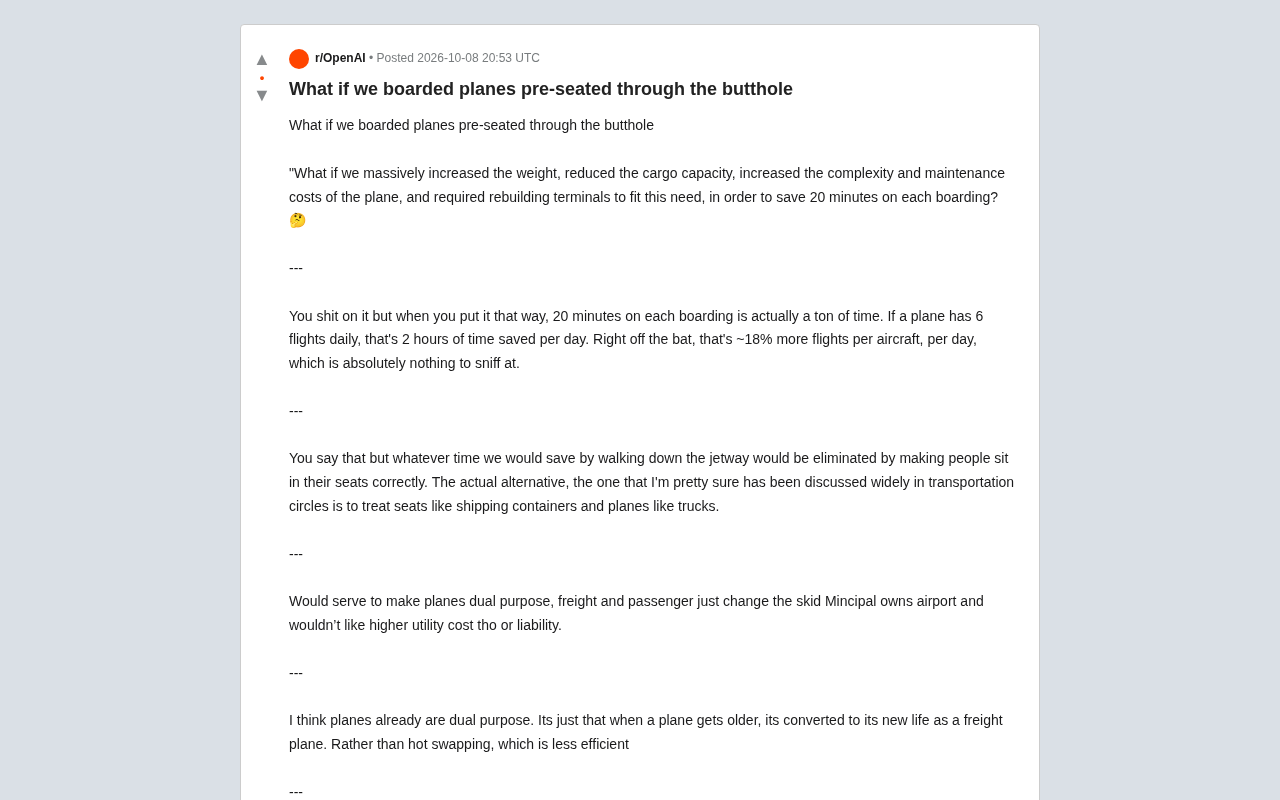
The discussion kicked off with a sharp counterpoint: is saving 20 minutes per boarding cycle really worth the trade-offs — significantly increased aircraft weight, reduced cargo hold capacity, greater mechanical complexity, higher maintenance costs, and the need to rebuild terminals? This chain of objections put the real costs of modular cabins squarely on the table.
Is 20 Minutes Actually Worth It?
Interestingly, it was precisely this pushback that produced one of the most valuable estimates in the thread. One commenter fired back: don't underestimate those 20 minutes.
If an aircraft operates 6 flight segments per day, time saved during boarding alone could add up to roughly 2 hours. By that logic, each aircraft could effectively handle about 18% more daily flights. For airlines, aircraft are the most expensive fixed assets in the operation — improving single-aircraft daily utilization means expanding capacity without growing the fleet. That's a very compelling number.
From an asset-turnover perspective, the argument holds up. Aviation's profit model depends heavily on "time in the air"; every minute on the ground is a cost. So even a theoretical efficiency gain is enough to make industry insiders take the idea seriously.
Aircraft Utilization is one of the core operational metrics for airlines, typically measured by flight hours or segments flown per aircraft per day. Narrowbody jets (such as the Boeing 737 and Airbus A320 family) average around 10–13 block hours per day in high-frequency short-haul markets, with low-cost carriers (LCCs) pushing that figure to the limit. Turn-around Time (TAT) — encompassing deplaning, cleaning, refueling, and boarding — is the most direct variable affecting utilization. LCCs typically target a TAT of 25–35 minutes, while legacy carriers run longer. This is precisely why shaving even a minute off the boarding process can generate meaningful capacity gains at scale, and why methods like reverse boarding and the WILMA boarding sequence have received sustained research attention.
The Time Saved Might Be Eaten Up by Re-seating
That said, another voice in the thread pointed out a hidden offset effect. One commenter noted that even if time spent shuffling down the jet bridge is saved, those gains could easily be canceled out by "getting passengers properly seated inside the module." In other words, the bottleneck may not be walking from the gate into the cabin — it's the act of sitting down, stowing luggage, and buckling up.
If modular boarding simply replaces "queuing in the aisle" with "queuing inside the module," the net system-level benefit shrinks considerably. This was an effective correction to the earlier optimism — efficiency gains can't be measured by swapping one step for another; what matters is whether total elapsed time actually decreases.
Treating Cabins Like Containers, Planes Like Trucks
The thread's most grounded idea, in terms of industry relevance, was the "containerization" concept: treating seat modules like standardized shipping containers and the aircraft fuselage as the truck that carries them. This kind of thinking has genuine precedent in transportation.
The extended value proposition is convertibility between passenger and cargo operations: swap out the skid, and the same fuselage can flip between carrying people and carrying freight. In theory, this maximizes the utilization of the airframe as an asset.
But practical constraints surface immediately. Commenters noted that airport operators would be unlikely to welcome the associated rise in infrastructure costs and liability exposure. More critically, such a design would likely fail to meet safety certification requirements — modern aircraft rely on cargo hold space for weight-and-balance management, emergency equipment storage, and revenue cargo. A fully modular design would disrupt the existing structural and safety architecture.
Modular cabins are not entirely new to aviation. Airbus has offered Convertible Freighter configurations allowing widebodies like the A330 to switch between passenger and pure-cargo layouts. More recently, Quick Change (QC) aircraft — where seats are mounted on standardized pallets and can be swapped between configurations in a matter of hours — have attracted attention for "dual-shift" operations: passengers by day, cargo by night. During the COVID-19 pandemic, several airlines temporarily removed cabin seats to carry cargo, prompting renewed industry interest in cabin flexibility. However, even these solutions take hours to execute, and the gap between them and true hot-swap modularity remains vast. The core barriers are structural certification and emergency exit requirements — not engineering ingenuity.
Why Aviation Favors Gradual Conversion Over Hot-Swapping
One overlooked but practical observation in the thread: aircraft are already "dual-use" assets — just not in real time.
The industry's actual approach is lifecycle conversion rather than hot-swappable modularity — when a passenger jet ages out of passenger service, it gets converted into a freighter for a "second life." This gradual transition isn't as flashy as modular hot-swapping, but it strikes a balance between engineering feasibility, safety redundancy, and economics.
This illustrates a fundamental engineering truth: seemingly "more efficient" radical solutions are often undermined by the real-world costs of added weight, maintenance burden, safety requirements, and ground infrastructure. The thread's closing quip — "why not just move the tail fin to the middle of the plane like a shark fin because it looks cooler" — captures the core point with irony: intuition-driven "optimization" that ignores system constraints tends to produce ideas that look good on paper and fall apart in practice.
Passenger-to-Freighter (P2F) conversion is a mature commercial pathway, with dedicated programs available for the Boeing 737, 747, Airbus A321, and other types. Conversion typically involves reinforcing the floor structure, installing a cargo door, stripping the passenger interior, upgrading the cargo loading system, and re-obtaining an airworthiness certificate. The process takes months and costs millions of dollars — but for an airframe 15–20 years old with solid remaining service life, the economics often make sense. The reason this "one-time conversion" model prevails over frequent hot-swapping comes down to the stringent nature of aviation airworthiness certification: every structural modification requires regulatory approval, not just an engineer's sign-off. This institutional reality structurally favors the incremental path.
Conclusion: Engineering Thinking Inside an Internet Joke
The value of this thread isn't in its clickbait headline — it's that the comment section spontaneously produced a remarkably competent feasibility analysis: covering utilization gains, bottleneck identification, passenger-cargo convertibility, safety standards, and infrastructure costs. It was, in miniature, an engineering review. And it serves as a reminder that any "disruptive" efficiency concept must ultimately pass through the gauntlet of weight, cost, safety, and infrastructure constraints before it's worth taking seriously.
Related articles

Chain of Thought Isn't Just for AI: How Humans Can Use CoT to Improve Thinking Quality
Chain of Thought isn't just a prompt trick for large models. Starting from a Hacker News discussion, this article analyzes why CoT works for human thinking too, breaks down actionable ways to transfer it, and highlights the key differences between human CoT and machine CoT.
Cloudflare Teams Up with OpenAI: Closi…
Cloudflare Teams Up with OpenAI: Closing the Loop from Vulnerability Discovery to Defense with AI
Cloudflare uses OpenAI Daybreak to investigate security vulnerabilities and generate reviewable remediation plans, while developers use Codex to boost coding efficiency and quality.

Orca Multi-Agent Orchestration in Practice: A Guide to Parallel Collaboration with Claude and Codex
Orca is Stable AI's free open-source agent workbench supporting 34 agents like Claude Code and Codex in parallel. Learn its Git worktree isolation, multi-model orchestration, and mobile management.