Modulate Raises $25M: How Voice AI Is Fighting Back Against Deepfakes and Fraud

Modulate raises $25M to expand voice AI from interaction tool to deepfake detection and anti-fraud security infrastructure.
Voice AI company Modulate has closed a $25 million funding round, with proceeds focused on speech recognition, content analysis, and security applications. Against a backdrop of rapidly lowering barriers to voice cloning, the company is pivoting from voice generation toward deepfake detection and real-time fraud alerting — aiming to use AI to counter AI abuse where traditional voiceprint authentication falls short. Technical capabilities built in gaming and social contexts now position Modulate to serve identity-sensitive industries like finance, customer service, and government. The case reflects a broader transformation logic in voice AI: single-function voice processing can no longer build a defensible moat, and only by addressing security and compliance needs can companies generate lasting commercial value.
Modulate Closes $25M Funding Round
Voice AI company Modulate has announced the closing of a $25 million funding round to advance its voice models and analytics suite. The capital will be directed primarily toward speech recognition, content analysis, and security — marking a broader shift in voice AI from a purely interactive tool toward security infrastructure.
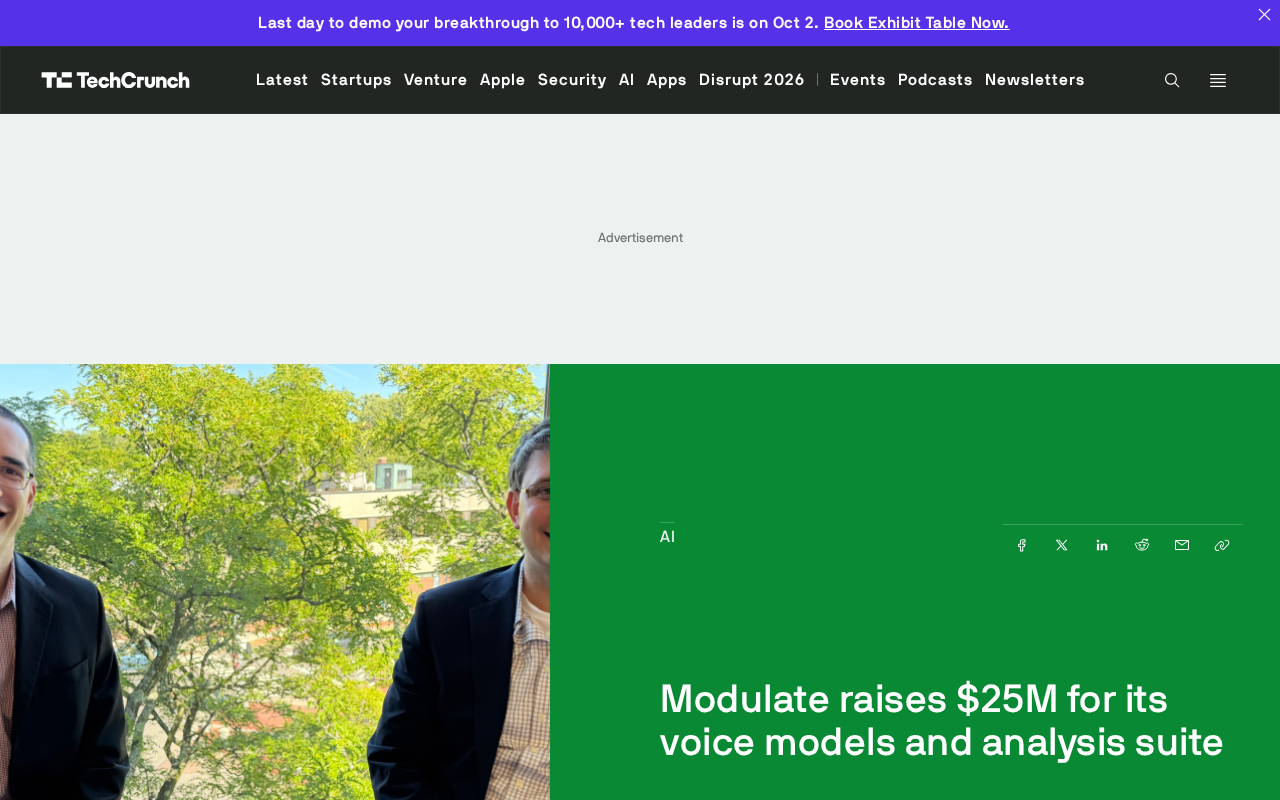
As generative AI becomes mainstream, the barrier to voice synthesis has dropped dramatically, bringing with it a sharp rise in deepfake and voice fraud risks. The core thesis behind Modulate's latest raise centers on this security pain point: using AI to fight AI abuse.
Fighting Back Against Deepfakes and Voice Fraud
According to public disclosures, Modulate is deploying its models to detect deepfakes, fraud, and scam activity. This means the company's technical direction is no longer limited to voice generation or enhancement — it now extends to verifying voice authenticity and identifying risk.
Why Voice Fraud Is Taking Center Stage
The maturation of voice cloning technology has enabled bad actors to impersonate others at minimal cost, enabling phone scams, identity theft, and financial fraud. Traditional voiceprint recognition often falls short against high-quality synthetic audio, and Modulate is aiming to close that gap with more advanced voice models.
The value of its analytics suite lies not only in determining whether a given audio clip is synthetically generated, but also in analyzing anomalous patterns during live calls in real time — flagging potential fraud before it happens. This "AI versus AI" approach is quickly becoming the dominant strategy in voice security.
The underlying technology is worth understanding: modern voice synthesis models — such as Transformer- or diffusion-based TTS systems — can generate highly convincing voice imitations from just a few seconds to a few minutes of target audio. Since 2023, publicly available tools like ElevenLabs and Vall-E have brought this capability out of research labs and into the hands of everyday users. Real-time voice conversion goes even further, allowing fraudsters to transform their voice into a target's voice mid-call, rendering traditional voiceprint-based identity authentication nearly obsolete. According to the U.S. Federal Trade Commission (FTC), voice fraud losses exceeded billions of dollars in 2023, with AI voice cloning listed as one of the fastest-growing scam vectors.
From Interactive Tool to Security Infrastructure
Modulate previously built its technical capabilities through voice-related products in gaming and social contexts. Expanding into anti-fraud and content moderation following this raise reflects a transformation logic common across voice AI companies: a single voice processing function is no longer enough to build a defensible moat. Only by entering high-stakes domains like security and compliance can companies generate sustainable commercial value.
Modulate's original flagship product was ToxMod, a real-time voice modulation tool built for game streaming that allowed users to communicate online while protecting their privacy, with built-in toxicity detection for in-game voice chat. This foundation gave the company a distinct technical edge in live voice stream processing and real-time analysis. The product trajectory — from voice enhancement to toxicity moderation to deepfake detection — exemplifies how voice AI companies expand application scenarios to increase technology reuse. It also demonstrates that gaming and social platforms are natural proving grounds for voice security technology: high concurrency, strong anonymity, and dense adversarial content closely mirror the technical demands of fraud detection.
The Opportunity in Voice AI Security
As regulators pay increasing attention to deepfake content, enterprise demand for voice authenticity verification is growing rapidly. Finance, customer service, and government — all sectors sensitive to identity verification — represent strong potential markets for voice security technology.
A $25 million raise isn't enormous by AI standards, but for a company focused on the vertical of voice security, it's more than sufficient to sustain technology iteration and market expansion. Modulate's move also signals broader investor confidence in the "AI security" subcategory.
For practitioners tracking applied AI, Modulate's case sends a clear signal: the risks created by generative AI are themselves breeding new commercial opportunities. As synthetic voice becomes widely accessible, the ability to distinguish real from fake — and to keep people safe — becomes all the more valuable.
Related articles

Workbuddy for Absolute Beginners: How a Desktop AI Agent Fits Into Real Workflows
A beginner's guide to the Workbuddy desktop AI agent: installation, claiming credits, file management, and building automated workflows—compared with CodeX for fit and cost, helping professionals shift from AI question-askers to AI managers.

OpenAI's New Agent Stack: Computer Use, Decisions API, and Ultra-Fast Workflows
OpenAI Dev Day unveiled a new agent stack: Computer Use outperforms humans, Decisions API delivers ultra-low-latency classification via Luna, Agents API opens the same Computer Use capabilities, and GPT-6.1 Sol costs only one-seventh of Astra. Core updates, benchmark data, and developer insights.

Liang Wenfeng Open-Sources DeepInfo Inference Framework, Takes On U.S. Ban
DeepSeek open-sources its DeepInfo inference framework after its models, featuring GPU/CPU cross-pipelining, small-model prediction with large-model verification, and full Huawei Ascend and NVIDIA chip support—facing the U.S. federal ban head-on. This article analyzes its significance for AI deployment and open-source strategy.