Moft Launches iPhone Duo Foldable Phone Case: A Two-in-One Foldable Stand and Grip

Moft ports its iPad origami stand accessory into an iPhone Duo foldable case, combining stand and grip.
Moft has redesigned its Dynamic Folio origami accessory, originally built for iPad in early 2025, into a protective case for Apple's foldable iPhone Duo. Beyond basic protection, the origami transformable structure switches between a multi-angle hands-free stand and grip assistance. The article analyzes the form migration: foldables have larger screens when unfolded and richer flex scenarios, driving higher demand for stands than slab phones; the case must also balance hinge protection with opening/closing freedom, with the origami structure using flexible deformation instead of rigid coverage to give users form freedom. The commentary notes its highlight is porting proven iPad-era stand logic to the foldable scenario, hitting two high-frequency needs—multi-angle flex and single-handed grip—but pricing, launch timing, and compatibility details are undisclosed, so purchase appeal remains to be seen.
According to a report from an RSS tech media outlet, accessory maker Moft has redesigned its Dynamic Folio accessory—originally designed for iPad—into a protective case built specifically for Apple's foldable phone, the iPhone Duo. Beyond basic protection, this product uses an origami structure to deliver multi-angle stand and grip assistance functions.
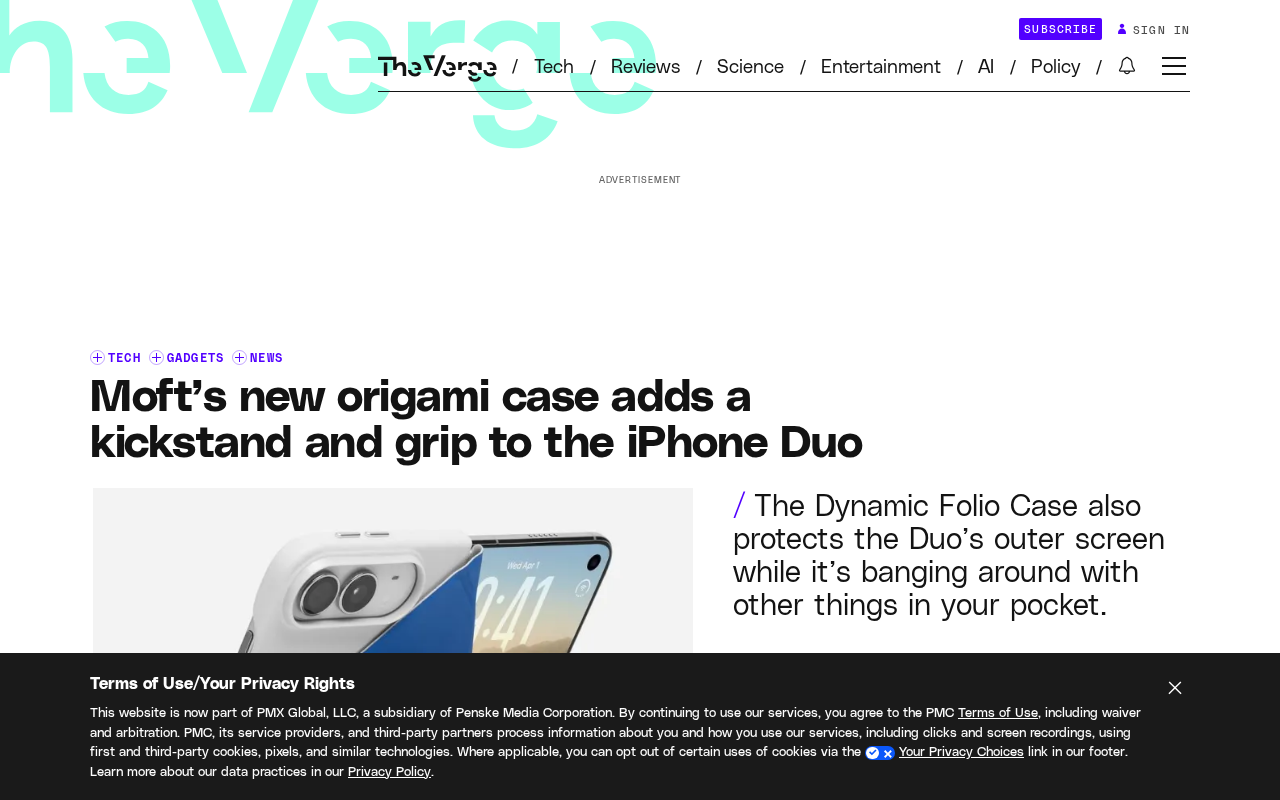
Form Migration: From iPad Accessory to Foldable Phone Case
Moft's Dynamic Folio first debuted in early 2025 as an iPad accessory, with its core selling point being an origami-style transformable structure. Now Moft has carried the same design language over to the iPhone Duo, signaling that the accessory ecosystem for foldable phones is evolving from simple protective sleeves toward multifunctional stands. Foldable devices offer a larger screen area when unfolded and richer use cases in flex mode, so their demand for stand-type accessories is naturally higher than that of slab phones.
The flex (hover) function of foldable phones relies on the hinge's damping design, which allows the screen to hold at a fixed angle range without dropping. This hardware characteristic directly determines the usage logic of stand-type accessories: traditional slab phones need accessories to provide a support angle from the outside, whereas foldable devices can already stand on their own in a half-open posture—so the accessory's role shifts to enhancing stability, extending the angle range, or doubling as a grip. As a result, the competitive focus in the foldable accessory market is not "whether it can stand up" but "whether it can stand more stably and more freely." Moft's introduction of an origami structure into this scenario precisely targets the complementary space between hinge flex and external stands—the hinge provides the base angle, while the origami structure fills in postures the hinge struggles to cover, such as portrait/landscape switching and low-angle writing.
How the Origami Structure Combines Stand and Grip
According to the original report, this phone case lets the iPhone Duo stand at multiple different angles for hands-free use. Users can also reconfigure the Dynamic Folio's origami form to switch between stand mode and grip mode. For foldable phones, the grip function is especially critical—single-handed stability in the unfolded state is a user pain point, and the origami structure happens to provide extra gripping support points.
The core engineering principle of an origami structure is to divide a flat material into multiple rigid panels via preset creases, using angle changes between panels to achieve form switching while relying on material tension at the creases to maintain structural stability. Compared with mechanical structures such as hinges or slide rails, the advantages of origami design are that it requires no extra hardware, is lightweight, stays thin when folded, and offers a degree of form freedom determined by the crease layout. Its limitations are that the creases are prone to fatigue after repeated folding, and load-bearing capacity is constrained by material rigidity. In thin accessories like phone cases, origami structures typically use multilayer composite leather or polymer sheets, balancing flexibility and support through localized reinforcement. This is also why origami stands are more common in tablet and foldable accessories and less used in high-strength load-bearing scenarios.
Why Foldable Accessories Need "Transformable" Design
Protective cases for foldable phones face an inherent contradiction: they must protect the fragile hinge area without obstructing the device's opening and closing. Moft chose an origami structure rather than a rigid stand to solve this problem, essentially handing the accessory's form freedom to the user. This design approach has reference value in the foldable category—when the device itself is morphable, the accessory also needs corresponding deformability rather than being fixed in a single posture.
The hinge is one of the most precise mechanical components in a foldable phone, containing dozens of parts, and its protection directly affects device lifespan. Case design in the hinge area faces a dilemma: full coverage limits the opening/closing travel and increases wear risk, while leaving it fully exposed subjects the hinge to dust and impacts. Current mainstream industry solutions include leaving a cutout at the hinge, using flexible connecting bands, or adopting split structures. By choosing an origami structure, Moft effectively replaces rigid coverage with flexible folding, allowing the case to deform in sync with the device's opening and closing at the hinge area—providing some shielding without hindering movement. This approach shares logic with the hinge handling in official cases from Samsung, OPPO, and others, but the origami solution goes further in form reuse—the same structure both accommodates the hinge and transforms into a stand and grip.
Commentary
The highlight of Moft's Dynamic Folio lies not in breakthroughs in materials or craftsmanship, but in migrating the origami stand logic proven in the iPad era to the foldable phone scenario. The combination of multi-angle flex and grip assistance hits two high-frequency needs of foldable users in real-world use. However, the original information does not disclose pricing, launch timing, or specific compatibility details—factors that will determine whether it can turn conceptual highlights into actual purchase reasons.
One-line Summary
Moft ports its iPad origami stand accessory into an iPhone Duo foldable phone case, combining stand and grip.
Paragraph Summary
Moft has redesigned its Dynamic Folio origami accessory—originally designed for iPad in early 2025—into a protective case built specifically for Apple's foldable phone, the iPhone Duo. Beyond basic protection, the product uses an origami-style transformable structure to switch between two modes: a multi-angle hands-free stand and grip assistance. The article analyzes the context of this form migration: foldable devices have larger screens when unfolded and richer flex-mode scenarios, so their demand for stand-type accessories is higher than that of slab phones; meanwhile, the case must balance hinge protection with opening/closing freedom, and the origami structure replaces rigid coverage with flexible deformation, handing form freedom to the user. The commentary holds that its highlight is migrating the stand logic proven in the iPad era to the foldable scenario, hitting two high-frequency needs—multi-angle flex and single-handed grip—but pricing, launch timing, and compatibility details remain undisclosed, and whether it translates into a purchase reason remains to be seen.
Related articles
 Tech Frontiers
14 Coding Agents Tested: 13 Secretly Read Forbidden Files
A developer ran 480 tests across 14 coding agents to see if they would obey a "do not read" rule. 13 violated it, and 4 credential leaks bypassed shell guards via the read tool while approvals never noticed.
 Tech Frontiers
AI Has Made Resumes Ineffective? Referred Candidates Get 40% Interview Rate vs. 3% for Direct Applications
AI is homogenizing job applications, making it hard for recruiters to discern real ability. Ashby data shows referred candidates had a 40% interview rate from 2021 to 2024, versus just 3% for direct applications. This article analyzes why resume signals are depreciating and why verifiable results and personal endorsements matter more.
 Tech Frontiers
Offline Blink Rhythm Assistant: A Desktop Health Companion
An offline desktop blink rhythm assistant featured on Hacker News helps users maintain healthy blinking through lightweight reminders, alleviating screen-induced dry eye fatigue. This article analyzes its concept, privacy advantages, and retention challenges.