Mol-JEPA: A Multimodal Foundation Model Bringing JEPA Architecture to Molecular Science
Mol-JEPA brings JEPA's representation-space prediction to molecular science via multimodal fusion.
Mol-JEPA is a multimodal foundation model that applies the Joint Embedding Predictive Architecture (JEPA) to molecular science. By fusing SMILES strings, molecular graphs, 3D conformations, and physicochemical descriptors, it learns universal molecular representations in abstract embedding space rather than reconstructing raw data. This paradigm shift from detail reconstruction to semantic prediction shows promise for drug discovery and molecular property prediction, though the model remains an early-stage exploration awaiting broader benchmark validation.
Introduction: A New Approach to Molecular Representation Learning
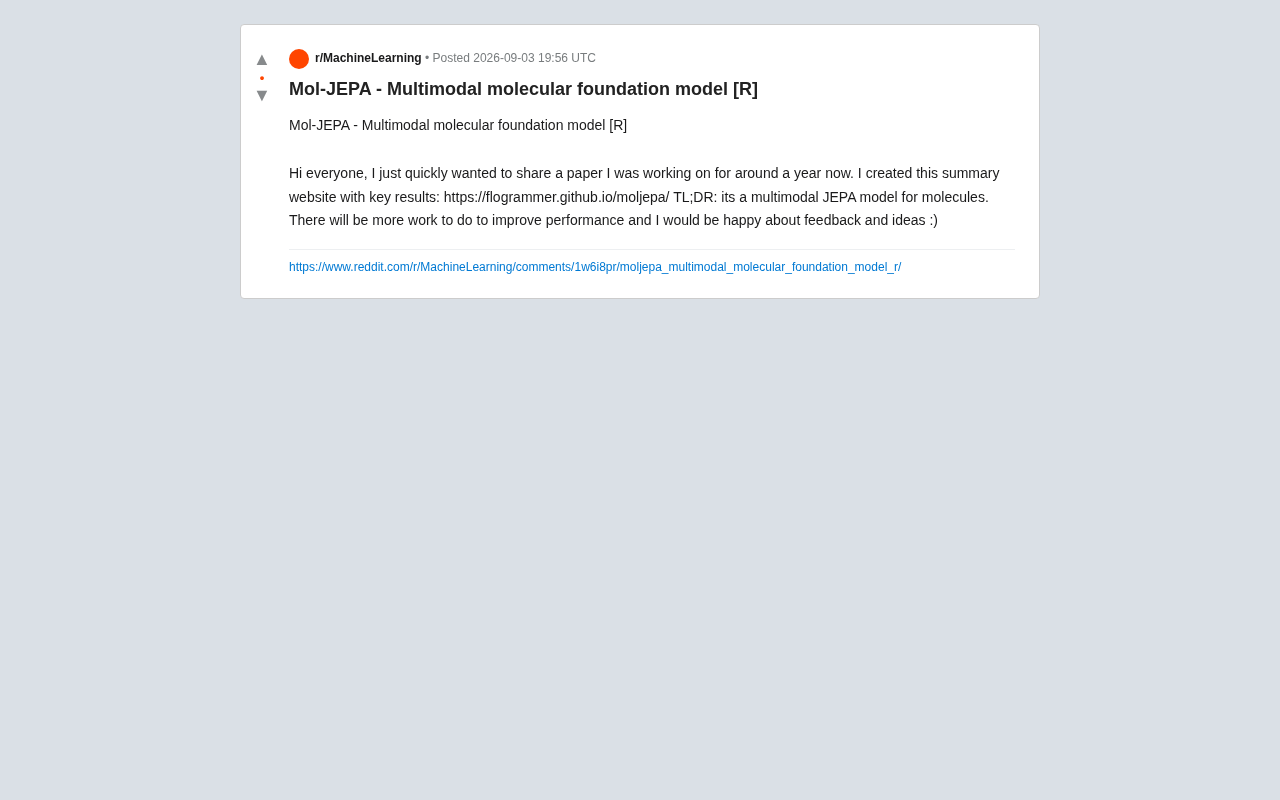
Recently, a researcher shared a project in Reddit's machine learning community that took roughly a year to complete — Mol-JEPA. This is a multimodal JEPA (Joint Embedding Predictive Architecture) foundation model designed for the molecular domain. The author released the work with a humble attitude, accompanied by a summary website showcasing the core results, while candidly acknowledging that "there's still a lot of room for improving performance" and welcoming community feedback and ideas.
This work deserves attention not only because it introduces the JEPA architecture into the relatively novel application domain of molecular science, but also because it takes a "multimodal" approach to understanding and representing molecules — opening new avenues of exploration for AI applications in drug discovery, materials science, and beyond.
Core Principles of the JEPA Architecture
A Paradigm Shift from Generative to Predictive
JEPA (Joint Embedding Predictive Architecture) is a self-supervised learning paradigm championed by Yann LeCun and colleagues. Unlike traditional generative models (such as autoregressive language models or diffusion models), JEPA does not attempt to reconstruct original data at the pixel or token level. Instead, it makes predictions in an abstract representation space.
Specifically, JEPA encodes one part of the input data, then predicts the representation of another part in the embedding space, rather than directly reconstructing its raw form. The core advantage of this approach is that it avoids wasting modeling capacity on irrelevant details, thereby learning more semantic and generalizable representations.
Notably, JEPA was not proposed as an isolated technical solution but is a core component of the "world model" vision systematically articulated by Yann LeCun in his 2022 paper A Path Towards Autonomous Machine Intelligence. LeCun argues that current mainstream generative AI (including large language models) essentially performs pattern matching at the token level and lacks genuine understanding of the world. His proposed alternative is to have models learn to predict in abstract representation spaces, thereby constructing internal representations similar to human mental models. Early success stories of JEPA include I-JEPA (for images) and V-JEPA (for video) developed by the Meta AI team, which demonstrated that prediction in representation space can indeed learn features with greater semantic value than pixel-level reconstruction. It is precisely these successes in the visual domain that provided the confidence and methodological foundation for extending JEPA to molecular science and other modalities.
Why JEPA Is a Natural Fit for Molecular Modeling
Applying JEPA to the molecular domain has inherent merit. Molecular data is highly structured and informationally redundant — many local features of a molecule can be inferred from its overall structure. Compared to generative approaches that forcefully reconstruct every atom or chemical bond, predicting partial molecular structures in representation space better aligns with chemical intuition and is more conducive to capturing functional molecular features.
To understand Mol-JEPA's innovations, it helps to review the evolution of self-supervised learning in the molecular domain. Early methods were primarily based on contrastive learning — for example, MolCLR constructs positive and negative sample pairs by applying different data augmentations to molecular graphs. Subsequently, masked pretraining strategies emerged, with Grover and GraphMAE as typical examples, which learn molecular representations by masking parts of atoms or chemical bonds and requiring the model to reconstruct them. However, these methods commonly face a problem: pixel-level or node-level reconstruction objectives force the model to invest substantial modeling capacity in low-level details like atom types and bond angles, which offer limited benefit for downstream tasks such as drug activity prediction. The JEPA framework circumvents this problem by predicting in abstract space — this is precisely Mol-JEPA's theoretical starting point, representing a paradigm leap in molecular self-supervised learning from "reconstructing details" to "predicting semantics."
Mol-JEPA's Multimodal Fusion Design
The Complementary Value of Multimodal Molecular Representations
Mol-JEPA's most prominent feature is its "multimodal" nature. In molecular science, the same molecule can be represented in multiple ways:
-
SMILES strings: Represent molecules as text sequences for computational processing. SMILES (Simplified Molecular Input Line Entry System) is a linear molecular notation proposed by David Weininger in 1988 that encodes a molecule's 2D topological structure as an ASCII string. For example, ethanol is represented as "CCO" and benzene as "c1ccccc1". The advantage of SMILES lies in its compactness and efficiency, allowing direct input into NLP models, which gave rise to Transformer-based molecular language models such as ChemBERTa and MolBERT. However, SMILES has inherent limitations: the same molecule can have multiple valid SMILES representations (i.e., non-canonicality), and the string format cannot directly encode three-dimensional spatial information.
-
Molecular graphs: Graph structures with atoms as nodes and chemical bonds as edges, reflecting topological relationships. The primary tools for processing such data are Graph Neural Networks (GNNs), whose core idea is to use message-passing mechanisms where each node iteratively aggregates information from neighboring nodes to update its own representation. Widely used GNN variants in the molecular domain include SchNet and DimeNet (focusing on 3D geometric information) as well as AttentiveFP and D-MPNN (focusing on topological information). GNNs are naturally suited for encoding local chemical environments but face challenges like over-smoothing when capturing long-range interactions.
-
3D conformations: The geometric configuration of molecules in space, containing stereochemical information. A molecule's 3D conformation refers to the specific coordinate arrangement of atoms in three-dimensional space, which is crucial for biological activity — drug molecules must achieve complementary matching with the binding pocket of target proteins in 3D space. However, the same molecule may have multiple low-energy conformations (conformational isomers), and the conformational space grows exponentially with molecular size. Obtaining 3D conformations typically relies on quantum mechanical calculations (such as DFT — Density Functional Theory) or molecular dynamics simulations, with computational costs far exceeding those of generating 2D graphs or SMILES. This means 3D data is typically much smaller in scale than 2D data, and how to effectively fuse multimodal information under data imbalance conditions is a practical engineering challenge for models like Mol-JEPA.
-
Physicochemical property descriptors: Various attribute data obtained through computation or experiments.
Each modality characterizes molecular properties from a different perspective. A single modality often struggles to fully express all of a molecule's information, while multimodal fusion enables the model to comprehensively leverage these complementary viewpoints, yielding more complete and robust molecular representations. This is the fundamental reason Mol-JEPA chose the multimodal route — within JEPA's representation-space prediction framework, information from different modalities can naturally align and complement each other at the abstract semantic level, avoiding the awkwardness of rigidly concatenating data in different formats at the raw data level.
Positioning as a Molecular Foundation Model
The author positions Mol-JEPA as a "foundation model," meaning it aims to learn universal molecular representations through large-scale self-supervised pretraining and then transfer to various downstream tasks — such as molecular property prediction, drug-target interaction prediction, molecular generation, and more. This "pretrain once, reuse everywhere" paradigm is the extension of the current mainstream AI approach into molecular science.
The Foundation Model concept was formally introduced by Stanford's HAI Institute in 2021, referring to large models pretrained on massive datasets that can be adapted to multiple downstream tasks. The migration of this paradigm from NLP (GPT series, BERT) and computer vision (CLIP, SAM) to scientific domains is accelerating. In molecular and materials science, representative works include Meta's ESM series (protein language models), Google DeepMind's GNoME (inorganic materials discovery), and Microsoft's MoLFormer, among others. The common logic behind these models is: leveraging vast amounts of unlabeled molecular data for self-supervised pretraining to learn universal chemical representations, then fine-tuning on small amounts of labeled data to complete specific tasks, thereby dramatically reducing dependence on expensive experimental data. Mol-JEPA is a new exploration within this macro trend, with its distinctiveness lying in combining the JEPA learning paradigm with multimodal fusion, attempting to forge a differentiated path on the molecular foundation model technology roadmap.
Research Significance and Real-World Challenges
Potential Applications in Drug Discovery
The value of molecular foundation models is particularly significant in drug development. Traditional wet-lab experiments are expensive and time-consuming, while a high-quality molecular representation model can dramatically improve efficiency in virtual screening, lead compound optimization, and other stages. Combining JEPA's efficient representation learning capabilities with multimodal information fusion could theoretically surpass existing methods in data efficiency and generalization.
More specifically, in the drug development pipeline, Virtual Screening refers to using computational methods to rapidly screen candidate molecules from compound libraries of millions or even billions that may bind to target proteins, replacing traditional high-throughput experimental screening. Hits identified through screening undergo preliminary validation before entering the lead optimization stage, where researchers need to improve the molecule's pharmacokinetic properties (ADMET — Absorption, Distribution, Metabolism, Excretion, and Toxicity) while maintaining activity. Traditional drug development takes an average of 10–15 years from target discovery to market approval and costs over $1 billion. High-quality molecular representation models could potentially increase virtual screening hit rates several-fold from fractions of a percent and reduce the number of synthesis-testing cycles during lead optimization, thereby significantly compressing development timelines and costs. If Mol-JEPA can demonstrate the superiority of its representation quality at these critical stages, it would have direct industrial value.
Limitations That Should Be Viewed Objectively
You may not have noticed, but the author explicitly states that the model "still has a lot of work to do to improve performance." As a research project completed by an individual over the course of a year, Mol-JEPA currently represents more of a valuable architectural exploration and proof of concept than a mature, industry-grade solution. Its real-world performance and comparative advantages over existing mainstream molecular models (such as various GNNs and molecular Transformers) still await broader benchmark testing and community validation.
Current mainstream models in molecular AI can be roughly divided into three schools: GNN-based methods (such as SchNet, DimeNet++, Uni-Mol), which excel at processing molecular graphs and 3D geometric structures; Transformer-based methods (such as MolBERT, ChemBERTa, MoLFormer), which treat SMILES as natural language; and hybrid methods (such as GEM, Graphormer), which attempt to combine the advantages of graph structure awareness and global attention mechanisms. On mainstream benchmarks (such as MoleculeNet, OGB-LSC), each approach has its strengths, and no overwhelmingly dominant unified solution has yet emerged. Mol-JEPA's uniqueness lies in that it doesn't belong to any of these schools but instead introduces an entirely new learning paradigm — cross-modal prediction in representation space. This may provide fresh ideas for breaking through the performance ceilings of existing methods, but it also means it needs to prove itself on these established benchmarks.
Additionally, as a single-source share from the Reddit community, the specific experimental details and reproducibility of this work require readers to verify further by consulting the publicly available summary website.
A Vivid Example of Open Science in Practice
The way Mol-JEPA was released is itself quite representative — the researcher proactively shared results in an open community, published a project website, and earnestly sought feedback. This open and collaborative research attitude is an important driving force behind the rapid progress in the intersection of AI and science.
For researchers and practitioners interested in AI4Science, molecular representation learning, or the JEPA architecture, Mol-JEPA offers a case study worth following. It may not be perfect yet, but it represents a worthwhile attempt to bring cutting-edge self-supervised learning architectures into the chemistry domain. Interested readers can visit the author's project website to learn more about the technical details and experimental results.
Key Takeaways
Related articles

DeepCell: One-Click AI Generation of Documents, Spreadsheets, and Slides
DeepCell tops Product Hunt with one-click generation of documents, spreadsheets, and slides, using the .deepcell format for linked updates, designed for System 2 tasks like modeling and sales reviews.

Doneas: 15-Minute Daily Accountability Calls That Keep Indie Developers From Procrastinating
Doneas is a daily accountability tool for indie developers: plan tasks on Monday, join a 15-minute call with five builders each day, and log deliveries on a public progress page. This article analyzes its core mechanics, effectiveness, and potential issues around retention and matching.

Fastlane 2.0: Fully Automated AI Ad Campaigns, From Creative to Optimization
Fastlane 2.0 is an AI ad automation tool: enter your website and it learns your brand, generates video and image ads, and runs and optimizes them on Meta, TikTok, Instagram, and YouTube.