Monet Was Mocked as 'Wallpaper' 150 Years Ago—How Does He Become a Metaphor for the AI Era?

Using Monet's dismissal as 'unfinished' to analogize AI content being called 'slop,' arguing that new paradigms require filtering and sedimentation, not automatic canonization.
The article opens with the 19th-century critic Leroy mocking Monet's seascape as 'wallpaper in its embryonic state,' noting that this scathing review ironically became a source of the name 'Impressionism,' and juxtaposes it with the current phenomenon of AI-generated content being denigrated as 'slop.' The author argues both share the same logic: the old evaluative framework measures new paradigms by completion standards and inevitably concludes they 'fail to meet standards.' But the article also warns against cheap optimism, emphasizing that Impressionism's canonization went through decades of controversy, market testing, and sustained high-quality practice by creators, and that AI content likewise needs sedimentation mechanisms. The conclusion is that tool novelty does not confer value on works; as AI lowers the execution barrier, aesthetic judgment and editorial selection become scarce capabilities, and creators should respond to the 'slop' label with specific choices.
One Scathing Review, Echoing Across a Century
"Wallpaper in its embryonic state is more finished than that seascape." The speaker was Louis Leroy, a 19th-century art critic. His target was a seascape by Claude Monet. In that era, Impressionism was just beginning to sprout—Monet's seemingly hasty brushstrokes and fleeting capture of light and shadow looked to the academic establishment like nothing more than "an unfinished sketch." Leroy's cutting remark even became one of the sources of the name "Impressionism"—he borrowed Monet's Impression, Sunrise to mock these painters as "Impressionists," never expecting that they would gladly embrace the label.
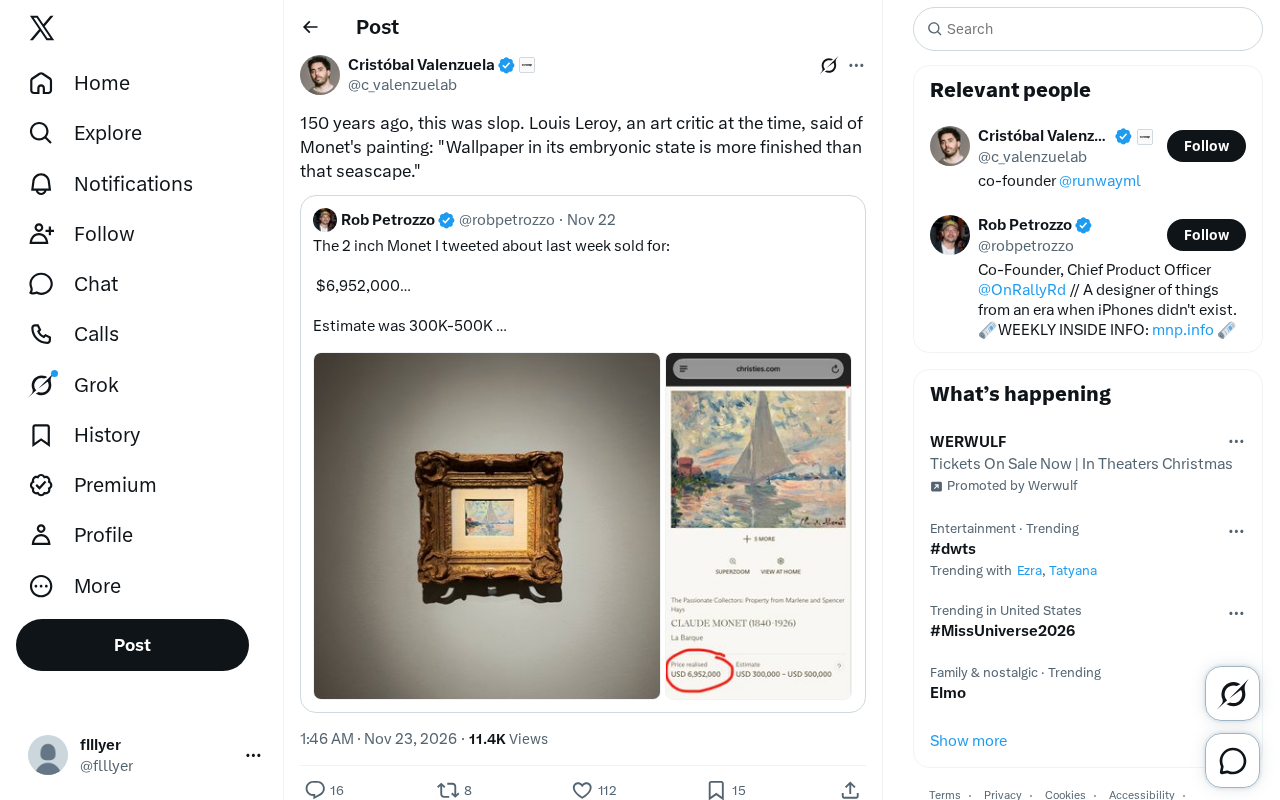
One hundred and fifty years later, this tweet resurfaces that old controversy—but its purpose isn't art history. The author juxtaposes Monet's reception with the "slop" accusations currently leveled at AI-generated content. "Slop" is a pejorative term that has emerged in recent years to describe the mass-produced text and images churned out by AI, with quality ranging from uneven to poor. Comparing Monet's paintings to AI output may seem absurd, yet it precisely hits upon a recurring historical pattern: every paradigm shift in expression is initially dismissed by the gatekeepers of the old order as "incomplete" or "inferior."
Impressionism was an art movement that originated in France in the 1860s, named after Monet's Impression, Sunrise (1872). The painting was exhibited at the first Impressionist exhibition in 1874, where Leroy seized on the title to mock the group as "Impressionists." Impressionist painters rejected the academic establishment's preference for historical and mythological subjects, turning instead to plein-air painting and focusing on the fleeting changes of light and color, using short brushstrokes and juxtaposed unmixed colors to capture visual impressions. Key figures include Monet, Renoir, Pissarro, and Degas. Impressionism was initially heavily criticized but ultimately became one of the starting points of modern art.
Why "Sloppy" Eventually Became "Revolutionary"
Leroy was not lacking in discernment. He could see the difference between Monet's painting and traditional seascapes—he simply refused to acknowledge that this difference had value. The academic standard demanded clear contours, smooth transitions, and recognizable narrative, while Monet delivered what looked like a jumble of arbitrary color patches. The problem is that the evaluative framework itself lags behind. When a new creative tool or method appears, people habitually measure it with the yardsticks of the old tools, and the inevitable result is "fails to meet standards."
Impressionism's victory did not come because it was more "refined" than the Academy—it came because it redefined the problem that painting was meant to solve: no longer to reproduce the subject, but to capture the moment of seeing. The "slop" accusations against AI-generated content today are highly isomorphic in logic. Much AI text and imagery is indeed rough, but critics tend to judge it by the standards of completion expected of human handcrafted work. AI's real strength lies in generating massive variations at extremely low cost, rapidly exploring style spaces, and completing tasks that are difficult to scale with human labor—values that simply cannot be measured on the dimension of "does it look like a human wrote/drew this?"
Academic art refers to the official European art system of the 18th and 19th centuries, centered on the French École des Beaux-Arts and the salons it organized. Academic art championed the classical tradition, emphasizing precision in drawing, idealized forms, smooth brushwork, and historical, mythological, or religious subjects. Its evaluation criteria included rigorous composition, completeness of detail, and clarity of narrative. Through the salon jury system, the Academy controlled artists' reputations and market access. Impressionist painters were often rejected from the salon due to stylistic nonconformity, which prompted them to establish their own exhibition spaces and gradually dismantle the Academy's authority.
The Gap Between "Slop" and "New Paradigm"
Drawing a direct analogy between Monet and AI easily slides into cheap optimism: what is called "slop" today will become classic tomorrow. This inference omits the most critical intermediate step—filtering and sedimentation. Impressionism did not automatically become classic; it went through decades of controversy, market testing, reconstruction of critical discourse, and sustained high-quality practice by a group of creators. Monet himself kept painting—from seascapes to water lilies—responding to the "unfinished" accusations through the work itself.
What the AI content field currently lacks is precisely this sedimentation mechanism. When generation costs approach zero, the absolute volume of "slop" will continue to expand, but the path to canonization does not automatically open. The resonance sparked by the tweet is more of an emotional defense: don't reject an entire direction just because of its initial roughness. This defense is reasonable, but it cannot substitute for the proof of specific works. What Impressionism left behind is a body of paintings that withstand repeated viewing. For AI content to shed the "slop" label, it likewise needs to produce something that stands the test of time—not merely rely on historical analogy to gain legitimacy.
Slop is a pejorative term that began circulating on the English-language internet around 2023, specifically referring to low-quality content mass-produced by generative AI (such as large language models and image generation models). Unlike "junk content," "slop" emphasizes its characteristics of scale, low cost, and lack of human curation, often appearing on social media, content farms, and search engine results. The term also implies criticism of AI-generated material as "seemingly fluent but actually hollow." However, the boundaries of slop are blurry and depend on context and use—the same tool might be called "efficiency" when used for rapid prototyping, but denounced as "slop" when used for content flooding.
What This Means for Creators: Tools Aren't the Answer—Choices Are
Leroy's mistake was not that he criticized Monet, but that he treated the existing standard of completion as the only standard. For creators using AI tools today, the cautionary lesson from this history is equally clear: don't expect the mere "newness" of a tool to confer value on your work. The Impressionists were not great because they used tube paints (a new tool at the time), but because they used that tool to make unprecedented aesthetic choices.
AI lowers the barrier to execution, but the weight of aesthetic judgment, problem definition, and editorial selection actually increases. When generating a thousand versions becomes easy, the ability to decide "which one is worth keeping" becomes the truly scarce resource. Monet's seascape looked to Leroy like embryonic wallpaper, but Monet knew what he was trying to capture. One hundred and fifty years later, the question facing AI creators is no different: Are you mass-producing wallpaper, or are you using new tools to capture the moments that belong to this era? The answer isn't in the tools—it's in every specific choice.
Related articles

Michael Nielsen Takes Down His Classic Neural Network Textbook, Sparking Community Discussion
Michael Nielsen's classic free textbook Neural Networks and Deep Learning has been taken offline, sparking discussion on Hacker News about the reasons and impact.

Inside the AI Training Data Market: The Trade-off Between Exclusivity and Discounts
G2i founder Gabe Greenberg reveals the dual-track pricing of the AI training data market: labs pay a premium for exclusive data or accept discounts that allow others to buy it.

SessionGraph: Unifying All Coding Agent Sessions in One Interactive Graph
SessionGraph aggregates coding agent sessions into an interactive graph, helping developers review, debug, and manage AI coding workflows across sessions. This article examines its positioning, value, and open questions.