Monton: Using AI Agents to Handle an Agency's Tedious Daily Grind
Monton embeds AI agents into agency management software to automatically handle busywork like budget monitoring, collections, and reports.
Monton is management software designed specifically for agencies, with built-in AI agents that perform repetitive tasks such as budget monitoring, overdue invoice collection, client report writing, and timesheet reminders based on real timesheet, staffing, billing, and CRM data. It offers 18 preset templates and chat-based creation to lower the barrier to entry, while requiring all AI-drafted emails to be human-approved before sending, drawing a boundary between automation and client relationship safety. On pricing, AI features are included in all paid plans with no credits limits and no per-seat charges, with free use for teams under 5. Target users are small and mid-sized agencies, and its actual value depends on the quality of complex tasks like report writing.
The day-to-day operations of an agency are filled with repetitive, administrative work: watching budgets so they don't overrun, chasing clients for overdue payments, writing weekly and monthly reports, and reminding team members to fill in their timesheets. These tasks don't directly produce creative value, yet they consume a huge amount of a manager's energy. Monton, newly launched on Product Hunt, targets exactly this pain point—embedding AI agents into agency management software so the machines handle the "busywork."
Agency Management + AI Agents: What Monton Sets Out to Solve
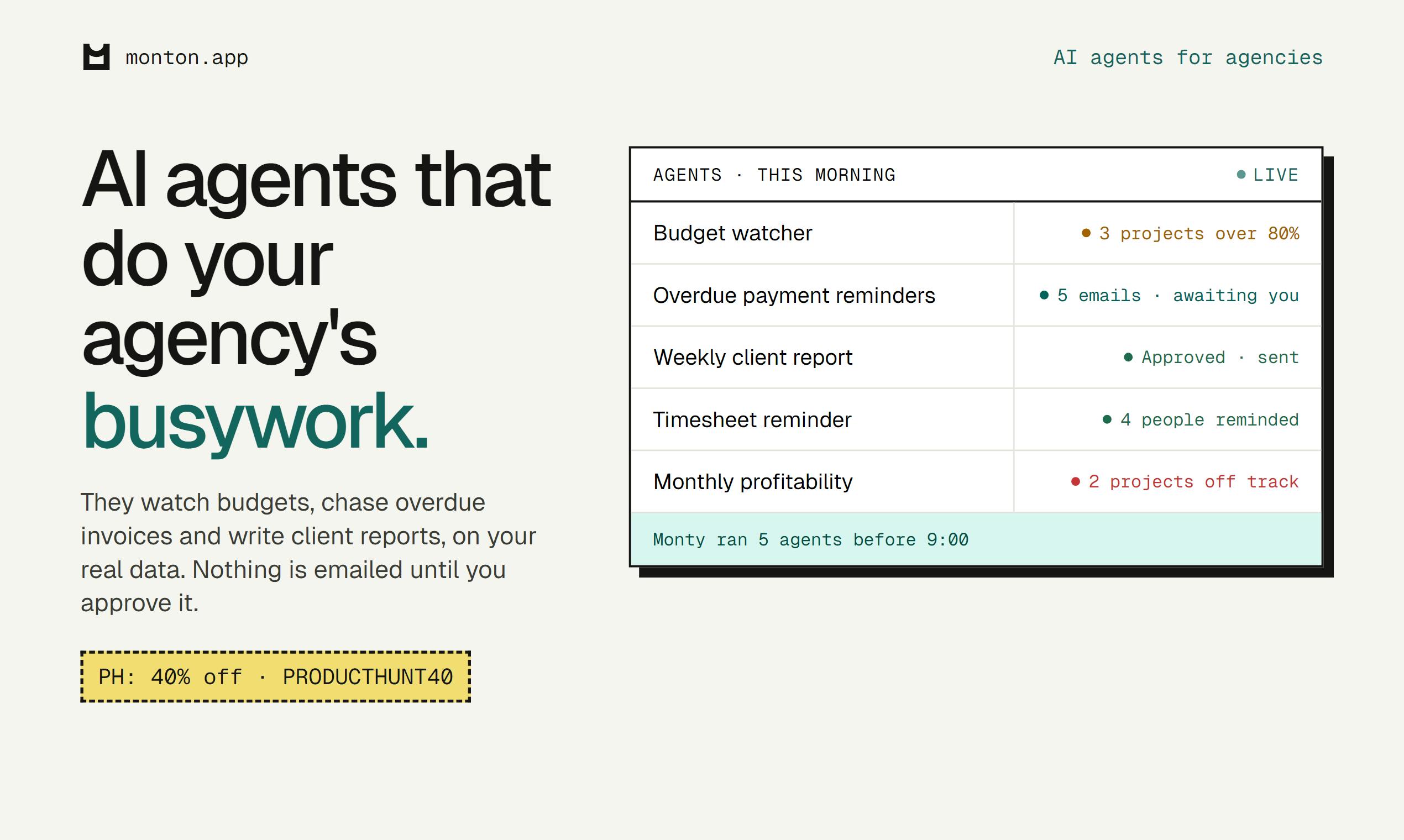
Monton's positioning is clear: it's not just another general-purpose AI assistant, but management software designed specifically for agencies, with built-in AI agents. According to its Product Hunt description, these AI agents monitor budgets, chase overdue invoices, write client reports, and remind about missing time entries—all based on real timesheet, staffing, billing, and CRM data.
In other words, the AI agents' "eyes" are on an agency's most critical operational data, rather than generating generic content in a vacuum. This point matters—an agency's pain often isn't a lack of tools, but fragmented data across those tools, forcing managers to manually piece together information before they can make a decision. Monton's approach is to connect agents directly to the data layer, so automation has a solid basis.
AI agents are fundamentally different from common chat-style AI assistants: the latter typically respond passively to a single question, while an AI agent, once given a goal, can autonomously plan steps, invoke tools, read data, and continuously execute tasks—proactively triggering reminders or requesting human intervention when necessary. In Monton's case, the agent's "autonomy" means it periodically checks budget balances, scans for overdue receivables, and issues a reminder when it detects missing time entries—rather than waiting for the user to ask. The technical foundation for this pattern is the LLM's function calling capability—the model can query databases and call business APIs on demand. However, the degree of agent autonomy needs to be bounded carefully, because the more autonomous an agent is, the harder its behavior is to predict—which is exactly why the article later emphasizes that emails must be human-approved.
18 Templates + Chat-Based Creation to Lower the Barrier to Entry
For teams that aren't skilled at configuring automation workflows, Monton offers two ways to get started: pick one of 18 preset templates, or simply describe in chat what you want the agent to do.
The value of templates lies in covering common scenarios—budget monitoring, invoice collection, report writing, timesheet reminders—which are most likely all within the preset range. Chat-based creation gives teams greater flexibility: if a template doesn't perfectly fit the business, just describe the need in natural language to generate the corresponding agent. This dual-track design of "templates + natural language" is really about finding a balance between ease of use and flexibility—it doesn't scare off non-technical users, nor does it lock advanced users into fixed workflows.
Worth noting: the Product Hunt page shows the product received 73 upvotes and 3 comments, ranking 10th for the day. That's not a blockbuster level of traction, but considering it targets a relatively vertical agency management scenario, the attention is reasonable within its niche.
The mechanism behind chat-based agent creation typically involves parsing a natural language description into a structured automation configuration: when a user says "check all project budgets every Monday and notify me if any is over by 10%," the system needs to identify the trigger condition (every Monday), the object to check (project budgets), the threshold (over by 10%), and the action (notify). This step relies on the LLM to convert unstructured language into executable rules or workflows. Compared with traditional automation tools that require users to manually drag nodes and fill in fields, chat-based creation shifts the configuration cost onto the model—but the trade-off is that the generated rules may not be precise enough and often require user confirmation or fine-tuning. This is also the significance of the "templates + chat" dual-track design: templates provide validated, reliable configurations, while chat covers the long-tail needs that templates don't address—the two complement rather than replace each other.
Every Email Requires Human Approval: Clear Safety Boundaries
AI agents automatically sending emails sounds highly efficient, but it also carries significant risk—poor wording, incorrect information, or sending to the wrong recipient could all damage client relationships. Monton makes a conservative but wise design choice here: every email drafted by an AI agent must wait for human approval before being sent.
This design reflects a reality of deploying AI agents today: in scenarios involving external communication, fully autonomous automation still makes people uneasy. Keeping the approval step lets AI handle the repetitive drafting work while humans retain final control. For an industry like agencies where client relationships are paramount, this "human-AI collaboration" boundary is easier to accept than aggressive full automation.
Human-in-the-loop is a common architectural pattern when deploying AI agents in high-risk scenarios: the agent drafts, organizes, and suggests, while key actions are executed only after human confirmation. In the email scenario, this typically means the agent generates a draft with cited data sources, and a human reviewer can verify wording and facts during approval before deciding to send, modify, or reject. This design not only reduces the risk of errors but also makes compliance easier to satisfy—if misleading content appears in external communication, responsibility is clearly attributable. The opposite is the fully autonomous mode, where the agent sends emails directly—higher efficiency but with very little margin for error. For client-relationship-sensitive agencies, human-in-the-loop is almost the only pragmatic choice at the current stage; as agent accuracy improves, the approval step can gradually transition from "review every email" to "spot checks" or "review only high-risk emails."
Pricing Strategy: No Extra Charge for AI, Per-Seat Rather Than Usage-Based
Monton makes a rather sincere commitment on pricing: AI features are included in all paid plans, with no credits limits and no separate per-seat charge. Teams of fewer than 5 people can use it for free.
This pricing model deserves a closer look. Many AI products today use a "base subscription + AI usage billing" model, where you have to pay more once credits run out, making costs hard for users to predict. Monton chooses to bundle AI into the subscription fee, which for agencies means predictable costs—no worrying that the agents ran too actively one month and sent the bill soaring. And "no per-seat charge" is friendlier for agencies whose team size will grow—no need to separately purchase AI access for each new member as they expand.
Of course, whether this model is sustainable depends on the actual usage frequency of the AI agents and control of the underlying inference costs. But for early customer acquisition, clear pricing does lower the barrier to trying it out.
Who Monton Is For
Judging from the feature design, Monton best fits small and mid-sized agencies—these teams typically don't have a dedicated operations middle office, and managers often wear multiple hats, watching projects while managing finances and maintaining client relationships. AI agents can take over the mechanical work of monitoring and reminding, freeing up energy for areas that require more judgment.
For large agencies, whether Monton is sufficient depends on its integration capabilities with existing systems. The product description mentions basing everything on "real timesheet, staffing, billing, and CRM data," but public information on exactly which external tools it supports is currently limited.
One point to watch: how "smart" the AI agents really are. Monitoring budgets and reminding about timesheets are automation tasks with clear rules, whereas writing client reports tests understanding of data and expression ability far more. The former is easy to do well; the latter is where real differentiation emerges. Whether Monton can reach a standard of "send with minor edits" in report quality will determine whether it's just an advanced reminder tool or a genuine AI operations assistant.
Summary
Monton targets a corner that general-purpose AI tools have overlooked: the management chores of agencies. It binds AI agents to real operational data, uses templates and chat to lower the barrier to entry, uses human approval to safeguard the boundary of external communication, and uses an "AI at no extra charge" pricing model to eliminate hesitation about trying it. This combination is logically coherent; what remains to be seen is how well the product is refined within real agency workflows.
One-line Summary
Monton embeds AI agents into agency management software to automatically handle busywork like budget monitoring, collections, and reports.
Paragraph Summary
Monton is management software designed specifically for agencies, with built-in AI agents that perform repetitive tasks such as budget monitoring, overdue invoice collection, client report writing, and timesheet reminders based on real timesheet, staffing, billing, and CRM data. The product offers 18 preset templates and chat-based creation to lower the barrier to entry, while requiring all AI-drafted emails to be human-approved before sending, drawing a boundary between automation and client relationship safety. On pricing, AI features are included in all paid plans with no credits limits and no per-seat charges, with free use for teams under 5, emphasizing cost predictability. Target users are small and mid-sized agencies, and its actual value depends on the quality of complex tasks like report writing.
Related articles

Michael Nielsen Takes Down His Classic Neural Network Textbook, Sparking Community Discussion
Michael Nielsen's classic free textbook Neural Networks and Deep Learning has been taken offline, sparking discussion on Hacker News about the reasons and impact.

Inside the AI Training Data Market: The Trade-off Between Exclusivity and Discounts
G2i founder Gabe Greenberg reveals the dual-track pricing of the AI training data market: labs pay a premium for exclusive data or accept discounts that allow others to buy it.

SessionGraph: Unifying All Coding Agent Sessions in One Interactive Graph
SessionGraph aggregates coding agent sessions into an interactive graph, helping developers review, debug, and manage AI coding workflows across sessions. This article examines its positioning, value, and open questions.