More Vulnerabilities ≠ More Breaches: Deconstructing the 'Vulnerability Apocalypse' Fallacy

'Vulnerability apocalypse' requires simultaneous growth in vulnerabilities, exploitation, and losses—CVE counts alone are misleading.
The article analyzes the popular 'vulnerability apocalypse' narrative. The researcher argues the concept shouldn't be simplified to 'more vulnerabilities' but must satisfy three conditions: more vulnerabilities, more exploitation, and more incident losses. Rising disclosure counts alone reflect increased visibility and patching pressure, not existential threat. True apocalypse requires synchronized order-of-magnitude jumps in both vulnerabilities and breaches. The article recommends shifting evaluation from CVE counts to exploitation evidence and incident data.
When 'Vulnerability Apocalypse' Becomes a Popular Narrative
The security world has never lacked doomsday prophecies. From 'ransomware will destroy everything' to 'AI will automatically break into every system,' every so often a new concept gets elevated to cult status. The latest one being debated repeatedly is the so-called 'vulnerability apocalypse.' According to a security researcher who has long tracked the topic in a video analysis, the debate around this concept has grown so extensive that he decided to define it himself.

His starting point is simple: if everyone invokes a term but nobody can clearly explain what it means, the discussion easily devolves into emotional venting rather than rational analysis. This observation actually hits on a long-standing communication ailment in the security industry—we habitually summarize complex trends with sensational labels while rarely questioning whether the causal chain behind those labels holds up.
The Real Definition of Vulnerability Apocalypse: Three Conditions, None Optional
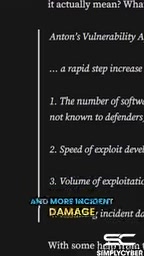
The definition this researcher offers deserves to be unpacked word by word. In his view, 'vulnerability apocalypse' cannot be satisfied by 'more vulnerabilities' alone; it requires three elements simultaneously: more vulnerabilities, more exploitation, and more incident losses.

The value of this definition lies in clearly separating 'vulnerability disclosure counts' from 'actual security risk.' CVE numbers hitting new highs year after year is virtually an industry consensus—mature disclosure processes, widespread scanning tools, and increased research incentives all push the numbers up. But rising numbers themselves indicate 'increased visibility,' not 'proportionally amplified risk.' Conflating the two leads to a false conclusion: the more vulnerabilities, the more dangerous we are.
The researcher's own words are blunt: if vulnerabilities increase but they are unexploitable and never actually exploited, he doesn't consider that an apocalypse.

At most, it's operational pressure—more patching work, tighter remediation schedules. This sounds like pouring cold water on the industry, but it's actually a reminder: the severity of a threat must ultimately be defined by exploitation behavior and actual damage, not by disclosure counts.
CVE (Common Vulnerabilities and Exposures) is a public vulnerability numbering system maintained by MITRE, assigning a unique identifier to each confirmed security vulnerability to facilitate information sharing across the global security community. CVE itself contains no severity rating or technical details—it's merely an index indicating 'a vulnerability exists.' Paired with CVE is CVSS (Common Vulnerability Scoring System), which produces a 0-10 severity score based on attack vector, complexity, privileges required, scope, and other dimensions. But CVSS measures theoretical harm under 'worst-case' conditions, not the probability of exploitation in real environments. Therefore, growth in CVE counts and in high-CVSS vulnerabilities does not directly equal an increase in attack incidents—this is precisely the technical context behind the original article's emphasis on distinguishing 'disclosure counts' from 'actual risk.'
Why Unexploitable Vulnerabilities Aren't Real Risk
The logic chain isn't complicated, but it's frequently skipped in everyday security discussions. For a vulnerability to go from 'disclosed' to 'causing incident losses,' it must cross several thresholds: whether a viable exploitation path exists, whether attackers have the motivation and capability to exploit it, whether the target system is exposed on an attackable surface, and whether existing defenses can block it. If any link breaks, the actual threat of the vulnerability diminishes significantly.
Many vulnerabilities flagged as high-severity may remain at the 'theoretical risk' level in real environments—due to demanding exploitation conditions, lack of public exploit code, or mismatched target architecture. Counting them all into the 'apocalypse' narrative treats possibility as inevitability.
This isn't to say we can afford to be complacent. The researcher acknowledges that increased patching workload is a real burden. But operational pressure and existential threat are two different things, and conflating them misdirects resource allocation—overinvesting in chasing every CVE ID may dilute attention from vulnerabilities that are genuinely being actively exploited.
Understanding 'unexploitable' requires introducing the concept of attack surface. Attack surface refers to the sum of all entry points a system exposes that attackers could potentially reach, including network ports, APIs, user input interfaces, third-party components, and more. Even if a vulnerability is technically exploitable, if the component it resides in is not exposed on an attacker-reachable path (e.g., running only in an isolated internal network environment, or the relevant service is disabled by default), it has little practical value to attackers. Additionally, the availability of exploit code is a key variable: vulnerabilities with public PoCs are far more likely to be exploited in practice than those with only theoretical descriptions. Security teams typically use tools like EPSS (Exploit Prediction Scoring System) to predict, based on threat intelligence, the probability that a vulnerability will be exploited within the next 30 days, thereby prioritizing remediation resources toward gaps that will actually be attacked.
What Deserves the Label 'Apocalypse': Synchronized Order-of-Magnitude Jumps
The researcher offers a clear criterion: if vulnerability counts rise thousands of times over and breach incidents also rise thousands of times over, that would qualify as an apocalypse.
The essence of this statement isn't the specific multiplier but the word 'synchronized.' Vulnerabilities and breaches must rise in the same direction and at the same magnitude for the former to be proven as the driving factor of the latter. If vulnerability counts surge while breach incidents remain flat, the more reasonable explanation is that disclosure mechanisms are improving or statistical scope is expanding—not that the attack surface is exploding. Conversely, if breach incidents rise while vulnerability counts stay flat, the problem likely lies in upgraded exploitation techniques, defense failures, or shifts in attacker strategy—not in vulnerability counts per se.
This framework actually provides an actionable monitoring approach: rather than fixating on total vulnerability counts alone, track simultaneously 'the proportion of vulnerabilities with public exploits,' 'the proportion of vulnerabilities actually exploited,' and 'the share of incidents caused by vulnerability exploitation.' The combined movement of these indicators reveals risk trends far better than any single number.
The Mismatch Between Hype and Reality Is What Warrants More Vigilance
The question posed at the video's opening—where does hype run ahead of reality, and where does reality run ahead of hype—is especially apt when applied to the vulnerability issue.
On the hype side, 'vulnerability apocalypse' offers a simple, powerful narrative: numbers are rising, therefore danger is approaching. It spreads easily, triggers anxiety easily, and serves easily as a talking point for product marketing and budget requests. But on the reality side, there is a long transmission chain full of variables between vulnerability disclosure counts, exploitability, actual exploitation rates, and incident losses. Ignoring this chain compresses a complex security landscape into a distorted conclusion.
A more pragmatic approach is to accept 'vulnerability count growth' as the norm while shifting the evaluation focus to exploitation evidence and incident data. The purpose of vulnerability management isn't to drive CVE numbers to zero—that's impossible—but to direct limited remediation resources toward gaps that will actually be exploited. From this perspective, defining 'vulnerability apocalypse' strictly is itself a valuable correction: it forces the discussion from emotion back to evidence.
For security practitioners, this definition can serve as a mirror: when someone next invokes 'vulnerability apocalypse' to argue a point, it's worth asking—do you mean more vulnerabilities, more exploitation, or more losses? Confuse the three, and the conclusion becomes unreliable.
Hype cycle is an analytical framework proposed by Gartner describing the typical path of a technology from conceptual hype to substantive adoption: trigger, peak of inflated expectations, trough of disillusionment, slope of enlightenment, and plateau of productivity. Many concepts in security—from zero trust to AI security—have gone through overestimation during the peak of inflated expectations and subsequent correction. By asking 'where hype runs ahead of reality,' the original article is essentially suggesting that the 'vulnerability apocalypse' discussion is also in its peak of inflated expectations, where narrative intensity exceeds evidence strength. A common method for distinguishing hype from reality is to look for the degree of divergence between leading indicators (e.g., vulnerability disclosure counts, PoC releases) and lagging indicators (e.g., actual breach incident counts, ransom payment amounts). The greater the divergence, the more likely the narrative has detached from data support.
One-line Summary
'Vulnerability apocalypse' requires simultaneous growth in vulnerabilities, exploitation, and losses—looking only at CVE counts is a misjudgment.
Paragraph Summary
The article examines the popular narrative of 'vulnerability apocalypse.' The researcher argues the concept shouldn't be reduced to 'more vulnerabilities' but must satisfy three conditions simultaneously: more vulnerabilities, more exploitation, and more incident losses. Rising disclosure counts alone reflect increased visibility and patching workload pressure, not existential threat. What truly deserves the 'apocalypse' label is a synchronized order-of-magnitude jump in both vulnerability counts and breach incidents, proving the former drives the latter. The article further notes that hype narratives compress a complex security transmission chain into the distorted conclusion that 'rising numbers mean approaching danger,' and recommends security practitioners shift their evaluation focus from single CVE counts to exploitation evidence and incident data, directing limited remediation resources toward gaps that will actually be exploited.
Related articles

Private Key Set to 4? CA's Elementary Mistake Leaves TLS Exposed
CA eMudra set private keys to tiny values like 4, making TLS certificates brute-forceable. A Computerphile video demonstrates the full process from extracting public keys to forging certificates, and explores the fragility of the PKI trust chain.

How Gen Turns Data into Decisions with ChatGPT Work
In an OpenAI user case, business leader Gen shares how ChatGPT Work turns data into decisions: within hours of launch, teams can judge whether integrations and onboarding flows work, shifting decision iteration from hundreds of trial-and-error attempts to a fast feedback loop.

ChatGPT vs. Claude In-Depth Comparison: Strong at Coding but Weak at Research — How to Bridge the Gap?
A user considers switching from ChatGPT to Claude, finding Claude stronger at coding but shallower at research. We analyze the differences and share tips to make Claude's research deeper.