Morsa Signals: A GTM and AI Visibility Workflow Platform Built for Developer Tools

Morsa Signals gives developer tool teams an all-in-one GTM workflow for outreach, early adopters, AI visibility, and competitive analysis.
Morsa Signals is a growth platform designed for developer tool founders and GTM teams, recently debuting at #6 on Product Hunt. It integrates four core workflows — scaled developer outreach, early adopter identification, GEO (Generative Engine Optimization) visibility auditing, and competitive profiling — into a single platform anchored to the user's actual product. Its most forward-looking feature is the GEO audit, which helps teams understand how AI search systems interpret their site content, an increasingly critical traffic channel as users shift from traditional search to AI assistants.
When Developer Tools Meet Growth Challenges
Building a great developer tool is only the first step. Getting it in front of the developers who actually need it, earning early adopters, and making sure AI search systems understand it correctly — these are often the trickier challenges for any team. Morsa Signals, which recently debuted at #6 on Product Hunt, zeroes in on exactly this niche. It offers founders and GTM (Go-To-Market) teams behind developer tools a set of actionable growth and SEO/GEO workflows.
The product earned 87 upvotes on Product Hunt and sits at the intersection of Marketing, SEO, and Developer Tools — a tightly focused positioning. Its core promise: instead of delivering a generic report or a one-size-fits-all database, it starts from your actual product and produces targeted, executable results.
Breaking Down the Four Core Workflows
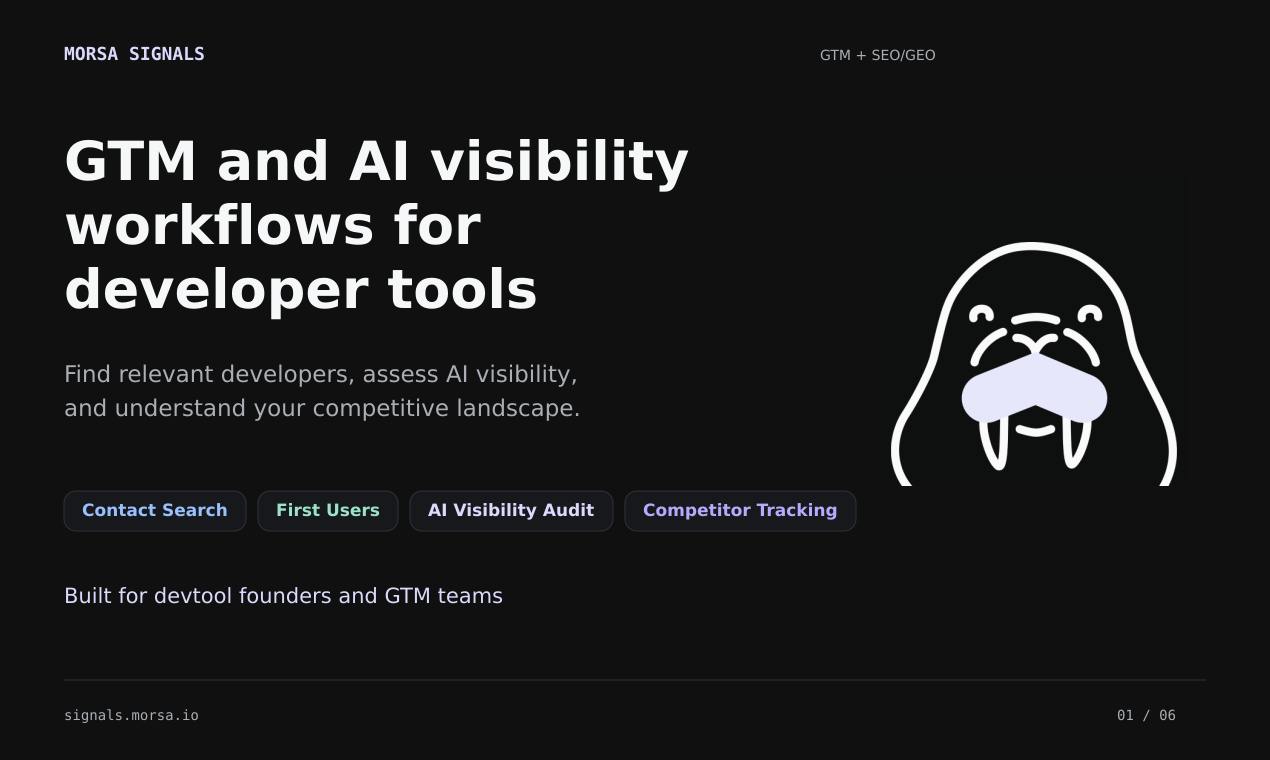
Morsa Signals structures developer tool growth into several clear workflows, each addressing a specific marketing pain point.
Find the Right Developers for Scaled Outreach
For developer tools, broad ad campaigns typically yield poor conversion rates because the target audience is highly vertical. Morsa Signals' first workflow helps teams identify developer communities relevant to their product, enabling targeted, scaled outreach. Compared to spray-and-pray marketing, this product-fit filtering logic is far more aligned with how developer communities actually spread the word.
Identify Potential First Users and Early Adopters
Early adopters are critical to any developer tool's cold-start phase. The platform provides the ability to surface potential first users, helping teams concentrate limited resources on the people most likely to convert and most willing to try something new. For seed-stage startups, this workflow's value lies in reducing the cost of trial and error.
In technology product diffusion models (such as Everett Rogers' Diffusion of Innovations), early adopters sit in a pivotal position — after innovators but before the early majority — representing roughly 13.5% of the total potential user base. They're willing to accept the risk of using an immature product in exchange for a technical edge or influence, and they're most likely to organically spread the word within their communities. For developer tools, early adopters tend to cluster among active GitHub contributors, Discord/Slack communities around specific tech stacks, and technical bloggers. The challenge of identifying this group is that, unlike consumers, they don't fill out interest surveys. Instead, they reveal their needs indirectly through signals like open-source project dependencies, technical discussion threads, and Stack Overflow questions.
GEO: The New Visibility Battleground for AI Search
This is arguably Morsa Signals' most forward-looking feature. Traditional SEO focuses on how search engines crawl and rank web pages. GEO (Generative Engine Optimization) focuses on how AI search systems — such as LLM-powered Q&A tools — understand your website's content.
Morsa Signals provides an audit capability that lets teams see how AI search systems actually interpret their site. As more users turn to AI assistants rather than traditional search boxes to find tools and answers, "being correctly understood and cited by AI" is becoming an entirely new traffic channel. Incorporating GEO into a standard workflow reflects the product's sharp awareness of where marketing is heading.
GEO as a concept emerged around 2023, alongside the rise of AI search products like ChatGPT, Perplexity, and Google SGE. Unlike traditional SEO, which relies on signals like keyword density, backlinks, and page authority, GEO's core logic is about structuring content to match how large language models "prefer" to understand it: clear entity definitions, explicit Q&A pairs, structured technical explanations, and authoritative phrasing that models can directly cite. For developer tools, this means rethinking how product documentation, landing pages, and technical blog posts are written. When a model answers a question like "what are some good API monitoring tools," it tends to cite content that clearly and semantically articulates the product's positioning and use cases. This is fundamentally different from the ranking mechanics that traditional SEO optimizes for — and it's precisely why existing SEO tools struggle to cover this need.
Competitive Tracking: Know Your Landscape First
The fourth workflow gives teams a preliminary profile of their competitive landscape — surfacing the rivals that are actually worth monitoring. For small teams with limited resources, understanding their relative position in the market matters more than building in a vacuum. This feature follows the same product philosophy of starting from real data and delivering focused conclusions, rather than handing users a sprawling table to make sense of on their own.
Product Positioning and Takeaways
What sets Morsa Signals apart is how it consolidates what are typically scattered efforts — developer outreach, early user discovery, AI visibility auditing, and competitive analysis — into a single platform, all anchored to "your actual product" as the starting point. This product-centric design philosophy, focused on delivering actionable outputs rather than generic reports, is what distinguishes it from broad-purpose marketing tools.
Zooming out, the developer tools category is getting increasingly crowded, and its growth playbook looks nothing like consumer products: developers hate hard-sell ads, they value word-of-mouth and utility, and they congregate in specific communities. There's a real market gap for GTM tooling tailored to this audience. Adding forward-looking capabilities like GEO also makes Morsa Signals stand out among a sea of conventional SEO tools.
One caveat worth noting: this is a brand-new product that just launched on Product Hunt with only 3 comments, so its real-world effectiveness still needs validation from more users. The capabilities described here are largely based on official product information. Interested teams would be wise to run a small pilot against their own use case before committing.
Summary
Morsa Signals targets two genuine pain points in developer tool growth: reaching a highly vertical audience with precision, and maintaining visibility in the age of AI. It wraps GTM and SEO/GEO into a unified workflow, with a focus on starting from your product and delivering actionable conclusions. For developer tool teams wrestling with cold starts and user acquisition, it offers a fresh angle worth exploring — though ultimate value will only be proven through actual use.
Related articles

Chain of Thought Isn't Just for AI: How Humans Can Use CoT to Improve Thinking Quality
Chain of Thought isn't just a prompt trick for large models. Starting from a Hacker News discussion, this article analyzes why CoT works for human thinking too, breaks down actionable ways to transfer it, and highlights the key differences between human CoT and machine CoT.
Cloudflare Teams Up with OpenAI: Closi…
Cloudflare Teams Up with OpenAI: Closing the Loop from Vulnerability Discovery to Defense with AI
Cloudflare uses OpenAI Daybreak to investigate security vulnerabilities and generate reviewable remediation plans, while developers use Codex to boost coding efficiency and quality.

Orca Multi-Agent Orchestration in Practice: A Guide to Parallel Collaboration with Claude and Codex
Orca is Stable AI's free open-source agent workbench supporting 34 agents like Claude Code and Codex in parallel. Learn its Git worktree isolation, multi-model orchestration, and mobile management.