Mosqitter Turns Mosquito Traps into a Disease Early-Warning Network with AI

Mosqitter uses AI to turn mosquito traps into an early-warning network for mosquito-borne diseases.
Mosqitter is turning outdoor mosquito-catching hardware into AI-driven data nodes that identify mosquito species via image recognition and upload results to the cloud, creating a real-time distribution map. The system can distinguish vectors like Anopheles and Aedes, replacing manual microscope ID and enabling scalable, continuous surveillance. Its core value is moving surveillance ahead of outbreaks to give public health agencies an earlier warning window than case reporting. Yet it faces three hurdles: field-sample recognition accuracy, deployment density, and integration with disease-control response workflows.
The seemingly small task of killing mosquitoes is being redefined by AI. Startup Mosqitter is upgrading its outdoor mosquito-catching hardware into an intelligent monitoring network capable of identifying mosquito species, tracking population density, and providing early warnings for mosquito-borne infectious diseases.
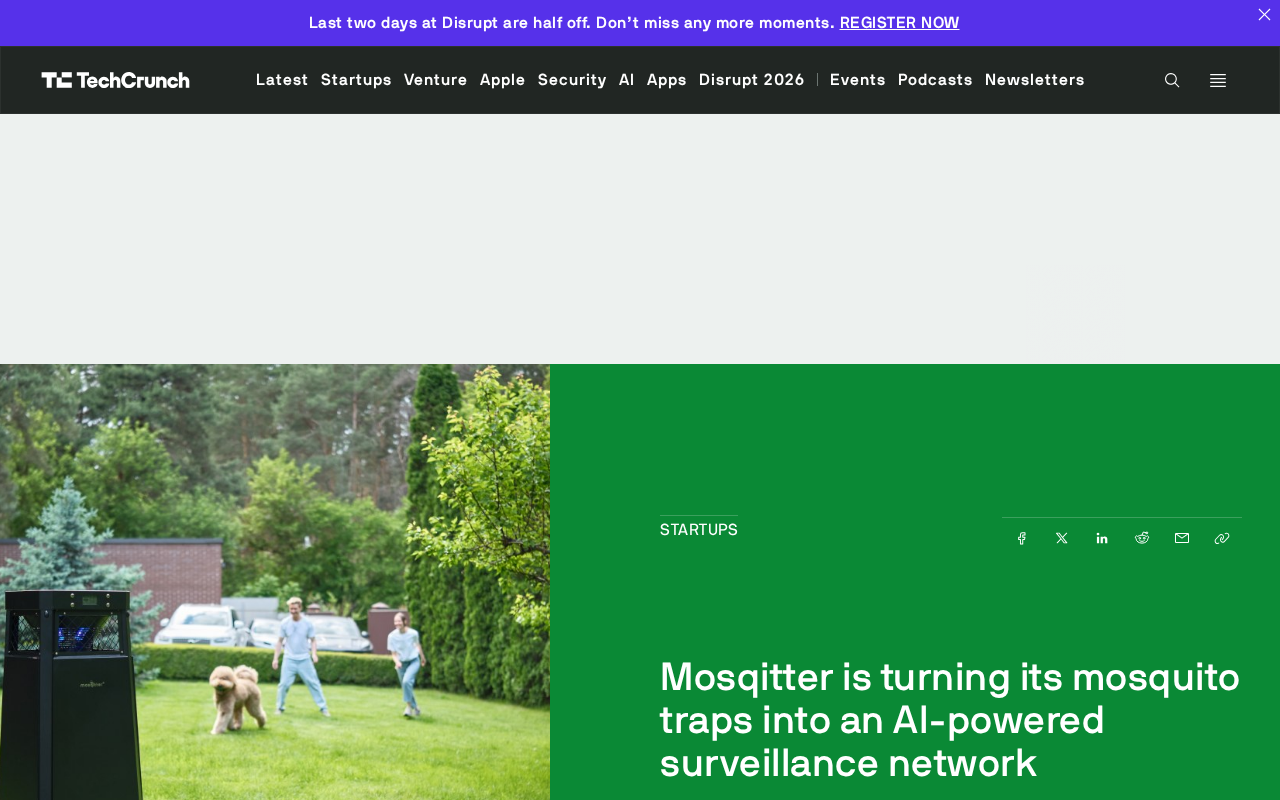
From "Mosquito Killer" to "Data Node"
Traditional mosquito-killing devices have only one core metric: how many mosquitoes were killed. Users can see the number of catches, but they have no way of knowing what species were captured, whether they carry pathogens, or whether the surrounding population is growing rapidly. Mosqitter's approach is to turn each trap into a data collection terminal—after mosquitoes are captured, the system determines the species through image recognition and uploads the results to the cloud.
This means the value of the hardware itself is no longer limited to "elimination," but lies in continuously generating structured data. When enough nodes operate in the same area, a real-time mosquito distribution map can be assembled, rather than just scattered kill records.
Mosquito-borne disease surveillance has long been a persistent challenge in public health. According to World Health Organization data, mosquito-borne diseases account for a significant proportion of the global infectious disease burden, with the endemic areas of diseases such as malaria, dengue, Zika, and chikungunya expanding due to climate change and urbanization. Traditional surveillance systems mainly rely on two types of methods: first, manual mosquito trapping surveys, in which CDC personnel use light traps or aspirators to collect samples at fixed or random points and bring them back to the laboratory for identification; second, case reporting, which waits for patients to seek medical care, confirms infection through clinical diagnosis and laboratory testing, and then traces the transmission chain backward. The former is limited by manpower and temporal density, typically providing only weekly or monthly data snapshots; the latter is naturally lagging behind the actual time of transmission. This gap in surveillance capability is precisely the space Mosqitter is trying to fill with distributed automated nodes.
How AI Recognition Works Inside the Trap
According to Mosqitter's description, the core task of its AI system is mosquito species classification and population counting. Different mosquito species transmit different diseases: Anopheles mosquitoes are associated with malaria, while Aedes mosquitoes are more closely linked to diseases such as dengue and Zika. Distinguishing these species used to require professionals to identify them one by one under a microscope, with efficiency and coverage limited by manpower.
The value of automated recognition lies in turning this work into a scalable, continuously operating process. After the system identifies captured samples, the data is aggregated to determine the dominant mosquito species and population trends in a given area. For public health departments, the timeliness of this kind of information is far more meaningful than after-the-fact statistics.
Morphological identification of mosquito species is the traditional method in mosquito-borne disease surveillance, relying on professionals to observe adult mosquito characteristics such as scale patterns, palpus length, wing vein markings, and abdominal markings under a high-power microscope. This method has relatively high accuracy but faces clear bottlenecks: a single identification takes from several minutes to tens of minutes, cultivating qualified identifiers takes a long time, and it cannot meet the demands of large-scale continuous surveillance. In addition, specimens captured in the field often lack key diagnostic features due to mechanical damage from traps or improper preservation, further increasing identification difficulty. In recent years, image classification methods based on convolutional neural networks have begun to enter this field. Their basic approach is to have the model learn the visual feature distributions of different mosquito species from large numbers of labeled samples, thereby automatically classifying new samples during inference. Compared with morphological identification, automated recognition has significant advantages in speed and scalability, but its accuracy depends heavily on the coverage of training data and image quality—for morphologically similar species (such as certain Anopheles complexes), it may be difficult to distinguish them reliably from appearance images alone, and auxiliary methods such as molecular identification or wing geometric morphometrics are often needed.
Early Warning Is the Real Goal
There is a widely recognized difficulty in the prevention and control of mosquito-borne infectious diseases: by the time cases begin to appear, transmission has often already been underway for some time. If abnormal mosquito population growth or the appearance of specific vector species can be detected earlier, the prevention and control window can be moved forward.
Mosqitter positions its mosquito-catching network as an "early warning system," with the logic of moving surveillance ahead of disease outbreaks. Compared with traditional pathways that rely on hospital reports and manual inspections, distributed automated surveillance can theoretically provide finer temporal and spatial granularity. This is also the most imaginative part of such solutions—it turns mosquito control from passive response into active observation.
The Hurdles This Path Must Clear
From demonstration to a truly usable monitoring network, there are several real-world thresholds to cross.
Recognition accuracy is the first hurdle. Field-captured samples are often incomplete or contaminated, and morphological differences between mosquito species may not be obvious in low-quality images. Recognition errors directly contaminate population data, which in turn affects early warning judgments.
Deployment density is the second hurdle. Mosquito distribution is highly dependent on local environments—standing water, temperature, and vegetation can all cause significant differences. Sparse nodes can only provide scattered snapshots; forming a statistically meaningful monitoring network requires sufficiently dense and continuously online devices.
How data enters the public health decision-making process is the third hurdle. Even if surveillance data is accurate, if it cannot connect with the response mechanisms of disease control departments, early warnings remain on the dashboard. This is not only a technical issue, but also involves institutional collaboration and the division of responsibilities.
Another Possibility for Hardware + AI
Mosqitter's attempt represents a trend that is taking shape: transforming physical devices with originally single functions into data entry points through sensing and AI capabilities. Mosquito killer lamps sell insect-killing effectiveness, while monitoring networks sell a continuous stream of information—their business models and customer profiles are completely different.
If this path succeeds, the beneficiaries are not limited to the mosquito control industry. It provides a replicable paradigm: how to enable low-cost hardware to continuously collect high-quality data in real environments and use AI to extract actionable judgments from it.
Background Note
In public health decision-making, surveillance data must be embedded in existing emergency response frameworks to be effective. National disease control systems usually have statutory epidemic reporting, tiered response, and joint prevention and control mechanisms. The integration of new data sources needs to address several key issues: data standardization and interoperability (whether devices from different vendors output a unified format), credibility certification (whether surveillance data can serve as one of the legal bases for initiating a response), and the division of rights and responsibilities (after a device alert, who verifies, who decides, and who executes). In addition, privacy and site selection issues cannot be ignored—when mosquito traps are deployed near residential areas, the environmental data they collect may indirectly involve population distribution information. These non-technical factors often determine whether a surveillance technology can truly be implemented more than the recognition algorithm itself.
One-line Summary
Mosqitter uses AI to upgrade mosquito traps into an early-warning monitoring network for mosquito-borne infectious diseases.
Paragraph Summary
Mosqitter is transforming outdoor mosquito-catching hardware into AI-driven data collection nodes, using image recognition to identify mosquito species and upload results to the cloud, forming a real-time mosquito distribution map. The system can distinguish different vector species such as Anopheles and Aedes, replacing manual microscope identification and enabling scalable, continuous population surveillance. Its core value lies in moving surveillance ahead of disease outbreaks, providing public health departments with an earlier warning window than case reporting. But this path faces three real hurdles: recognition accuracy for field samples, the deployment density required for a monitoring network, and how surveillance data connects with disease control departments' response and decision-making processes. This attempt also represents a paradigm shift in hardware + AI—from selling insect-killing effectiveness to selling a continuous information stream.
Related articles

Workbuddy for Absolute Beginners: How a Desktop AI Agent Fits Into Real Workflows
A beginner's guide to the Workbuddy desktop AI agent: installation, claiming credits, file management, and building automated workflows—compared with CodeX for fit and cost, helping professionals shift from AI question-askers to AI managers.

OpenAI's New Agent Stack: Computer Use, Decisions API, and Ultra-Fast Workflows
OpenAI Dev Day unveiled a new agent stack: Computer Use outperforms humans, Decisions API delivers ultra-low-latency classification via Luna, Agents API opens the same Computer Use capabilities, and GPT-6.1 Sol costs only one-seventh of Astra. Core updates, benchmark data, and developer insights.

Liang Wenfeng Open-Sources DeepInfo Inference Framework, Takes On U.S. Ban
DeepSeek open-sources its DeepInfo inference framework after its models, featuring GPU/CPU cross-pipelining, small-model prediction with large-model verification, and full Huawei Ascend and NVIDIA chip support—facing the U.S. federal ban head-on. This article analyzes its significance for AI deployment and open-source strategy.