Mozilla Spends Big on Privacy Ads—But Is It Just an Inside Job?

Mozilla's nostalgia ads call for privacy, but critics say it acquired an ad company and deleted its privacy promise.
Mozilla launched a nostalgia-driven Firefox ad campaign, using 2006 internet memories to question worsening privacy and spending heavily on TV and international markets. But tech commentator Lunduke notes Mozilla itself is a privacy destroyer: leadership made 'beyond deplatforming' remarks, acquired an ad company in 2025 and embedded tracking into Firefox, and deleted its 'never sell data' promise. Critics use the 'bicycle fallacy' to satirize its self-orchestrated victim narrative. The core issue is consistency between words and actions on privacy—once trust is destroyed, nostalgia marketing can't win it back.
Title
Mozilla Spends Big on Privacy Ads—But Is It Just an Inside Job?
Meta Description
Mozilla launches a nostalgia-driven ad campaign for Firefox, asking why internet privacy has gotten worse. But critics point out that Mozilla itself deleted its "never sell data" promise and acquired an ad company to embed tracking technology—satirizing it as an "inside job."
Article Content
Mozilla recently launched a massive ad campaign for Firefox, with a core question that hits home: "Why does the internet today have less privacy than in 2006, when the whole family shared a single computer?" They brought back early internet viral video stars—the Numa Numa guy, the Chocolate Rain singer, the "lady with the eyeballs"—to evoke nostalgia for an internet era that was "weird, private, and ours." The ads aired on NBC and were pushed to international markets, with spending reportedly "astronomical."
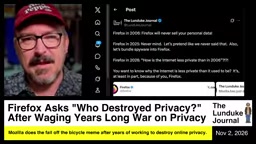
Sounds like a brilliant nostalgia marketing play. But tech commentator Lunduke, in a video, pulled no punches: Mozilla itself is a repeat offender when it comes to destroying privacy, and this ad campaign is a perfect reenactment of the "bicycle fallacy"—sticking a stick in your own wheel, falling down, and then asking "who did this?"
The Ad Campaign: Nostalgia Lands, But Doesn't Hold Up to Scrutiny
Mozilla's market share has plummeted to extremely low levels, with comments even speculating it might be under 2%. Against this backdrop, the motivation for spending heavily on TV ads is easy to understand: desperate to bring people back. The creative itself isn't bad—contrasting 2006 internet memories with today's privacy dilemmas should, in theory, resonate.
But the problem is that the entity asking the question lacks moral legitimacy. Lunduke sharply retorted: "Why is your data being sold left and right? That doesn't make sense, we don't like it. We'd better hear what the Numa Numa guy and Chocolate Rain dude have to say." The sarcasm is unmistakable.

Controversial Past: From "Beyond Deplatforming" to Deleting Privacy Promises
Lunduke listed a series of Mozilla actions in recent years that contradict its self-styled image as a "privacy guardian."
"Beyond Deplatforming" Remarks: Mozilla leadership publicly stated that for certain political figures and groups, merely "deplatforming" isn't enough—more needs to be done. Lunduke interpreted this as an attempt to completely exclude certain people from the internet, calling it "crazy, outrageous censorship."
Deleting the "Never Sell Data" Promise: This is the core accusation. For years, Firefox explicitly promised: "No, we have never sold your personal data, and never will." This was considered one of its foundational commitments. But according to Lunduke, Mozilla acquired an advertising company in 2025, embedded new ad and data tracking technology into Firefox, partnered with a German data marketing firm, and then deleted that years-old promise.

"Deplatforming" is a key concept in recent debates around content moderation and free speech, referring to social platforms or internet infrastructure providers stripping a user or group of the ability to speak, gather, or monetize on their platform. Critics argue that deplatforming itself is already a strong intervention against speech; "beyond deplatforming" means taking further action—such as cutting off payment channels, refusing hosting services, restricting content distribution, or even coordinated exclusion—making it difficult for the targeted party to maintain a normal presence on the internet. Supporters typically view it as a necessary means to combat hate speech, disinformation, or incitement to violence; opponents believe it leads to systematic suppression of viewpoints, breeds "vigilante-style" censorship, and gives platforms excessive power over public discourse. The controversy over Mozilla leadership's remarks stems precisely from touching on the core question of "where the boundaries of platform governance lie."
The "Never Sell Data" Promise is an important pillar of Firefox's privacy narrative. For years, Mozilla repeatedly emphasized in privacy policies, product marketing, and public statements that Firefox would not sell users' personal data or use it for ad tracking. Such promises are sensitive because browsers occupy a critical position between users and the internet, able to observe vast amounts of data including browsing history, search behavior, and device information. Once a browser vendor introduces ad technology or data brokerage capabilities into its product, users find it hard to distinguish between "product feature improvements" and "commercial data exploitation." Deleting a long-standing public promise—even if not legally equivalent to admitting data selling—significantly undermines user trust in the product's privacy stance. For Mozilla, whose brand core is "open, private, user-first," this symbolic loss is often more serious than specific technical changes.
The Core Contradiction: Who Is Really Destroying Privacy?
Lunduke acknowledges that Mozilla isn't the only destroyer of internet privacy—many companies, individuals, and governments play a role. But he emphasizes that Mozilla has been "laser-focused" on destroying privacy over the past few years—acquiring companies, building tracking technology, deleting promises—and these actions speak for themselves.

"There's absolutely no reason to completely delete a promise not to spy on you and not to sell your data unless they're doing exactly that. They did it, and they bought a company to do it."
This "destroy first, then advocate" posture makes the ad's line "what happened to the internet?" especially jarring. Commenters even joked that his own Lunduke Computer OS 1.0 happens not to come with Firefox preinstalled.
The "Bicycle Fallacy" originates from a widely circulated comic: a person riding a bicycle sticks a stick into the front wheel themselves, falls down, and then lies on the ground blaming others—"why are you doing this to me?" In online discussions, this meme describes the "self-orchestrated victim" behavior pattern—the subject first actively creates a problem, then packages themselves as the victim of that problem, using it to shift responsibility or garner sympathy. Lunduke uses this meme to satirize Mozilla: on one hand, deepening data commercialization by acquiring ad tech companies, embedding tracking capabilities, and deleting privacy promises; on the other hand, running ads asking "what happened to internet privacy?" as if it had nothing to do with privacy deterioration. The metaphor is powerful because it simplifies complex business behavior into an intuitive moral image: it's not that you can't ask the question—it's that the questioner's own hands aren't clean.
What Does This Teach Us?
Setting aside the emotional sarcasm, this controversy touches on a more universal issue: consistency between words and actions on privacy at tech companies. When a company deepens data tracking through acquisitions and product design while simultaneously running ads calling for privacy attention, users have reason to feel confused or even offended.
Trust takes years to build but only one deleted promise to destroy. Firefox's ads may evoke nostalgia, but if product behavior runs counter to the ad's message, no amount of Numa Numa guys can win back user trust.
Of course, a caveat: Lunduke's narrative carries a distinct personal stance, and some statements (such as "tens of billions in annual revenue") diverge from the actual situation of Mozilla as a company under a non-profit foundation. Readers should maintain critical thinking when receiving these views. But the core facts—deleting the privacy promise and acquiring an ad tech company—are publicly verifiable points of controversy that deserve serious attention from anyone concerned about digital privacy.
Background
Mozilla's Non-Profit Structure and Revenue Model is important context for understanding this controversy. The Mozilla Foundation is a non-profit organization, but its main product Firefox is developed and operated by the for-profit subsidiary Mozilla Corporation. The company's revenue has long been heavily dependent on search engine default placement partnerships, with Google's payments accounting for the vast majority. This structure means that while Mozilla doesn't aim to maximize shareholder profits, it still needs enormous funds to sustain browser development and marketing. In recent years, as search partnership revenue faces uncertainty, Mozilla has begun exploring diversified revenue sources including advertising, subscriptions, and commercial partnerships—which explains why it ventured into ad technology and data marketing. Critics argue that revenue pressure can explain motivation but cannot dissolve the trust problem caused by "deleting the privacy promise"; supporters emphasize that the coexistence of a non-profit mission and a commercial subsidiary is not inherently contradictory—the key is whether product behavior still prioritizes user interests.
One-line Summary
Mozilla's nostalgia ads call for privacy, but critics say it acquired an ad company and deleted its privacy promise.
Paragraph Summary
Mozilla launched a nostalgia-driven ad campaign for Firefox, drawing on 2006 internet memories to question worsening privacy, spending heavily on TV and international markets. But tech commentator Lunduke points out that Mozilla itself is a privacy destroyer: leadership made "beyond deplatforming" remarks, acquired an ad company in 2025 and embedded tracking technology into Firefox, and deleted its long-standing "never sell data" promise. Commenters use the "bicycle fallacy" to satirize its self-orchestrated victim narrative. The article argues that the core issue is consistency between words and actions on privacy at tech companies—once trust is destroyed by a deleted promise, even the strongest nostalgia marketing can't win it back.
Related articles
 Tech Frontiers
Gemini Omni 1.2 Flash: AI Video Moves Toward Draft-Style Editing
Google's Gemini Omni 1.2 Flash update enables conversational, draft-style editing of the same video—swap scenes while keeping products, adjust lighting while keeping characters. Clips up to 15s, 720p costs 30% less than the previous Flash—ideal for e-commerce ads, previs, and short-asset production.

Codex Tutorial: One-Command Install and Run Your First Task
Codex tutorial: one-command install and run your first task. Covers the four Codex forms, sandbox and approval guardrails, AGENTS.md and MCP configs, cloud network policy, and the iron rule of human review—everything you need to get started with this autonomous coding agent.
 Tech Frontiers
Localix: An Open-Source Agentic Development Environment with Multi-Model and Local AI Integration
Localix is an MIT open-source Agentic Development Environment (ADE) supporting seamless Claude Code plugin loading, multi-model cloud and local execution, Mini Apps extensions, and agent context management—an open AI collaboration workbench for developers.