mpai: An Open-Source Tool Bringing Multiplayer Collaboration to Codex and Claude Code

mpai brings multiplayer collaboration to Codex and Claude Code sessions via Tailscale-powered context sharing.
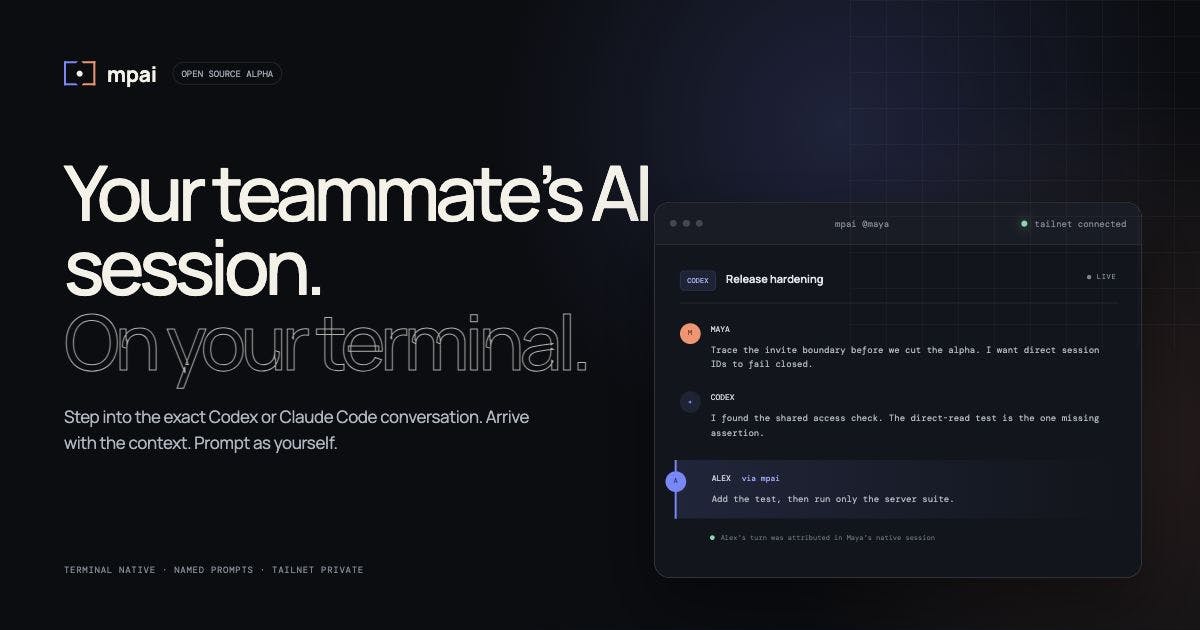
mpai is an open-source tool that transforms single-player Codex and Claude Code sessions into multiplayer collaboration experiences. Team members can join shared sessions from another Mac with full context intact, submit attributed prompts, and maintain privacy through Tailscale's peer-to-peer encrypted connections. The host always retains control over who joins and how sessions proceed.
When AI Programming Meets Multiplayer Collaboration
As AI programming tools become increasingly prevalent, terminal-based tools like Codex and Claude Code have become daily companions for many developers. These tools enable conversational programming with large language models through the command line, maintaining a continuous context window so the AI can remember previously discussed code structures, modification intentions, and technical decisions. However, a long-overlooked pain point is that these AI programming sessions are fundamentally a single-player experience. Unlike traditional IDEs that have long supported real-time collaborative editing (such as VS Code Live Share), AI programming sessions have their context windows bound to a single user's local terminal process, lacking native sharing mechanisms. When you're pair programming with AI to solve a tricky problem and want a colleague to join in debugging, you're often limited to screenshots, copy-pasting, or screen sharing to convey context — inefficient and fragmented.
The recently launched open-source tool mpai on Product Hunt targets exactly this scenario. Its core philosophy is simple and direct: turn existing Codex and Claude Code sessions into multiplayer collaboration mode. The tool received 94 upvotes on Product Hunt, ranking #11 on the daily leaderboard, spanning categories including open-source software, developer tools, and artificial intelligence.
What Problem Does mpai Actually Solve?
Joining Sessions with Real Context
mpai's most critical value lies in "context migration." Team members can join a teammate's explicitly shared native session from another Mac, "arriving with real context."
This means the person joining doesn't see a blank new session, but rather the complete conversation history, code state, and AI reasoning process their teammate is currently working with. To understand the technical complexity involved, recognize that "context" in AI programming sessions is far more complex than ordinary documents — it encompasses not just conversation history text, but also the file state of the current working directory, analyzed codebase structure, the AI's Chain of Thought, and intermediate results from tool calls. For example, Claude Code reads files, runs commands, and analyzes output while executing tasks, forming a stateful workflow. mpai needs to serialize this multi-dimensional state information and transmit it over the network, ensuring the joining user's terminal can correctly reconstruct the entire session state. This seamless context inheritance eliminates the communication overhead of repeatedly explaining "where we are right now" in traditional collaboration.
Attributed Prompt Input
When joiners enter prompts, their name is attached. This seemingly minor feature is actually crucial — in multiplayer AI sessions, clearly identifying who issued which instruction is essential for tracing decisions, understanding intent, and maintaining team collaboration transparency.
This design reflects mpai's deep thinking about the nature of collaboration: true multiplayer collaboration isn't just about giving multiple people access to the same session — it's about preserving each person's identity and contribution trail.
Balancing Privacy and Control
For any development tool involving remote access, security is an unavoidable core concern. mpai offers two clear commitments in this regard.
Tailscale Ensures Privacy
mpai builds its network connections on Tailscale. Tailscale is a zero-configuration VPN tool popular among developers, built on the WireGuard protocol. WireGuard is a modern VPN protocol known for its minimal codebase (approximately 4,000 lines, compared to OpenVPN's hundreds of thousands) and high performance. Tailscale adds identity authentication, key distribution, and NAT traversal capabilities on top of WireGuard. Its core architecture uses a coordination server (control plane) to exchange devices' public keys and network address information, but actual data transmission occurs entirely peer-to-peer between devices (data plane), never passing through any central server. This architecture is called a "zero-trust network" — every connection is encrypted and authenticated, ensuring communication security even in untrusted network environments.
For mpai, this means session data between collaborators transmits directly between two Macs, with lower latency and stronger privacy. For teams handling sensitive code and business logic, this "data never leaves the private network" architecture is an important trust foundation.
The Host Mac Always Maintains Control
mpai emphasizes that the host Mac always retains control. The session owner has final say over who can join and how the session proceeds. Joining must result from "explicit sharing" rather than arbitrary access, avoiding the permission chaos common in collaboration tools.
The Significance and Positioning of Open Source
As an open-source terminal multiplayer collaboration tool, mpai's open-source nature delivers value on several levels:
- Transparent and auditable: Developers can review the code to verify whether security promises hold up
- Low adoption barrier: Teams can freely deploy, customize, or even extend it without closed-product restrictions
- Complementary ecosystem positioning: It doesn't replace Codex or Claude Code, but layers collaboration capabilities on top of existing tools
This "Enhancement Layer" strategy has proven precedents in the developer tools ecosystem. Similar success stories include tmux (adding multi-window and session persistence to terminals) and direnv (adding directory-level environment variable management to shells). These tools don't reinvent the wheel but layer specific capabilities on existing tools. mpai's strategy is similar — it doesn't attempt to build its own AI programming engine but exists as collaboration middleware for Codex and Claude Code. The advantage of this positioning is that it automatically benefits from underlying AI tool upgrades while focusing on solving the vertical problem of collaboration. This avoids direct competition with mainstream AI programming tools while precisely filling their collaboration gap.
Scenario Value and Potential Limitations
Use Cases
mpai's most direct application scenarios include:
- Real-time AI assistance during pair programming
- Senior engineers remotely guiding newcomers through debugging
- Teams collectively reviewing AI-generated code proposals
- Distributed teams brainstorming around the same AI session
As AI penetrates deeper into programming workflows, the "human-AI-human" three-way collaboration model may become a new team work paradigm. Traditional Pair Programming originated from Extreme Programming (XP) methodology, emphasizing two people sharing one machine — one coding, one reviewing. With AI programming assistants entering the picture, the work pattern is evolving from a "human-human" binary relationship to a "human-AI-human" ternary relationship. In this new paradigm, AI serves as both executor and knowledge intermediary — it can translate one developer's intent into code while another developer reviews and corrects the AI's output in real time. GitHub's research data shows that AI-assisted pair programming improves code completion speed by approximately 55% compared to traditional approaches, and multiple participants can further reduce logic error rates in AI-generated code. mpai is an early explorer of this trend.
Limitations to Watch
Currently mpai clearly centers on Mac as its core platform, with cross-platform support status unclear, which may limit adoption by mixed-OS teams. Additionally, as an early-stage open-source tool, its stability, maximum concurrent collaborator count, and performance in complex network environments all await further real-world validation.
Conclusion
mpai represents a natural and important direction in AI programming tool evolution: moving from single-player intelligent assistants to multiplayer collaboration platforms. It captures three core collaboration elements — "context sharing," "identity attribution," and "privacy control" — combined with Tailscale's secure networking and open-source transparency to build a lightweight yet practical solution.
For Mac development teams that heavily use Codex and Claude Code and value collaboration efficiency, mpai is worth trying.
Key Takeaways
Related articles

Meet My Human: A Social Experiment Where ChatGPT Introduces You
Meet My Human is an innovative Reddit social experiment where ChatGPT introduces its human users in its own voice. Explore how AI might become a more authentic social intermediary.

cMCP: Adding Signed Receipts to AI Agent Tool Calls for Auditable Denial Mechanisms
cMCP introduces cryptographic signed receipts for AI agent tool call denials under the MCP protocol, enabling auditable refusal credentials for AI governance.

Oxide Computer Raises $445 Million to Rebuild Server Architecture from the Ground Up
Cloud hardware startup Oxide Computer raises $445M to redefine server architecture with open-source firmware and integrated rack-scale design for on-premises cloud experiences.