cMCP: Adding Signed Receipts to AI Agent Tool Calls for Auditable Denial Mechanisms

cMCP adds cryptographic signed receipts to AI agent tool call denials, enabling auditable and tamper-proof refusal evidence.
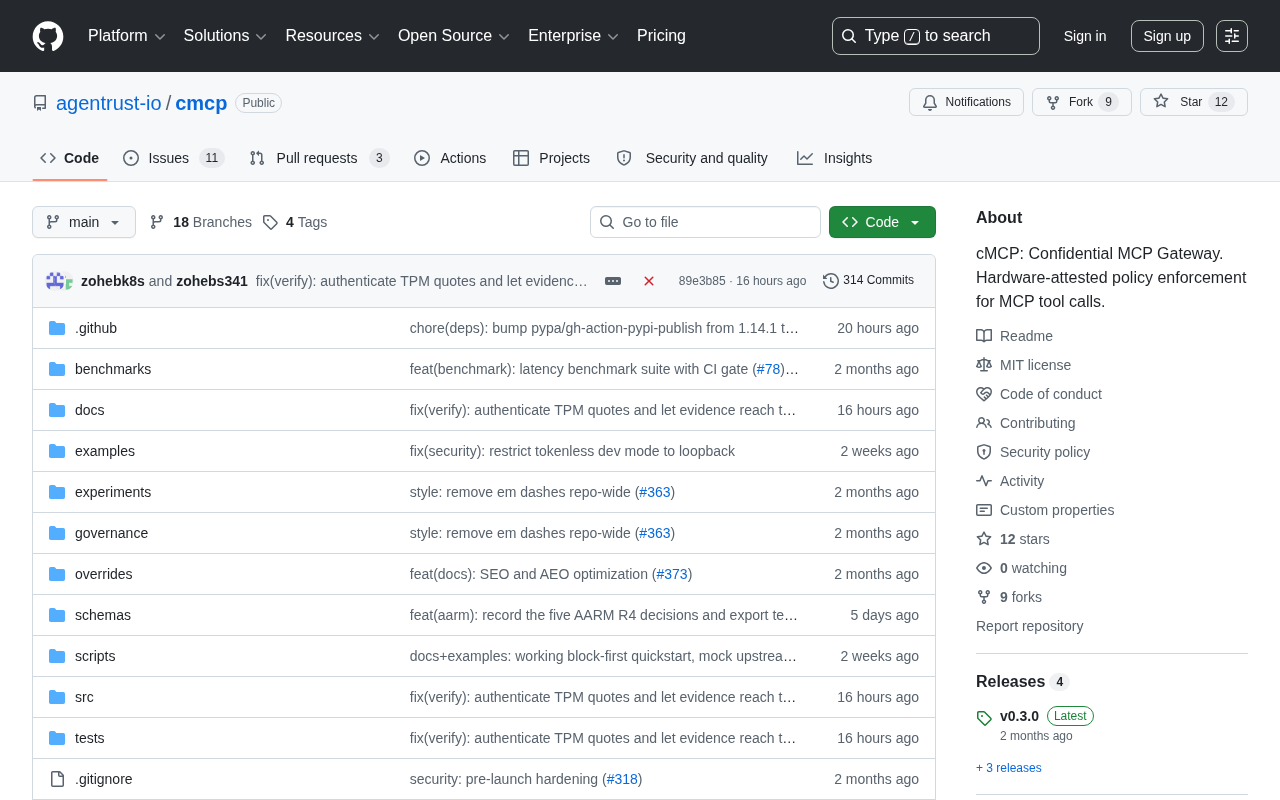
cMCP is an early-stage project that introduces cryptographic signed receipts into the MCP (Model Context Protocol) ecosystem for AI agent tool calls. When an agent's request is denied, the system generates a digitally signed receipt recording the context, timestamp, and denying party's identity—creating non-repudiable audit evidence. This fills a critical gap in AI security governance by complementing existing preventive and detective controls with post-hoc provability, aligning with zero-trust principles and emerging regulatory requirements like the EU AI Act.
When AI Agents Start "Doing Things Themselves," Who's Standing Guard?
As MCP (Model Context Protocol) gradually becomes the de facto standard for connecting large language models to external tools, AI agents are no longer just "chatting" — they're actually calling APIs, reading and writing files, executing database operations, and even triggering payments. This capacity for "autonomous action" brings tremendous efficiency gains, but also introduces a pointed question: When an AI agent requests to execute a high-risk operation, how do we safely deny it while leaving undeniable evidence?
MCP is an open protocol released by Anthropic in late 2024, designed to standardize communication between large language models and external data sources and tools. Before MCP, every AI application needed custom integration code for different tools and data sources, resulting in massive duplication of effort and a fragmented ecosystem. MCP adopts a client-server architecture where AI applications (such as Claude Desktop, IDE plugins, etc.) serve as MCP clients, while various tools and data sources expose their capabilities through MCP servers. The protocol defines three core primitives: Resources (read-only data access), Tools (allowing models to perform actions), and Prompts (prompt templates). MCP's design philosophy is similar to how USB-C standardizes physical connections — through a unified protocol, any compatible model can seamlessly interface with any compatible tool.
Recently, a project called cMCP appeared on Hacker News as a "Show HN" post. Its core concept strikes at the heart of the problem: it allows you to deny an AI agent's tool call while simultaneously obtaining a signed receipt. This seemingly simple feature actually touches on a long-overlooked aspect of AI security governance — auditable denial mechanisms.
The Core Problem cMCP Solves: From Denial to Provable Denial
Limitations of Permission Control in Existing MCP Architecture
In the existing MCP architecture, permission control for tool calls is typically binary: either allow or block. But in enterprise and compliance scenarios, simply "blocking" isn't enough. Audit, compliance, and accountability requirements demand that we be able to answer: Who denied which agent's call, at what time? Is the denial itself trustworthy and untampered with?
cMCP's approach is to layer cryptographic signatures on top of the denial action. When a tool call is denied, the system generates a signed receipt recording the call context, the denial timestamp, and the identity of the denying party. Since the receipt is signed, any subsequent tampering with the record can be detected, forming a non-repudiable audit chain.
From a cryptographic perspective, digital signatures are one of the core applications of public-key cryptography. The principle is that the signer uses a private key to perform cryptographic operations on a message (or its hash), generating a signature value. Any verifier holding the corresponding public key can confirm three things: the message was indeed issued by the private key holder (identity authentication), the message hasn't been tampered with since signing (integrity), and the signer cannot later deny the signing act (non-repudiation). Common digital signature algorithms include RSA, ECDSA, and EdDSA. In cMCP's context, the value of signed receipts lies in transforming the "denial" event from a soft state within the system into hard evidence in the cryptographic sense — even if system logs are deleted or the database is wiped, as long as the receipt itself and the signer's public key exist, the denial can be independently verified. This belongs to the same cryptographic paradigm as transaction signatures in blockchain and server identity verification in TLS certificates.
Why Signed Receipts Are Critical for AI Security Auditing
In traditional security logs, the logs themselves can be deleted or modified — especially when attackers or malicious agents have gained certain privileges. Signed receipts elevate "denial" from an "internal log" to a "publicly provable credential." This means:
- Compliance auditing: Enterprises can present cryptographic evidence to regulators proving that specific dangerous operations were indeed intercepted.
- Responsibility allocation: In multi-party systems, receipts clearly identify the responsible party for denials, avoiding finger-pointing.
- Extension of zero-trust principles: No component is assumed trustworthy; all actions must be verifiable.
Zero Trust is a security architecture philosophy whose core principle is "never trust, always verify." Traditional network security models assume the internal network is trustworthy and only place firewalls at the perimeter; Zero Trust assumes any network location, any user, and any device could be compromised, so every access request must undergo identity verification, authorization checks, and continuous monitoring. In AI agent systems, the zero-trust philosophy means: even authorized agents should have every tool call independently verified and recorded; even internal denial logs should not be assumed to be tamper-proof. cMCP's signed receipt mechanism is a concrete manifestation of zero-trust thinking — it doesn't trust the system's own log integrity, but instead generates independently verifiable evidence for each critical decision point through cryptographic means.
New Propositions for AI Agent Security Under the MCP Ecosystem
The Tension Between Agent Autonomy and Controllability
The emergence of MCP has greatly simplified model-tool integration, but has also extended the "reach" of AI agents further and further. Industry-wide concerns about prompt injection, privilege escalation, and unintended destructive operations are further amplified in autonomous agent scenarios. An agent manipulated by a malicious prompt might attempt to call tools that delete databases, transfer funds, or send sensitive information.
Prompt injection is a class of attacks targeting large language model applications, where attackers embed malicious instructions in inputs to override or bypass the system's preset system prompt, thereby manipulating model behavior. These attacks can be divided into direct injection (users directly input malicious instructions in conversation) and indirect injection (malicious instructions hidden in external documents, web pages, or emails retrieved by the model). In AI agent scenarios, indirect injection is particularly dangerous: an agent browsing web pages or reading files might inadvertently execute malicious instructions embedded within them, then leverage its tool-calling privileges to perform dangerous operations. The industry currently has no perfect defense; primary mitigation strategies include input filtering, least-privilege principles, human-in-the-loop confirmation, and behavior monitoring — and the signed denial mechanism provided by cMCP is precisely an additional security barrier at the tool-calling layer.
cMCP's "denial + credential" model essentially inserts a trusted gatekeeper into the MCP call chain. It doesn't change the agent's autonomy but adds a checkpoint where humans or policy engines can intervene for high-risk actions, and solidifies this checkpoint's decision process into verifiable records.
cMCP's Complementary Relationship with Existing AI Security Solutions
Current AI agent security solutions mostly focus on pre-emptive blocking (permission whitelists, sandbox isolation) or real-time monitoring (live behavioral analysis). cMCP's uniqueness lies in emphasizing post-hoc provability — the auditability and traceability of the denial action itself. These three approaches aren't mutually exclusive but rather constitute different layers of defense in depth. Signed receipts complete the final piece of the puzzle: the evidence chain.
Defense in Depth originates from military strategy; in information security, it refers to protecting systems through multiple independent layers of security controls so that failure at any single layer doesn't lead to a complete security collapse. In AI agent security, defense in depth can be concretized into three layers: the first layer is preventive — permission whitelists limit the scope of tools an agent can call, and sandbox isolation limits the impact of operations; the second layer is detective — real-time behavioral analysis identifies abnormal call patterns, and rate limiting prevents bulk malicious operations; the third layer is auditing — signed receipts ensure all security decisions are traceable, and tamper-proof evidence chains support compliance reports and incident investigations. cMCP fills precisely the gap of "provability of denial decisions" in this third layer, making the entire defense system a complete closed loop.
AI Governance Industry Trends from a Show HN Project
An Early-Stage Project with a Direction Worth Watching
Judging from the Hacker News activity (approximately 7 upvotes and 1 comment at publication time), cMCP is still in a very early stage with limited community discussion. As a Show HN project, it's more of a proof of concept and directional exploration, still far from a mature production-grade solution. But the questions it raises are highly forward-looking.
It's worth emphasizing that this article's analysis of cMCP's specific implementation details is based on its publicly available project description — this is single-source information, and its actual cryptographic implementation, performance overhead, and usability still await further verification.
Auditable AI Governance Is Becoming a Hard Requirement
Regardless of how far cMCP itself goes, the trend it reflects is clear: as AI agents move from demos to production, governance, auditing, and compliance will become critical topics no less important than model capabilities themselves. It's foreseeable that more middleware and infrastructure focused on identity, authorization, auditing, and non-repudiation will emerge around MCP and similar protocols.
This trend is closely related to the broader AI regulatory environment. The EU's AI Act officially came into force in 2024, with explicit requirements for traceability and transparency in high-risk AI systems. The U.S. White House's AI Executive Order similarly emphasizes the importance of safety testing and auditing. Against this regulatory backdrop, infrastructure like cMCP that provides cryptographic-level auditing capabilities may well shift from "nice to have" to a hard compliance requirement.
For developers and enterprises building AI agent systems, now is the time to consider: When your agent makes a wrong decision, can you prove that the system performed the correct gatekeeping at critical junctures? cMCP offers a rather inspiring answer.
Conclusion
cMCP uses a small but precise feature — "deny and issue a receipt" — to cut into the deep waters of AI agent security governance. It reminds us that while pursuing agent autonomy, controllability and provability are equally indispensable. Although the project is still in its early stages, the concept of "giving every denial a signed credential" may well become an important component of future trusted AI infrastructure.
Related articles

Apple HomeView Hands-On Review: Is the $300 Smart Home Hub Worth It?
Apple HomeView hands-on: a $300 smart home hub with facial recognition for quick account switching, but no App Store or voice recognition. Is the wall-mounted version worth it? Should you buy the first generation?

Meta Muse Wonder Launch: What It Means for Meta's Return to the Frontier AI Race
Meta releases Muse Wonder and WonderFull, benchmarks reach the frontier, community feedback is polarized. An in-depth look at Meta's return to the frontier AI race, its personal agent strategy, and Zuckerberg's different path.

Apple Home Smart Home Lineup Leaked: LG and Schneider Team Up, UWB Door Lock on Board
Apple Home ecosystem gains new LG and Schneider devices: UWB smart lock with proximity unlock, 2.5K dual-camera doorbell, privacy indoor camera, and AirPods-like seamless pairing.