MrBeast Reportedly Spends Millions Reverse Engineering Platform Algorithms: The Industrial Logic Behind Content Dominance

MrBeast reportedly spent millions systematically cracking platform algorithms, revealing how top content creation has become data-driven industrial engineering.
Top YouTube creator MrBeast allegedly invested millions to reverse engineer recommendation algorithms across major platforms. Though the sourcing is thin, the claim reflects a deeper industry trend. The "reverse engineering" isn't code decompilation — it's large-scale A/B testing of thumbnails, titles, and content structure, treating the algorithm as a black-box function to approximate through experimental data. This resource-intensive optimization mirrors black-box adversarial attacks in ML, and its direct consequence is amplifying the Matthew Effect in content distribution, structurally widening the gap between top creators and everyone else. As generative AI lowers production costs and enables cheaper large-scale testing, designing algorithms resistant to resource-driven exploitation will become a central challenge for platform governance.
When Content Creation Becomes Algorithm Reverse Engineering
A discussion on Hacker News has drawn attention to a striking claim: top YouTube creator MrBeast has allegedly invested millions of dollars specifically to reverse engineer recommendation algorithms across major platforms. The original post itself offers limited detail (just 9 upvotes and 9 comments), but it touches on an industry phenomenon worth examining — as content creation pushes toward extreme industrialization, understanding and taming algorithms has become a core capability requiring dedicated resource investment.
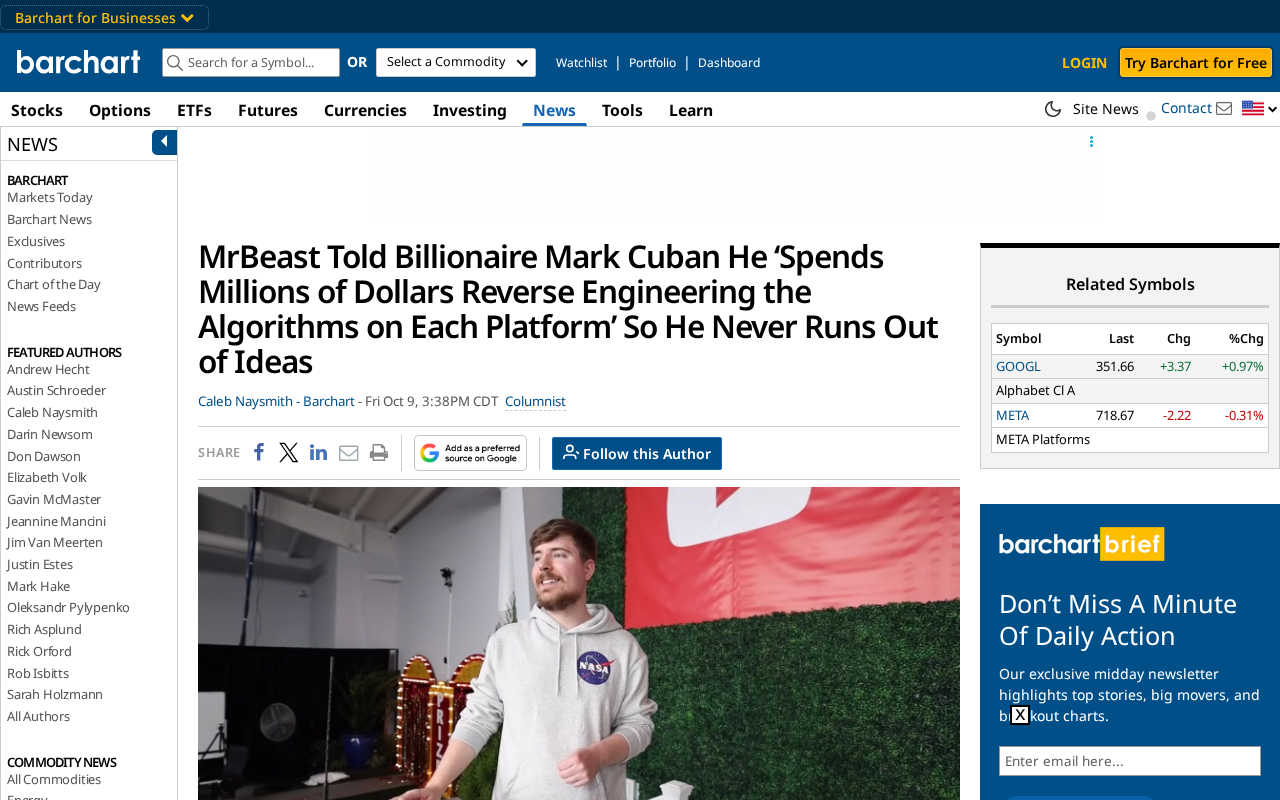
For ordinary creators, the algorithm is a black box: you publish content, and the platform decides how many people see it. For top-tier players like MrBeast, that passive relationship is clearly unacceptable. A more accurate interpretation of "reverse engineering the algorithm" might be: systematically figuring out what thumbnails, titles, and opening seconds maximize retention and click-through — through massive A/B testing, data analysis, and a highly organized team operation.
What Does "Reverse Engineering" Actually Mean Here
To be clear, this "reverse engineering" almost certainly isn't traditional software decompilation. Platform recommendation algorithms are highly confidential server-side systems with no externally accessible code. The more realistic interpretation is empirical, data-driven decoding.
Industrializing Data Experimentation
MrBeast's team is widely known for running large-scale tests on video thumbnails and titles. Before a video is officially pushed out, dozens of thumbnail variations may already have been tested. By observing how different variants perform on click-through rate (CTR) and watch time, the team reverse-infers what the platform is actually "rewarding." In essence, this treats the recommendation algorithm as a function that can be observed through inputs and outputs, using experimental data to approximate its behavioral patterns.
A/B testing (split testing) is the foundational methodology for internet product optimization: randomly divide an audience into two groups, present each with a different version of content, and use statistical significance testing to determine which version performs better. YouTube's Creator Studio offers limited built-in testing functionality, but MrBeast's team reportedly goes far beyond this — pushing different thumbnails to small audience segments in the early hours after a video goes live, collecting CTR data, and then deciding which version to serve to the broader audience. CTR is one of the key early signals platforms use to determine whether content deserves wider distribution, typically having the greatest influence on algorithmic decisions in the first few hours after upload. This explains why precise thumbnail testing can produce a significant distribution leverage effect.
Why It Takes "Millions"
If the dollar figure is accurate, the spending isn't on the algorithm itself — it's on the infrastructure supporting this kind of experimentation: specialized data analysis teams, production costs for shooting and editing multiple versions, and content structure design optimized around retention rates. In other words, the money goes toward turning "dark arts" into a science.
The Ongoing Battle Between Platform Algorithms and Creators
This phenomenon reflects a long-standing tension in the creator economy: platforms want their algorithms to remain opaque, to maintain fairness and prevent manipulation; meanwhile, top creators have strong incentives to crack them in order to consolidate their advantage.
When a small number of well-resourced players can systematically optimize their algorithmic performance, the "Matthew Effect" in content distribution gets further amplified. One of the original goals of recommendation algorithms was to give quality content a fair shot at exposure — but when optimization itself becomes a discipline requiring millions of dollars in investment, the gap between mid-sized creators and the top tier may become structurally entrenched.
The Matthew Effect (coined by sociologist Robert Merton in the context of scientific resource allocation) describes the positive feedback loop of "the rich get richer, the poor get poorer." In content distribution ecosystems, this manifests as: new videos from high-subscriber channels receive larger seed audiences in the algorithm's initial distribution phase, accumulating more early engagement signals, which in turn earns even broader reach. When top creators can additionally invest resources to optimize algorithmic response rates, the gap in that flywheel's speed widens further. Academics have taken note as well — some researchers point out that platform recommendation systems inadvertently create an "attention tax," where smaller creators producing equally good content must absorb much higher randomness costs just to overcome the cold-start bottleneck.
Implications for AI Recommendation Systems
From a technical perspective, this case is a vivid example of adversarial optimization against recommendation systems. Modern recommendation algorithms increasingly rely on machine learning models, and the MrBeast approach is essentially a "black-box attack" on these models using human labor and capital — no knowledge of internal model parameters is needed; strategy is optimized purely by observing the relationship between inputs and outputs.
This also poses a challenge for platforms: how do you design an algorithm that rewards genuinely high-quality content without being dominated by resource-heavy optimization? As generative AI lowers the barrier to content production and drives down the marginal cost of large-scale testing, this arms race will only intensify.
Black-box attack is a term from machine learning security, referring to scenarios where an attacker, without access to a model's internal parameters or architecture, repeatedly queries the model's inputs and outputs to infer its decision boundaries and exploit them. The counterpart — a "white-box attack" — requires full model access. The MrBeast-style algorithm optimization is methodologically isomorphic to black-box adversarial attacks in ML: both rely on large volumes of probing experiments, using statistical patterns to approximate the target system's behavior. The difference is that traditional black-box attacks aim to fool the model, while content optimization aims to get the model to "genuinely" assign higher scores — but both have a similar effect on algorithmic fairness: the party with a larger query budget (i.e., more resources) holds a structural advantage.
Keeping This in Perspective
It must be noted that the original source for this claim is quite thin — more of a conversation-starting headline than a verified, in-depth report. Both "millions of dollars" and "reverse engineering" carry a degree of exaggeration and virality.
What's genuinely valuable isn't the specific number, but the trend it reveals: top-tier content creation has evolved into a systems engineering discipline that blends data science, psychology, and industrialized workflows. For those tracking the intersection of AI and the content industry, this is a reminder — recommendation algorithms have never been a neutral technical backdrop. They are a dynamic battleground where all parties continuously compete, optimize, and counter-optimize.
Related articles

Felix Rieseberg Personal Homepage
Felix Rieseberg's personal homepage sparks attention on Hacker News. This article covers the Slack engineer's technical background, the rise and fall of nativefier, and the value of a developer homepage as a tech calling card.

@ai-sdk/vue 3.0.306 Patch Release Syncs with [email protected] Update
@ai-sdk/vue 3.0.306 released, synced with [email protected]. A routine patch release for the Vercel AI SDK ecosystem with no public API changes; the Vue adapter layer stays version-aligned with the core package.

Gemini 4 Argon API Launches: The Era of Million-Token Output Begins
Google launches Gemini 4 Argon with sparse MoE architecture, up to 1M output tokens, and a 68.90% Vals Index score, available across API, AI Studio, and the Gemini app.