MudawanSn: Bridging the Gap in Wolof–Arabic Machine Translation
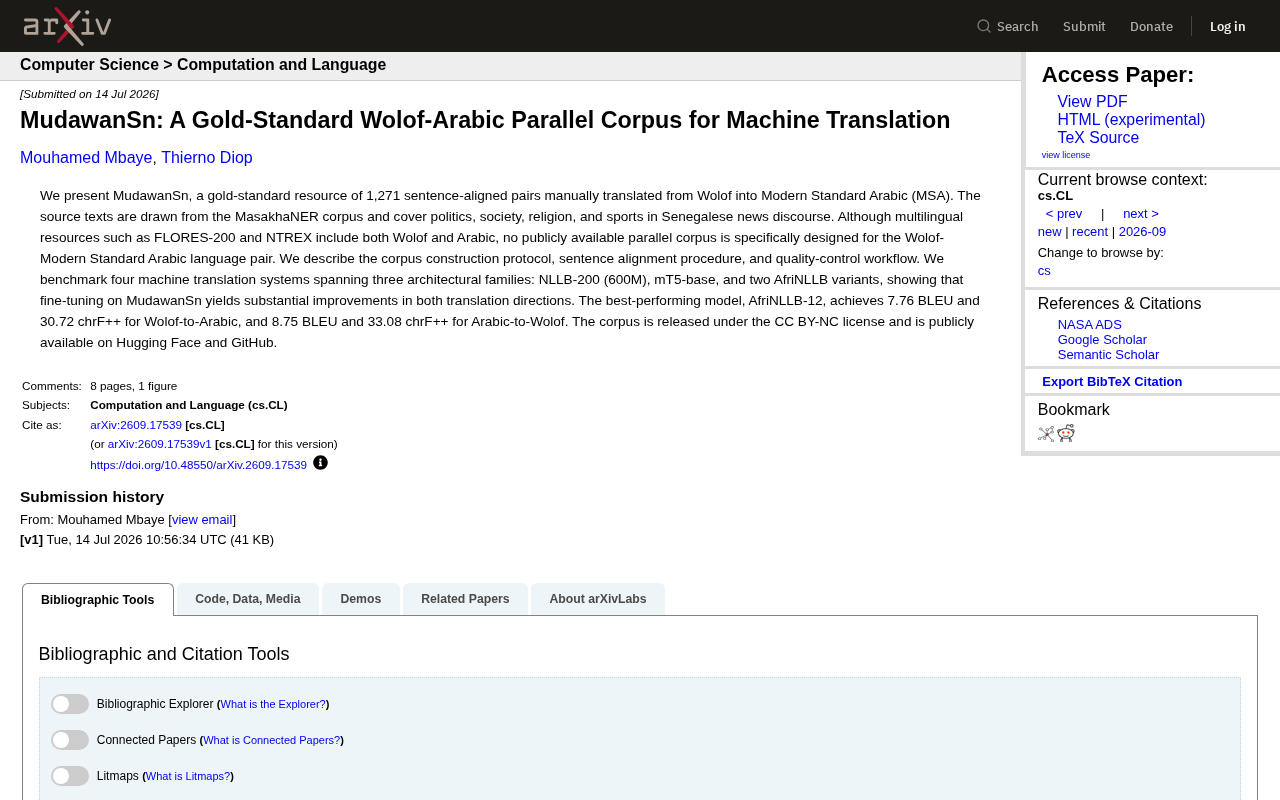
MudawanSn: the first gold-standard parallel corpus bridging Wolof and Modern Standard Arabic.
MudawanSn is the first human-translated parallel corpus designed specifically for Wolof and Modern Standard Arabic, containing 1,271 sentence-aligned pairs sourced from MasakhaNER news texts spanning politics, society, religion, and sports in Senegal. Benchmarks on NLLB-200, mT5-base, and two AfriNLLB variants show significant quality gains after fine-tuning, with AfriNLLB-12 achieving the best results — chrF++ scores above 30 in both directions. Released under CC BY-NC on Hugging Face and GitHub, it establishes a reproducible evaluation baseline for a previously resource-free language pair.
A Neglected Language Pair
Machine translation research has long centered on high-resource languages like English, Chinese, and French, leaving a severe gap in translation capabilities between indigenous African languages and Arabic. Wolof is the primary language spoken by millions in Senegal and surrounding regions, while Modern Standard Arabic (MSA) holds significant religious and cultural importance in West African Muslim communities. There is a genuine demand for direct translation between these two languages — yet the available resources are virtually nonexistent.
Although multilingual benchmarks such as FLORES-200 and NTREX include both Wolof and Arabic, no publicly available parallel corpus has ever been designed specifically for the Wolof–Modern Standard Arabic language pair. MudawanSn was created to fill exactly this gap.
Corpus Construction and Scale
MudawanSn provides 1,271 sentence-aligned gold-standard parallel pairs, all human-translated from Wolof into Modern Standard Arabic. The source texts are drawn from the MasakhaNER corpus, covering topics in Senegalese news discourse — including politics, social issues, religion, and sports — making it representative of real-world contexts.
The research team provides detailed documentation of the corpus construction protocol, sentence alignment process, and quality control workflow. "Gold-standard" means these translations were produced and verified by human translators rather than generated by machines or sourced from low-quality crowdsourcing — a critical distinction for low-resource language benchmarks, where data quality matters more than quantity when it comes to model fine-tuning.
It is worth noting that 1,271 sentence pairs is a modest scale for training large models, but as a fine-tuning dataset and evaluation benchmark, its value lies in precision and domain coverage rather than sheer volume.
MasakhaNER is a multilingual annotated corpus built for named entity recognition tasks across African languages, covering more than ten languages (including Wolof), with texts sourced from local-language news websites. Using MasakhaNER as the source material offers several advantages: the news genre ensures natural fluency and topical diversity, and the corpus benefits from community-maintained quality assurance, making it a solid foundation for a parallel corpus. Sentence alignment — the process of establishing precise sentence-level correspondences between source and target language texts — is a critical step in parallel corpus construction, ensuring each source sentence maps exactly to its translation and avoiding training noise from paragraph drift or multi-sentence merging.
Benchmarking Four Models
The research team benchmarked four machine translation systems across three model architecture families: NLLB-200 (600M parameters), mT5-base, and two AfriNLLB variants. Results show that fine-tuning on MudawanSn yields significant improvements in both translation directions.
The best-performing model, AfriNLLB-12, achieved a BLEU score of 7.76 and a chrF++ score of 30.72 on the Wolof-to-Arabic direction, and 8.75 BLEU with 33.08 chrF++ on Arabic-to-Wolof.
In absolute terms, these BLEU scores remain low, reflecting the inherent difficulty of low-resource language translation — scarce training data, large morphological differences, and insufficient pre-training coverage all drag down model performance. However, the chrF++ scores are noticeably higher than BLEU, indicating that models perform relatively better at character-level matching, which is a common finding when evaluating morphologically rich language translation. The AfriNLLB variants — optimized for African languages — outperformed the general-purpose NLLB-200 and mT5, reinforcing the value of region-specific pre-training.
BLEU (Bilingual Evaluation Understudy) is the most widely used automatic evaluation metric in machine translation, measuring translation quality by computing n-gram overlap between machine output and reference translations, on a scale of 0 to 100 (higher is better). chrF++ is a character-level n-gram metric that is more robust for morphologically rich languages — such as Arabic's inflectional system and Wolof's prefix/suffix agglutinative morphology — because character-level matching is more tolerant of morphological variants and doesn't penalize a word entirely for an affix change. NLLB-200 (No Language Left Behind) is Meta's 2022 multilingual translation model covering 200 languages; AfriNLLB is a derivative further optimized with African language pre-training; mT5 is Google's multilingual text-to-text pre-trained model. Together, these three represent a spectrum from general large-scale models to regionally specialized ones, and the comparative results in this study provide empirical support for the "domain-specialized pre-training" strategy.
Open License and Research Significance
MudawanSn is released under a CC BY-NC license and is publicly hosted on Hugging Face and GitHub for direct use and reproduction by the research community. The non-commercial license means it is freely available for academic research, though commercial use requires separate authorization.
For researchers committed to linguistic diversity and technological equity, resources like this carry significance beyond raw performance numbers. MudawanSn establishes a reproducible evaluation starting point for a language pair that previously had no dedicated parallel corpus, and it offers a replicable methodology for future work. Whether the goal is expanding the corpus, adding new domains, or exploring more suitable model architectures, MudawanSn provides a solid baseline to build on.
At its core, machine translation research for low-resource languages is about narrowing the global digital divide. Work like MudawanSn is a necessary step toward making AI technology accessible to a broader range of language communities.
Related articles
The Open Source Dilemma: A Non-Autoregressive Architecture Pioneer Overshadowed by Frontier Labs
An indie developer claims a frontier lab repackaged his year-old open-source non-autoregressive RL architecture as a breakthrough. We compare PPO sequence embeddings vs. RLCD parallel sampling and examine open source attribution gaps.
AI Plans an Entire Vineyard: A Real-World Experiment with 100 Grapevines
A Spokane hobbyist let Muse AI plan his entire vineyard — variety, spacing, irrigation, even the logo. He planted 100 Cabernet Franc vines and is documenting everything publicly.
Iceland's Treble Raises $18M to Bet on Voice Simulation Platform
Iceland-based voice simulation company Treble raises $18M. Its platform serves voice AI developers, AI wearables, and robotics firms. A deep dive into the technology and what the funding signals.