Multi-Agent Collaborative Paper Writing System: End-to-End Automation with FastAPI + Vue 3

A FastAPI + Vue 3 paper writing platform combining LLM, RAG, and multi-Agent collaboration.
This article analyzes an intelligent paper writing platform built with FastAPI + Vue 3, integrating LLM, RAG, and multi-Agent collaboration to automate the full workflow—from topic selection and outline generation to writing and polishing—making it an ideal case study for AI application developers.
Project Overview: An Intelligent Writing System from Topic Selection to Polishing
Recently, a content creator on Bilibili shared an intelligent paper writing platform built on the FastAPI + Vue 3 tech stack. This project integrates cutting-edge technologies such as Large Language Models (LLM), RAG (Retrieval-Augmented Generation), and multi-Agent collaborative writing, achieving full-process automation covering topic selection, outline generation, content writing, and polishing optimization.
For researchers, graduate students, and technical developers, this project is not only a practical writing assistant tool but also an excellent case study for learning modern AI application architecture—it clearly demonstrates how to orchestrate and coordinate multiple AI expert roles to collectively accomplish a complex, knowledge-intensive task.
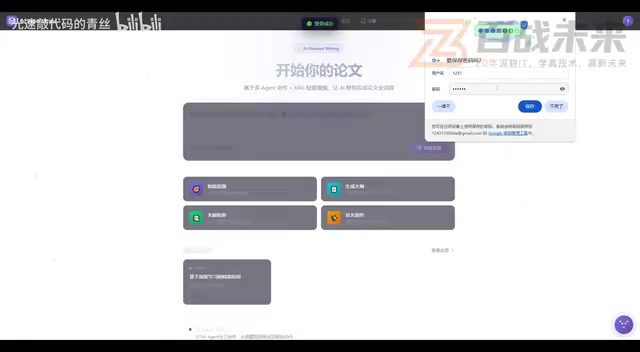
Core Features: Five Modules Covering the Entire Writing Workflow
The system's feature design covers the complete paper writing pipeline, mainly consisting of the following core modules:
User Authentication and Permission Management
The system adopts a standard registration and login mechanism, implementing identity verification based on JWT (JSON Web Token) to ensure secure isolation of user data. Interestingly, if the backend database sits idle for an extended period, it enters a dormant state, which may occasionally cause the first access to fail—simply retry a few times. This is a common phenomenon among projects that use free cloud databases.
Intelligent Topic Selection and Outline Generation
Intelligent topic selection is one of the system's core highlights. Users only need to enter a research field and keywords, and the system can recommend 3 to 5 valuable topic directions based on the capabilities of the large model. After selecting a topic, users can further generate a structured paper outline, with support for manual editing and adjustment. This "AI generation + manual correction" interaction model strikes a good balance between efficiency and controllability.
Full-Text Generation and AI Editing
The body-writing stage supports one-click full-text generation and comes with built-in auxiliary functions such as AI expansion, AI rewriting, and AI polishing (some features are still under iterative development). The generation process uses Streaming technology, allowing users to view content generation progress in real time, effectively improving the waiting experience during long-text generation.
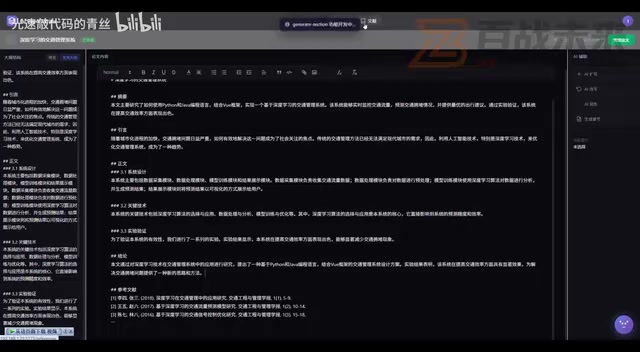
Literature Management and AI Workflow Visualization
The system provides complete literature management functionality, supporting full CRUD operations. AI workflow visualization is another design highlight—users can intuitively view the execution status of each paper stage and perform semantic retrieval based on the vector database, enabling intelligent literature matching and citation recommendations.
Technology Choices: A Modern Full-Stack Architecture Explained
This project adopts a mainstream current tech stack, offering high engineering reference value.
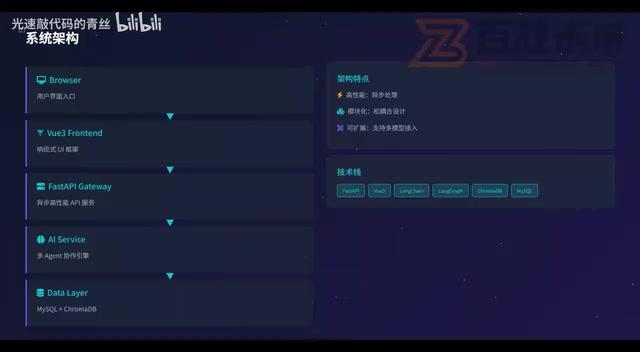
Backend Tech Stack
- Programming Language: Python 3.10+
- Web Framework: FastAPI (high-performance asynchronous RESTful API)
- ORM: SQLAlchemy (database operation abstraction layer)
- Workflow Engine: LangChain (multi-Agent collaborative process orchestration)
- Vector Database: ChromaDB (supporting RAG semantic retrieval)
Frontend Tech Stack
- Framework: Vue 3.4+
- Language: TypeScript
- Component Library: Element Plus
- Build Tool: Vite 5.3
With its asynchronous nature and automatic API documentation generation, FastAPI is naturally suited to handle LLM calls; Vue 3 + TypeScript + Vite represents the modern best practice in frontend engineering. The combination of the two is currently the mainstream "golden pairing" for AI application development.
System Architecture: Layered Design and Multi-Agent Orchestration
Overall, the system adopts a clear four-tier layered architecture:
- Frontend Layer: A user interaction interface built on Vue 3
- API Gateway Layer: RESTful API services provided by FastAPI
- AI Orchestration Layer: Multiple AI workflows orchestrated using LangChain
- Data Layer: MySQL for storing structured data, ChromaDB for storing vector data
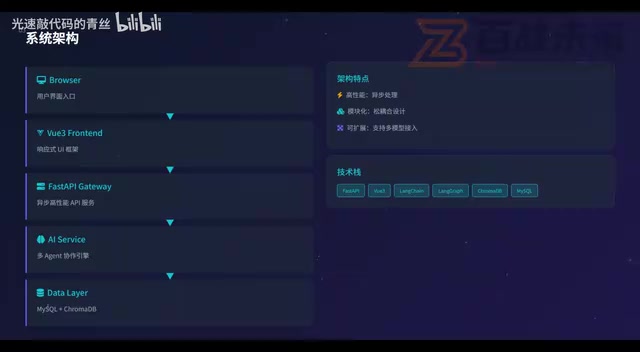
Multi-Agent Expert Collaboration Mechanism
The most technically valuable part of this project is its multi-Agent writing process design. The system breaks down paper writing into multiple specialized AI roles, each with its own responsibilities:
- Topic Selection Expert: Responsible for analyzing research directions and recommending topics
- Outline Expert: Responsible for paper structure planning and outline generation
- Writing Expert: Responsible for writing the body text of each chapter
- Literature Expert: Responsible for literature retrieval, management, and citation
- Polishing Expert: Responsible for language optimization and reducing repetition
Compared to a single large model completing all tasks "in one breath," multi-Agent collaboration allows each role to focus on a specific subtask, significantly improving output quality and controllability. The Agents are linked together through the workflow engine, ultimately forming a complete automated writing pipeline.
In-Depth Analysis of Three Key Technical Highlights
Overall, the core value of this project is reflected in the following three aspects:
① Practical implementation of RAG technology. By using a vector database for semantic retrieval, the system can cite relevant literature when generating content, alleviating the "hallucination" problem of large models to some extent and improving the accuracy and credibility of paper citations.
② Engineering practice of multi-Agent orchestration. Breaking down complex writing tasks into expert collaboration is not only a technical ingenuity but also aligns with the division-of-labor logic of real academic writing, making it an ideal reference project for developers who want to dive deep into Agent development.
③ Experience optimization through streaming output. Presenting the generation process in real time avoids long blank waits, which has become a key design principle for improving user experience in LLM applications.
It should be specifically noted that such tools should be positioned as writing assistants rather than complete replacements for a researcher's judgment. AI-generated content still requires rigorous fact-checking, logical review, and adherence to academic standards. In addition, some features (such as AI expansion) are still under development and refinement, so their actual use should be evaluated rationally based on real circumstances.
Conclusion
This paper writing system, which integrates FastAPI, Vue 3, and a multi-Agent collaboration mechanism, is a typical example of an AI application with a modern tech stack and clear architecture. It intuitively demonstrates how to organically combine LLM, RAG, and multi-Agent collaboration and apply them to the vertical scenario of paper writing. For readers hoping to get started with AI application development, a locally runnable project with complete source code is undoubtedly an excellent starting point. According to the creator, upcoming content will provide an in-depth analysis of the system's technical architecture and core code implementation—well worth continued attention.
Related articles

Transformer²: Achieving Co-Design of Robot Morphology and Control with a Unified Architecture
Deep dive into how Transformer² uses a unified Transformer architecture to integrate robot morphology design and motion control into one model, enabling task-driven end-to-end co-design for embodied AI.

Tutorial: Installing Tailscale on a Jailbroken Kindle to Create a Private Network Node
Learn how to deploy Tailscale on a jailbroken Kindle, turning an idle e-reader into a private network node. Covers cross-compilation, power optimization, and risk considerations.
Tutorial: Installing Tailscale on a Jailbroken Kindle to Create a Private Network Node
Learn how to deploy Tailscale on a jailbroken Kindle to turn an idle e-reader into a private network node. Covers cross-compilation, power optimization, and risk considerations.