Multi-Agent Orchestration Framework: A Super AI Development Team of 98 Expert Agents

98 expert agents form a swarm-style AI dev team covering the entire software development lifecycle.
A multi-agent orchestration framework built on Claude Code, featuring 98 expert agents covering architecture design, coding, testing, operations, and more. It employs swarm-style orchestration for unified collaboration, HNSW vector memory for sub-millisecond knowledge retrieval, and autonomous learning for continuous improvement. Supports cross-machine federated collaboration with data privacy protection, offers both plugin and WebUI modes, and is MIT-licensed open source.
Project Overview: 98 Expert Agents Building an AI Super Development Team
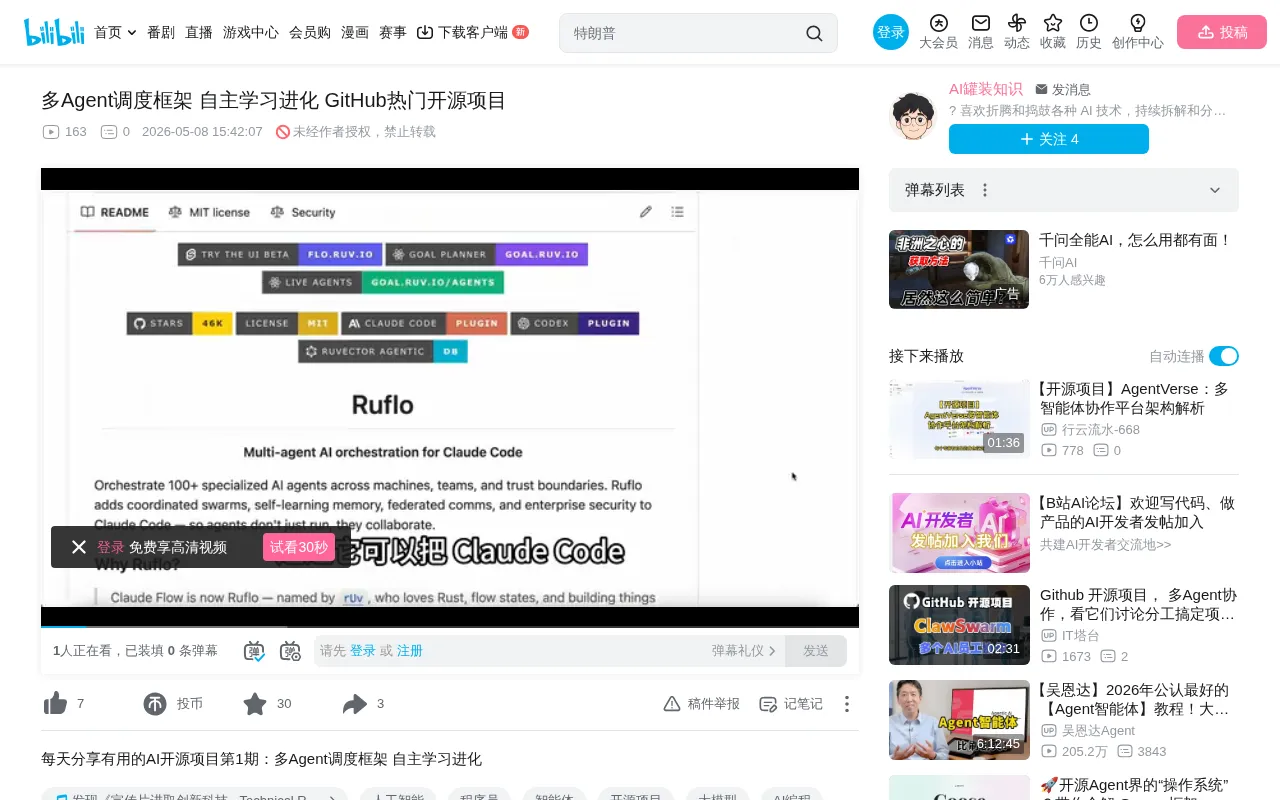
A multi-agent orchestration framework has recently surged in popularity on GitHub, generating significant buzz in the developer community. The project's core concept is straightforward—transform Claude Code into a complete AI development team with 98 built-in expert agents covering the entire software development lifecycle, from architecture design, documentation, coding, and automated testing to operations and deployment.
Claude Code is a command-line AI programming tool developed by Anthropic, built on the Claude large language model. It can understand natural language instructions directly in the terminal and execute tasks like code writing, file modification, and Git operations. Unlike GitHub Copilot, which primarily provides code completion, Claude Code is more akin to an "AI developer" role—it understands project context, executes multi-step operations, and proactively suggests improvements. It supports functional extensions through custom commands and a plugin mechanism, which is the technical foundation that allows the multi-agent framework introduced in this article to integrate seamlessly as a plugin.
Notably, these agents don't work in isolation. Instead, they collaborate in an orderly fashion through a sophisticated orchestration mechanism, truly achieving "a team of AIs working for you." The project is open-sourced under the MIT license, completely free for commercial use.
Core Architecture: Swarm-Style Multi-Agent Collaboration
Queen Bee Leadership Model: Unified Orchestration to Avoid Chaos
This framework draws inspiration from how bee colonies organize in nature, implementing a "queen-led swarm" orchestration mechanism. A core agent acts as the queen bee, responsible for understanding user intent, decomposing complex tasks, and then assigning subtasks to the most suitable expert agents for execution. All agents share a collective memory and maintain decision consistency through a consensus algorithm.
Swarm Intelligence is an important research direction in artificial intelligence, originating from the observation and simulation of collective behavior in nature. In real bee colonies, the queen bee coordinates the behavior of tens of thousands of worker bees through pheromones and other chemical signals, achieving highly efficient division of labor. This hybrid of centralized and decentralized organization has been adopted by computer scientists for multi-agent system design. Compared to traditional single-agent architectures, the core advantage of Multi-Agent Systems (MAS) lies in the fact that each agent can focus on reasoning and decision-making in a specific domain, accomplishing complex tasks through collaboration that a single agent would struggle to handle alone. In recent years, as large language model capabilities have improved, multi-agent frameworks like AutoGen, CrewAI, and LangGraph have emerged one after another. However, resolving task conflicts, information synchronization, and decision consistency between agents remains the core challenge in this field.
This swarm-style architecture delivers three clear advantages:
- Unified Orchestration: The core agent coordinates task assignment, preventing conflicts or redundant work between multiple agents
- Shared Collective Memory: All agents can access the same contextual information, completely eliminating information silos
- Consensus Algorithm Guarantee: When handling complex tasks, multiple agents can reach agreement, ensuring output coherence
Regarding the consensus algorithm, this concept originally comes from the distributed systems field, designed to solve the problem of how multiple nodes can reach agreement despite faults or delays. Classic consensus algorithms include Paxos, Raft, and PBFT from the blockchain domain. In multi-agent collaboration scenarios, the consensus algorithm ensures that when multiple agents produce different judgments about the same problem, they can converge to a unified decision through structured negotiation mechanisms. For example, when an architecture design agent suggests a microservices architecture while an operations agent believes a monolithic architecture is more suitable for the current team size, the consensus mechanism comprehensively evaluates the weight of each party's arguments and contextual constraints, ultimately producing a solution that all parties accept.
98 Expert Agents: Full Lifecycle Coverage
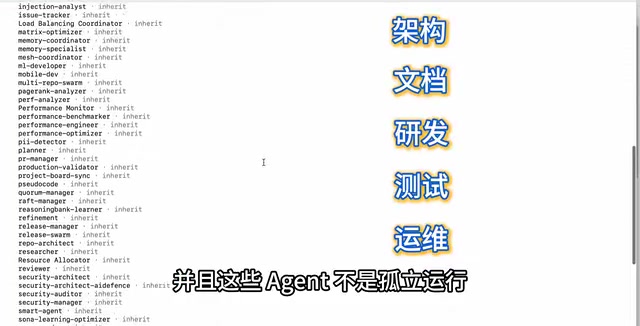
The framework's 98 built-in expert agents are divided by function to cover the complete software development lifecycle:
- Architecture Design Agents: Responsible for system architecture planning, technology selection, and module partitioning
- Documentation Agents: Automatically generate API documentation, READMEs, technical proposals, and other project documents
- Development & Coding Agents: Execute specific code writing and feature implementation
- Testing & QA Agents: Automated test case generation, execution, and quality inspection
- Operations & Deployment Agents: Handle deployment configuration, runtime monitoring, and troubleshooting
Each agent has clearly defined responsibilities and specialized capabilities, performing their respective duties under the queen bee's orchestration.
Performance Highlights: Vector Memory and Autonomous Learning
Sub-Millisecond Memory Retrieval Based on HNSW Indexing
On the performance front, the framework integrates a vector memory system based on HNSW indexing, achieving sub-millisecond retrieval speeds. In practice, this means agents can recall historical experience and relevant knowledge in near real-time while processing tasks, delivering extremely fast response times.
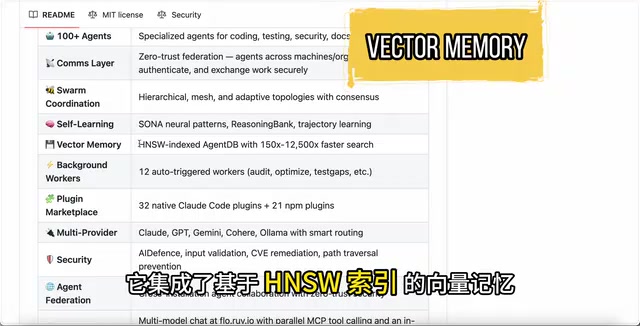
HNSW (Hierarchical Navigable Small World) is one of the mainstream approximate nearest neighbor search algorithms, proposed by Russian researcher Yuri Malkov and colleagues in 2016. Its core idea is to build a multi-layer graph structure: the bottom layer contains all data points forming a dense small-world network, while upper layers become progressively sparser, retaining only certain "stepping stone" nodes. During search, it starts from the highest layer, using sparse layers to quickly locate the target region, then descends layer by layer for fine-grained search—similar to a navigation strategy of "taking a bullet train to the city first, then hailing a taxi to the specific address." Compared to brute-force search with O(n) complexity, HNSW can complete retrieval at O(log n) level, maintaining millisecond-level response even at million or billion-scale vector volumes. Leading vector databases like Pinecone, Milvus, and Weaviate all use HNSW as their core indexing algorithm. By applying it to the agent's memory system, retrieval speed won't noticeably degrade even as historical data continuously accumulates, ensuring long-term system viability.
It's worth further explaining that vector memory systems are fundamentally different from traditional databases. Traditional databases (such as MySQL, PostgreSQL) perform data retrieval based on exact matching, requiring pre-defined query conditions and index fields. Vector memory systems, on the other hand, transform unstructured information like text, code, and experiences into high-dimensional vectors (typically 768 or 1536-dimensional floating-point arrays) through embedding models, then find semantically similar content by calculating cosine similarity or Euclidean distance between vectors. This means agents don't need to remember exact keywords—they can find relevant experiences based on semantic understanding. For example, when an agent encounters a "database connection pool exhausted" issue, even if the historical record describes it as "DB connection pool exhausted," vector retrieval can accurately match that experience because the two are close in vector distance within the semantic space.
Autonomous Learning Evolution: An Agent Team That Gets Smarter Over Time
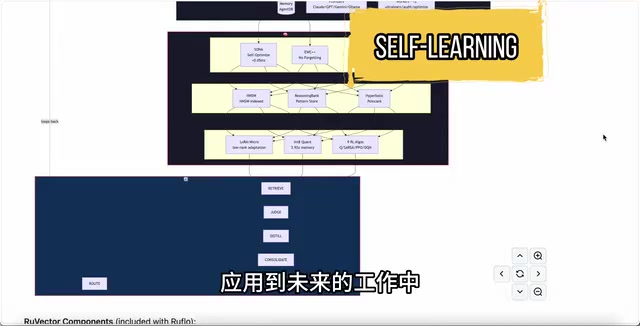
The autonomous learning mechanism is the most noteworthy feature of this multi-agent framework. The system automatically extracts successful patterns from completed tasks, solidifies effective experiences into reusable knowledge, and then intelligently applies them in subsequent tasks. In other words, this AI development team continuously evolves with use, achieving increasingly higher task accuracy over time.
Specifically, the autonomous learning mechanism consists of four key stages:
- Pattern Extraction: Identifying key decision paths and execution patterns from successfully completed tasks
- Experience Solidification: Converting validated patterns into structured knowledge units stored in the vector memory
- Intelligent Matching: Automatically retrieving and matching the most relevant historical experiences when encountering new tasks
- Feedback Iteration: Continuously adjusting strategy weights based on task execution results to optimize decision quality
Agent Federation: Cross-Machine Remote Collaboration
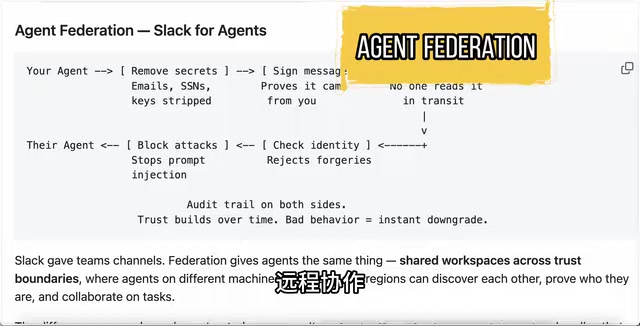
The framework also provides an Agent Federation feature, supporting networked collaboration among agents deployed on different machines. Agents on each node can remotely coordinate to complete large-scale engineering development while ensuring that each node's data doesn't leak to other nodes.
Federated Learning was first proposed by Google in 2016, originally designed to solve model training on mobile devices—allowing multiple devices to collaboratively train models while keeping raw data local without uploading. This concept was later widely applied in healthcare, finance, and other industries with stringent data privacy requirements. In the Agent Federation scenario, the core principle is similar: agents on each node only share task coordination information and abstracted intermediate results (such as interface definitions and module specifications), without transmitting specific code implementations, business data, or sensitive configurations.
This federated learning-inspired design directly addresses the most challenging data privacy concerns in enterprise scenarios. For example, agents from different departments or teams can jointly complete a cross-departmental project while keeping their respective codebases, business data, and sensitive information independent and secure. This design complies with regulations like GDPR (EU General Data Protection Regulation) and China's Data Security Law. For enterprises with compliance requirements, frontend teams, backend teams, and data teams can each run independent agent nodes, collaborating through federation protocols to develop a complete product without exposing their codebases to other teams—an extremely practical feature.
Two Usage Modes: Claude Code Plugin and WebUI
The framework offers two integration methods to accommodate different use cases:
Mode 1: Claude Code Plugin (Recommended)
Install as a plugin in Claude Code, then use Claude Code as usual. The framework runs automatically in the background, intelligently dispatching the appropriate expert agents based on task type. This approach is completely transparent to users—no need to change existing workflows, with virtually zero onboarding cost. Claude Code's plugin ecosystem supports customizing AI behavior through CLAUDE.md configuration files and custom slash commands, and the multi-agent orchestration framework leverages this extension mechanism to implement dynamic loading and dispatching of expert agents.
Mode 2: WebUI Chat Interface
Interact with the agent swarm directly through the framework's built-in WebUI via a conversational chat interface. This approach is more intuitive, allowing you to observe the entire task assignment and execution process. It's ideal for developers who need fine-grained control over agent behavior or want to deeply understand the orchestration mechanism.
Conclusion: The Future Direction of Multi-Agent Collaborative Development
This multi-agent orchestration framework demonstrates an important evolutionary direction for AI-assisted development tools: moving from a single AI assistant to multi-agent team collaboration. Swarm-style orchestration ensures rational task allocation, HNSW vector memory provides efficient knowledge retrieval, the autonomous learning mechanism enables continuous system evolution, and federated collaboration bridges the last mile of cross-team coordination.
For developers, the MIT open-source license means freedom to use, modify, and build upon the project. If you're looking for a multi-agent solution that can genuinely boost development efficiency, this project is worth investing time to explore and experiment with.
Related articles
 Product Reviews
The Programmer's Desk Setup Guide: Building a Workspace That Feels Like Home
Discover how programmers build productive, comfortable workspaces. From multi-monitor setups to ergonomic design, explore the desk philosophy that drives focus and flow.
 Product Reviews
Qoder vs Cursor Real-World Comparison: Which $20/Month AI IDE Is Better?
Hands-on comparison of Qoder vs Cursor AI IDEs: Agent autonomy, human interaction count, and architecture decisions. Qoder needed only 2 interactions vs Cursor's 8.
 Product Reviews
Cursor Cloud Agent Demo: Eliminating Bottlenecks Across the Entire Software Development Lifecycle
Deep analysis of Cursor's Cloud Agent demo showing how cloud VMs, automated test artifacts, and a full-chain control plane systematically eliminate human bottlenecks across the software development lifecycle.