Multi-Agent System TriAgent: A Real-World Case for Automatically Fixing Documentation Drift

TriAgent multi-agent system automatically finds and fixes documentation gaps by triaging tickets and code diffs.
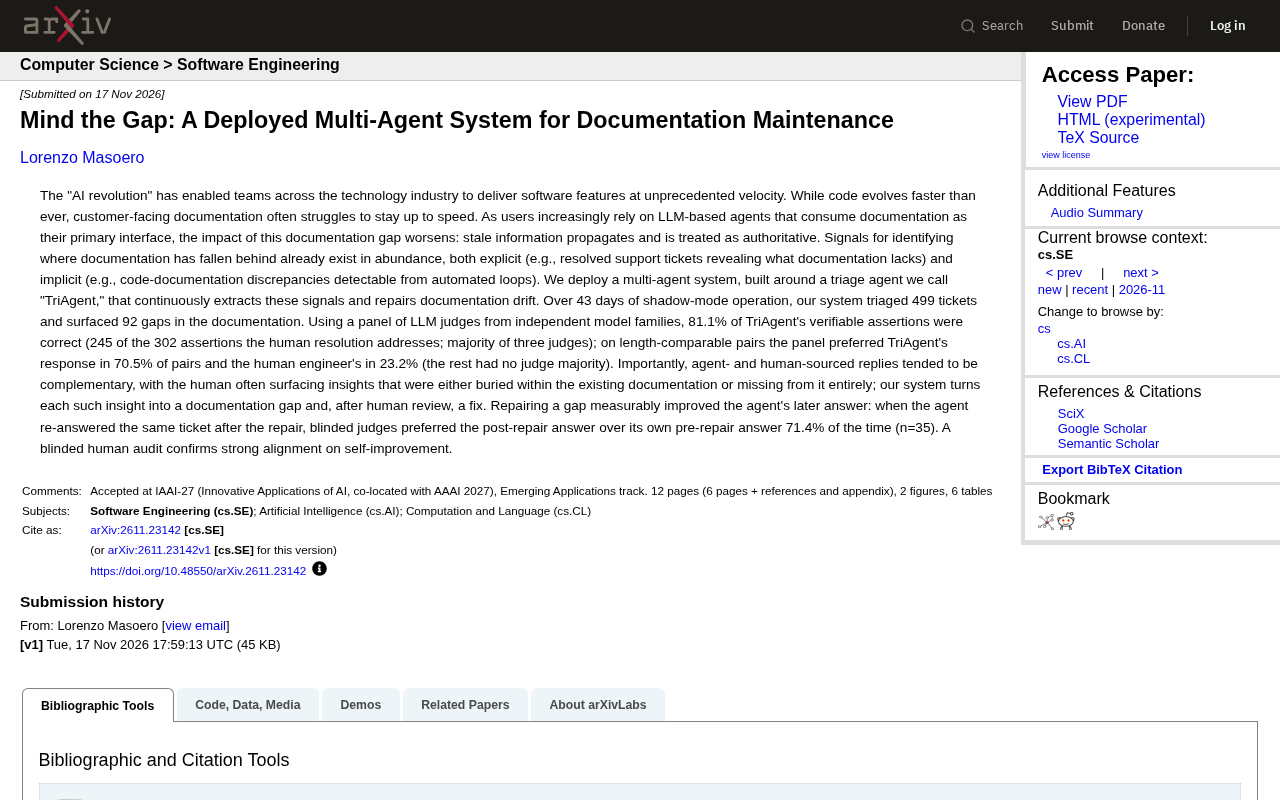
This article introduces a deployed multi-agent documentation maintenance system centered on the triage agent TriAgent, which systematically extracts documentation gaps from explicit signals (such as resolved support tickets) and implicit signals (such as code-documentation inconsistencies) and triggers a repair loop. Over 43 days of shadow-mode operation, the system triaged 499 tickets and identified 92 documentation gaps. An LLM judge panel from independent model families found that 81.1% of TriAgent's verifiable assertions were correct, and in length-matched pairwise comparisons, 70.5% of its responses were preferred versus 23.2% for human engineers. The study also found complementary relationships between agent and human responses, with human insights converted into documentation fixes; after repairing gaps, post-repair responses were preferred in 71.4% of blind evaluations. The article argues that documentation maintenance can be treated systematically and automatically, much like code testing.
Introduction: When Documentation Can't Keep Up with Code
In the AI-driven development cadence, code iterates faster than ever, but user-facing documentation often lags behind. What makes this trickier is that as LLM agents consume documentation as their primary interface for information, outdated docs are no longer just "outdated" — they get propagated as authoritative knowledge, amplifying errors. How to systematically detect and fix this "documentation drift" is a real problem facing engineering teams today. This article introduces a deployed multi-agent system — centered on the triage agent TriAgent — that continuously extracts documentation gaps from both explicit and implicit signals and automatically initiates fixes.
How TriAgent Works: Triage, Extraction, and Repair
Signal Sources: Explicit and Implicit Gaps
Documentation gaps don't lack clues — what's missing is a systematic extraction mechanism. The system leverages two types of signals: explicit signals such as resolved support tickets, which directly reveal where users couldn't find answers; and implicit signals such as inconsistencies between code and documentation, which can be detected through automated loops. TriAgent acts as the triage agent, responsible for identifying documentation issues worth fixing from these signals and triggering the subsequent repair workflow.
Documentation Drift refers to the gradual divergence between documentation content and the code, product behavior, or actual user needs it attempts to describe. It is usually not a one-time massive failure but rather accumulates from a series of seemingly minor changes: interface signatures change, default values are adjusted, error codes are added, deployment steps change — while the documentation is not updated in sync. Under traditional development cadences, this divergence could barely be managed through manual inspections and release checks; but in AI-driven high-frequency iteration, drift speed exceeds the throughput of manual maintenance. More critically, when LLM agents consume documentation as an authoritative knowledge source, drift is no longer just "stale information" — it becomes an erroneous premise repeatedly cited and propagated by agents, amplifying downstream failures. Therefore, documentation drift is essentially a form of technical debt that requires continuous detection and repair, not a one-time editing task.
System Architecture: Multi-Agent Collaboration
The entire system is built around TriAgent in a multi-agent architecture. It doesn't simply generate a block of text; instead, it first triages, then extracts gaps, and finally generates repair suggestions, closing the loop with human review. This design enables the system to run continuously in real production environments rather than remaining at the research demo stage.
Triage is a term borrowed from the medical and operations fields, referring to the rapid classification, prioritization, and routing of large volumes of raw signals under limited resources — deciding which issues need immediate handling, which can be deferred, and which can be ignored. In the documentation maintenance context, the core task of the triage agent is not to directly write repair copy, but to judge from mixed signals such as tickets, code diffs, and user feedback: whether this is a real documentation gap, which type of documentation the gap belongs to, what the repair priority is, and which downstream agent or human step it should be routed to. The value of triage lies in converging "massive noise" into an "actionable repair queue," preventing the downstream generation stage from being overwhelmed by low-value tasks. TriAgent's naming after triage precisely indicates that its design focus is on gap identification and routing, rather than pure content generation.
Measured Results: 43 Days of Shadow-Mode Operation
During 43 days of shadow-mode operation, the system triaged 499 tickets and identified 92 documentation gaps from them. These gaps were not guesses out of thin air — they were grounded in actual tickets.
To evaluate TriAgent's output quality, the research team used an LLM judge panel from independent model families. The results showed that 81.1% of TriAgent's verifiable assertions were correct (i.e., of the 302 assertions involved in human resolutions, 245 were judged correct by a majority of the three judges). In length-matched pairwise comparisons, the judge panel preferred TriAgent's responses in 70.5% of pairs, while preferring human engineers' responses in 23.2%, with the remaining pairs showing no majority opinion. These figures indicate that TriAgent already performs comparably to or even better than human engineers in terms of information accuracy and response preference.
LLM-as-a-Judge is an evaluation method that uses large language models to assess the quality of model outputs. A common approach is to have multiple judge models from different model families perform blind pairwise comparisons of two responses, or judge the correctness of individual assertions, then form conclusions by majority vote. The purpose of using independent model families is to reduce the preference bias of "grading one's own work." This method is low-cost and scalable, suitable for large-scale evaluation of open-ended text, but it has known limitations: judge models may favor longer, more fluent responses or those closer to their own training distribution, so it typically needs to be calibrated with human blind review. The 81.1% assertion accuracy and 70.5% pairwise preference cited in this article are relative conclusions drawn by such a judge panel under length-matched conditions.
Complementary, Not Replaceable: The Collaborative Value of Agents and Human Engineers
One noteworthy finding is that agent-sourced and human-sourced responses often exhibit a complementary relationship. Human engineers frequently provide insights that are deeply buried in existing documentation or entirely absent from it. The system converts each such insight into a documentation gap, which after human review becomes a repair action. This means TriAgent is not meant to replace engineers, but to externalize engineers' tacit knowledge and consolidate it into reusable documentation assets.
This complementarity is also reflected in repair outcomes: after fixing a gap, the agent's re-answer to the same ticket improved markedly in quality. In blind evaluations, the post-repair responses were preferred in 71.4% of cases (n=35), outperforming their pre-repair counterparts. A blind human audit also confirmed that this self-improvement aligned closely with expectations.
Implications for Documentation Maintenance
This deployment case conveys several key signals. Documentation maintenance can be treated systematically and automatically, much like code testing, rather than relying on scattered manual inspections. Tickets and code diffs are readily available high-value signal sources that deserve to be incorporated into documentation quality monitoring. The value of multi-agent systems in real production environments lies not only in generating content but also in their ability to triage, extract, and close the repair loop. For product teams that rely on LLM agents as their user interface, documentation quality directly determines the reliability of agent responses, and systems like TriAgent will only become more significant.
FAQ
Is TriAgent an open-source tool? The original article does not mention its open-source status; this article is based solely on a published deployment study of a multi-agent system.
What does shadow-mode operation mean? It means the system runs without directly affecting production outcomes, to evaluate its performance before deciding whether to integrate it into the formal workflow.
Is this approach applicable to non-technical documentation? The original research focuses on software documentation maintenance; its signal extraction approach has reference value for other domains but requires adapting the signal sources to specific scenarios.
Related articles
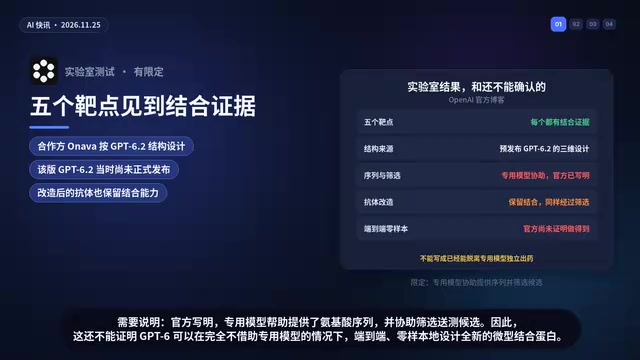
GPT-6 Designs Proteins, Claude Creations Become Apps with One Click, DeepMind Releases New Benchmark
OpenAI says GPT-6 can design protein 3D structures, Anthropic lets Claude creations install as desktop apps, DeepMind's HIP benchmark tests stability on simple questions, Google Workspace opens agent MCP interfaces.
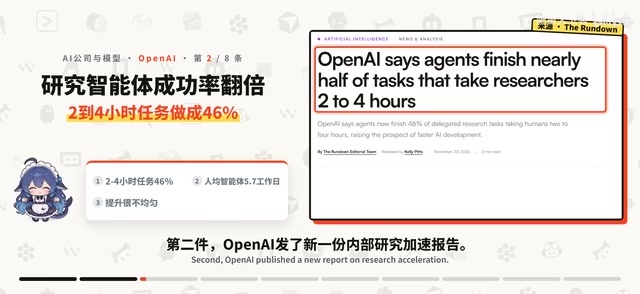
OpenAI Weekly Roundup: GPT-6.2 Rolls Out to ChatGPT, GPT-6 Designs Proteins
OpenAI's week: GPT-6.2 rolls out to ChatGPT, GPT-6 claims independent protein design, agent research share surges, perplexity proposed as a shared metric, and internal safety concerns surface.
Is the Crypto Industry About to "Turn Blue"? The Truth Behind Tech and Politics' Shifting Allegiances
Vergecast discusses whether the crypto industry will shift from the right to the Democrats, revealing the pragmatic nature of tech's politics and the costs of a crypto pivot.