Multi-Harness Integration in Practice: Striking the Balance Between Local and Cloud Inference

Balancing local and cloud AI inference through multi-harness integration and hybrid deployment strategies.
This article explores a developer's experience integrating multiple AI programming harnesses (OpenCode Go, Codex, etc.) and examines the tradeoffs between local and cloud inference. It covers the migration from Claude to Ollama's cloud plan, why even an M5 Max with 128GB RAM isn't fast enough for interactive coding, the concept of overnight batch processing mode, and a practical hybrid strategy that matches different tasks to optimal inference paths based on cost, speed, and privacy needs.
The New Landscape of AI Programming Harnesses
In the world of AI-assisted programming, the "harness" — the programming shell built around large language models — is becoming a critical factor in the developer experience. A harness refers to the programming interaction layer that hosts model capabilities, organizes context, and manages tool calls. The concept originates from "test harness" in software testing, and in the AI programming context, it denotes a complete interaction framework built around LLMs. A typical harness handles multiple layers of work: first, context window management — how to efficiently organize project files, codebase structure, and session history into a limited token window; second, tool use orchestration, including the scheduling of external capabilities like file I/O, terminal command execution, and code search; and finally, user interaction design, including streaming output, diff comparison, and code completion presentation. Tools like OpenCode Go, Codex CLI, Aider, and Continue can all be seen as harness implementations under different design philosophies.
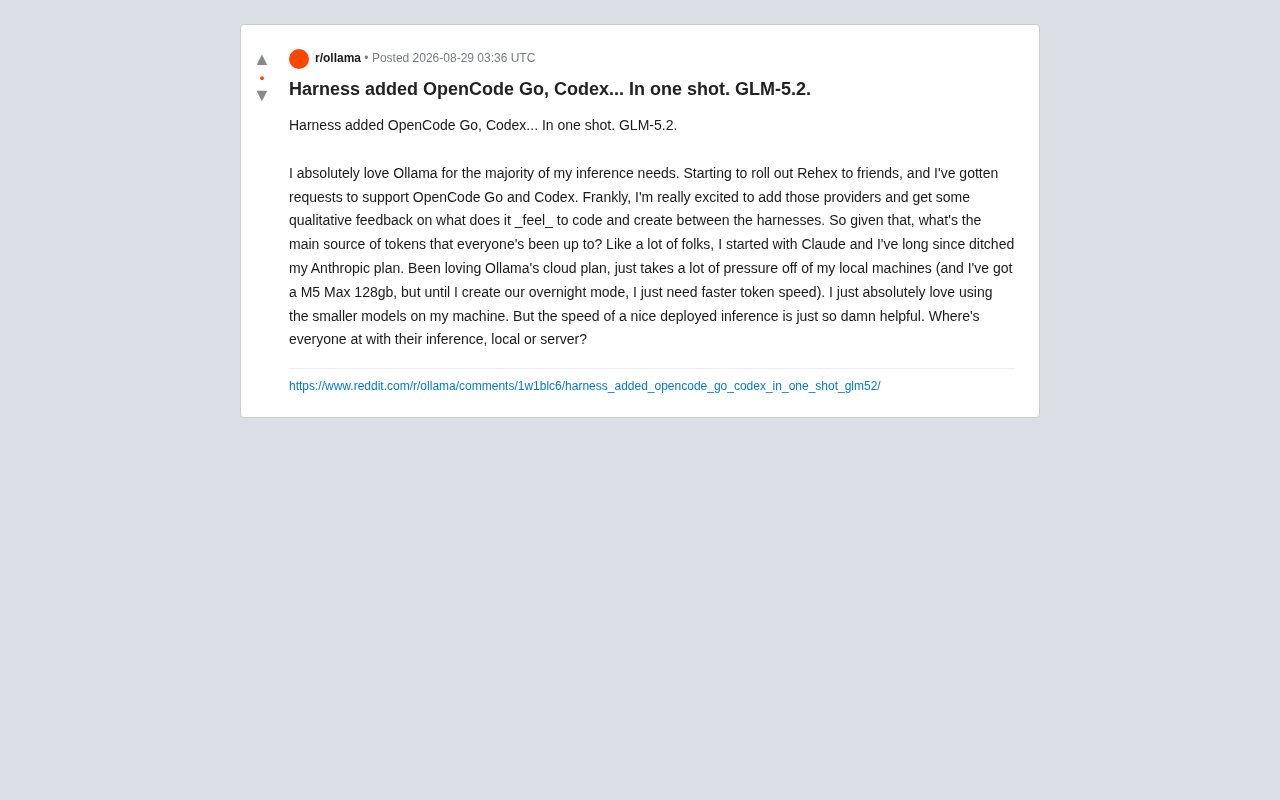
Recently, a Reddit developer shared their experience integrating multiple programming harnesses — including OpenCode Go and Codex — into their project, and posed a question that resonated deeply with the community: When it comes to local inference versus cloud inference, how should developers choose?
The topic may seem like a minor technical detail, but it touches on a core pain point for every local AI developer — how to find the right balance between privacy control, affordable costs, and inference speed.
Integrating Multiple Programming Harnesses in One Shot
From a Single Tool to a Diverse Toolchain
The original poster mentioned that while promoting their project Rehex to friends, they received requests to support OpenCode Go and Codex. You might not have noticed, but they used "In one shot" to describe the integration process, hinting at the maturity of modern harness architectures in terms of extensibility — adding a new model provider or programming shell often requires only relatively lightweight adapter work thanks to standardized provider interfaces.
This rapid integration capability has deep technical foundations. The OpenAI Chat Completions API has become the de facto industry standard interface. Nearly all major model providers — whether Anthropic's Claude, Google's Gemini, or inference services for various open-source models — offer OpenAI-compatible API endpoints. This means a harness only needs to implement one set of HTTP-based request/response protocols (including message formats, SSE streaming protocols, and JSON Schema definitions for tool calls) and can connect to different providers by simply changing the base URL and API key. The emergence of proxy tools like LiteLLM has further abstracted the complexity of multi-provider switching, turning "integrating multiple harnesses in one shot" from a technical feat into a routine operation.
The trend toward "multiple harnesses coexisting" has an inherent logic. Different programming shells make different tradeoffs in context management, tool call strategies, and code completion experience. What the author was most interested in was the subjective "feel" difference when coding and creating across different harnesses (what does it feel to code). This qualitative feedback often reflects the real development experience more accurately than cold benchmark scores.
Why "Feel" Matters So Much
For developers who use AI programming tools heavily on a daily basis, the model's raw capability is just the foundation. What truly determines productivity is response latency, context coherence, and whether the tool "gets" your intent. The same underlying model, wrapped in different harnesses, can produce drastically different interaction qualities. The technical details behind this are extremely rich: how context trimming is done determines whether the model can "remember" your previous intentions, the tool call triggering strategy determines whether the model proactively executes for you or passively awaits instructions, and the chunking granularity of streaming output affects the perceived "fluidity." This is why the author would rather spend the effort integrating multiple providers to personally experience the differences between them.
From Claude to Ollama: A Typical Migration Path
Leaving the Anthropic Subscription Behind
The author admitted that, like many developers, they originally started with Claude but "dropped the Anthropic subscription plan long ago." This statement reflects a sentiment spreading through the community: as open-source model capabilities rapidly catch up, more and more power users are reassessing the cost-effectiveness of paid proprietary APIs. Anthropic's Claude series (especially Claude Sonnet/Opus) performs excellently on programming tasks, but the usage limits attached to its Pro subscription ($20/month), along with the per-token API billing costs, can add up significantly for heavy users who generate large volumes of code daily. In contrast, the one-time deployment cost of open-source models is more manageable and isn't constrained by usage quotas.
The Appeal of Ollama's Cloud Plan
The author has now switched to Ollama's cloud plan, for a straightforward reason — it "greatly reduced the strain on their local machine." This is an interesting signal: Ollama has long been synonymous with local inference, and the launch of its cloud service addresses exactly those users who believe in the local/open-source philosophy but need higher throughput.
Ollama is a local LLM inference framework built on llama.cpp that wraps the complex processes of model quantization, loading, and inference into a Docker-like streamlined command-line experience (e.g., ollama run llama3). Under the hood, it relies on llama.cpp's GGUF quantization format and supports hybrid CPU and GPU inference (including Apple Silicon's Metal and NVIDIA CUDA). Cloud Ollama essentially deploys the same open-source models on data center GPU clusters (such as NVIDIA H100/A100) and provides them via API. Compared to local M-series chips, data center GPUs offer orders-of-magnitude advantages in batch throughput and concurrency.
In other words, Ollama's cloud offers an acceleration solution within developers' "comfort zone" — you're still using the familiar open-source ecosystem and models, just with the compute power moved to the cloud. This model elegantly eases the psychological tension between privacy and efficiency: while data goes to the cloud, at least it's not being handed to a proprietary giant like OpenAI or Anthropic — it's running within an open-source toolchain ecosystem you trust.
Local vs. Cloud: Even an M5 Max Isn't Enough?
The Reality of Top-Tier Hardware
The author owns a top-spec device with an M5 Max and 128GB of memory, which should theoretically provide considerable local inference power. They do indeed "absolutely love running smaller models locally." But the problem is: without having implemented an "overnight mode" yet, they still need faster token generation speeds.
To understand this "top-tier hardware still isn't enough" dilemma, you need to understand the performance bottlenecks of LLM inference. The Apple M5 Max uses TSMC's 3nm process, and its 128GB Unified Memory means the CPU and GPU share the same large memory pool. This architecture is crucial for LLM inference because the inference bottleneck is typically memory bandwidth rather than compute power — each token generation requires reading all model weights from memory. 128GB of unified memory can fully load a 70B-parameter 4-bit quantized model (roughly 35-40GB), and can even run some larger quantized models. However, the M5 Max's memory bandwidth is approximately 546GB/s, which limits token generation speed to roughly 10-30 tokens/s (depending on model size). By comparison, a single NVIDIA H100 with HBM3 memory delivers up to 3.35TB/s of bandwidth, enabling inference speeds tens of times faster than local devices. This is the fundamental reason why the author, despite owning top-tier hardware, still finds interactive programming "not fast enough."
This reveals a fundamental contradiction of local inference:
- Advantages: Data stays local, no API costs, full control
- Drawbacks: Even top-tier consumer hardware struggles to match the token throughput of dedicated cloud deployments
Design Insights from "Overnight Mode"
The "overnight mode" the author mentioned is a design concept worth paying attention to — scheduling tasks that don't require real-time responses (such as large-scale code analysis, documentation generation, and batch test case processing) to be processed slowly on the local machine overnight. This is essentially a strategy of trading time for cost and trading asynchronous execution for privacy. When interactive tasks need instant feedback, use cloud acceleration; when batch tasks can be deferred, let the local machine handle them at its own pace — each approach plays to its strengths.
This pattern is nothing new in distributed computing — it's similar to the batch scheduling philosophy in traditional HPC (High Performance Computing), except here the "compute cluster" is the Mac on your desk. From a product design perspective, the core technical challenges of "overnight mode" include: persistent storage of task queues, checkpoint-and-resume mechanisms, incremental merging of results, and power management (ensuring the machine doesn't sleep during task execution). If a harness were to implement a mature overnight batch processing mode first, it could become a killer feature for local inference users.
The Community's Question: Where Do Your Tokens Come From?
The most central question in the original post was: "Where do your tokens mainly come from? Local or server?" This question effectively drew the entire community into a discussion about inference strategy selection.
From the author's own practice, we can distill a highly representative hybrid inference strategy:
- Daily small model tasks — Run locally, enjoying privacy and zero cost
- Interactive programming that needs speed — Use cloud deployment solutions like Ollama Cloud
- Large-batch, non-real-time tasks — Plan for overnight local processing
- Horizontal comparison across multiple harnesses — Flexibly switch providers through standardized interfaces
The core logic of this hybrid strategy aligns perfectly with the "Hybrid Cloud" architecture in cloud computing: keep sensitive data and low-frequency tasks local (private cloud), and put elastic demand and peak loads on the public cloud. In the AI inference context, the decision dimensions shift from "data compliance" and "elastic scaling" to "privacy requirements" and "token generation speed."
No Single Answer, Only the Optimal Combination
While this Reddit post is a casual personal account, it precisely reflects the prevailing state of the AI programming community: neither purely local nor purely cloud is the endgame — hybrid deployment is the mainstream direction.
As open-source model capabilities continue to improve — GLM-5.2, subtly referenced in the post, is a prime example. The GLM series is developed by Zhipu AI, originating from Tsinghua University's NLP lab, and employs a unique Autoregressive Blank Infilling pre-training objective. GLM-5.2 represents the latest iteration of the series, with significant improvements in programming capabilities, forming a diverse competitive landscape of open-source programming models alongside Meta's Llama and Mistral AI's Codestral.
As these open-source models continue to improve, consumer hardware inference efficiency keeps optimizing, and tools like Ollama bridge the gap between local and cloud, developers have unprecedented freedom of choice. The real challenge is no longer "can it run" but rather "how to match the most appropriate inference path for different tasks across the dimensions of cost, speed, and privacy."
For every developer building their own AI workflow, perhaps the best answer lies in the original poster's practice — boldly try multiple harnesses, and calibrate your technology choices based on real-world "feel."
Key Takeaways
Related articles

Chain of Thought Isn't Just for AI: How Humans Can Use CoT to Improve Thinking Quality
Chain of Thought isn't just a prompt trick for large models. Starting from a Hacker News discussion, this article analyzes why CoT works for human thinking too, breaks down actionable ways to transfer it, and highlights the key differences between human CoT and machine CoT.
Cloudflare Teams Up with OpenAI: Closi…
Cloudflare Teams Up with OpenAI: Closing the Loop from Vulnerability Discovery to Defense with AI
Cloudflare uses OpenAI Daybreak to investigate security vulnerabilities and generate reviewable remediation plans, while developers use Codex to boost coding efficiency and quality.

Orca Multi-Agent Orchestration in Practice: A Guide to Parallel Collaboration with Claude and Codex
Orca is Stable AI's free open-source agent workbench supporting 34 agents like Claude Code and Codex in parallel. Learn its Git worktree isolation, multi-model orchestration, and mobile management.