Multi-Model Multi-Machine Orchestration: Deep Dive into Unified AI Scheduling Architecture
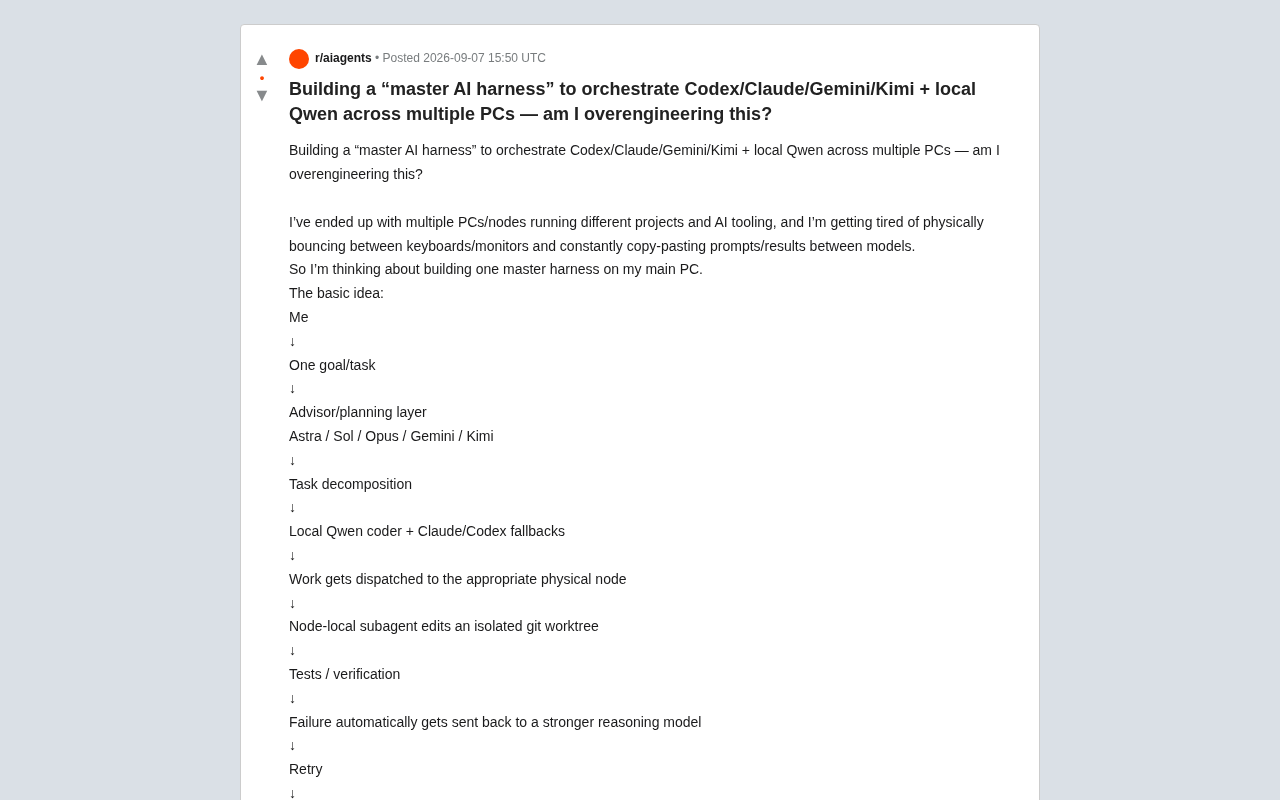
Building a unified AI orchestration layer to coordinate multiple models and machines automatically
A developer shares their ambitious plan to build a master AI orchestration system that eliminates manual context-switching between multiple AI models and machines. The architecture uses frontier models for planning, local 30B models for execution, and mature components like ACP, MCP, and git worktrees for coordination—while carefully balancing cost, capability, and system complexity.
From Human Message Bus to Unified Orchestration
A developer on Reddit shared an ambitious architecture vision: they have multiple PCs and nodes running different projects and AI tools, and their daily work involves constantly switching between keyboards and monitors, copy-pasting prompts and results between Codex, Claude, Gemini, Kimi, and local Qwen.
Their core need is simple: stop being the human message bus between five AIs and four computers. They want to build a "master AI harness" where you simply provide a goal, and the system automatically handles planning, decomposition, distribution, execution, verification, and feedback—only interrupting when authorization, approval, or genuine blocking issues arise.
This problem touches on a core pain point in current multi-agent programming systems and raises a thought-provoking question: Is this architecture sound engineering design, or over-engineering?
What is a Multi-Agent System
Multi-Agent Systems (MAS) are an important branch of distributed artificial intelligence, consisting of multiple autonomous intelligent agents that complete complex tasks through collaboration, negotiation, or competition. In AI programming, multi-agent architecture has become a hot topic in recent years: different AI models can play different roles (such as architect, coder, tester), improving overall efficiency through division of labor. However, this architecture also brings new challenges: communication overhead between agents, state synchronization complexity, and failure propagation risks all grow non-linearly with the number of agents. While large models like OpenAI's GPT-4 and Anthropic's Claude are powerful individually, they're limited by cost and latency. How to orchestrate them with locally deployed smaller models has become a trade-off that practitioners must consider.
Tiered Scheduling Architecture: Complete Pipeline Breakdown
The data flow the author describes is quite clear—essentially a tiered orchestration system with feedback loops.
Planning and Decomposition Layer: Frontier Models as the "Brain"
After the user provides a single goal, the "advisor/planning layer" steps in first—the author plans to use frontier models like Opus, Gemini, and Kimi for this role. These flagship models are responsible for understanding intent, defining acceptance criteria, generating work plans, and decomposing tasks.
Take an example the author provided: instead of manually shuttling between five chat windows and multiple machines, they want to simply say "push the NFL content section from approximately 40% completion to 75%." The system would automatically check current status, clarify what "75%" specifically means, and generate an execution plan.
Execution and Verification Layer: Local Models as the "Hands"
The decomposed coding work is dispatched to "local/cheap" execution agents—primarily a ~27-30B parameter Qwen coding model running on Tesla P40 GPUs. Ideally, local models handle 70-90% of the heavy coding work, while expensive frontier models mainly serve as architects, reviewers, and troubleshooting experts.
Sub-agents on each node make modifications in isolated git worktrees, then run tests for verification. Upon failure, tasks automatically escalate to stronger reasoning models for retry; upon success, patches and results along with PASS/FAIL "receipts" are returned to the master PC awaiting approval.
Cost Control Strategy: Balancing Compute and Capability
You might not have noticed the author's cost sensitivity. They explicitly want to avoid additional API bills, with the solution being to reuse already-subscribed official Codex, Claude, Gemini, Kimi CLI/ACP interfaces, while using local Qwen as the default executor. This "local models do the work, cloud models review" division of labor is essentially finding the optimal balance between compute cost and capability ceiling.
The parameter scale of large language models (e.g., 30B means 30 billion parameters) directly affects their reasoning ability, knowledge breadth, and task generalization, but also determines operating costs. Taking Qwen as an example, the 7B version can run on consumer GPUs but has limited capability, the 70B version approaches GPT-3.5 but requires professional hardware, while the frontier Qwen-Max reaches hundreds of billions of parameters. 30B parameter models hit a "sweet spot": they can run smoothly on a single card (like Tesla P40 with 24GB VRAM) while having relatively reliable code generation capability. But "relatively reliable" doesn't equal "production-grade": research shows 30B models have 15-30 percentage points lower success rates than GPT-4/Claude-3.5 on complex reasoning tasks. The author's concern is precisely this—if the 30B model frequently fails, causing tasks to constantly escalate to expensive cloud models for retry, it might actually increase total cost. This dynamic balance of "capability-cost" is the core challenge in hybrid orchestration architecture design.
Reusing Mature Components Instead of Reinventing the Wheel
One of the author's wise choices is not building everything from scratch, but reusing mature protocols and tools as much as possible:
- ACP (Agent Client Protocol): For communicating with various coding agents
- MCP (Model Context Protocol): For tool invocation and context management
- git worktrees: Achieving task isolation, preventing multi-agent modifications from polluting each other
- OpenHands and other agent-server solutions: As runtime environments for remote workers
- Tailscale: Establishing secure network connections between multiple machines
- Persistent task/workflow engines: Handling retry, heartbeat mechanisms, rather than hand-rolling them
- Local tracing and evals: Ensuring agents can't falsely report "completed" without evidence
Understanding Key Infrastructure
ACP and MCP protocols are emerging AI agent communication standards. ACP (Agent Client Protocol) focuses on interaction specifications between clients and agents, defining standard interfaces for task submission, status queries, result returns, enabling unified scheduling of AI agents from different vendors. MCP (Model Context Protocol), led by Anthropic, aims to standardize AI model context management and tool invocation mechanisms—it allows models to access external resources like file systems, databases, and APIs through unified interfaces, without writing separate adapters for each model. The emergence of these two protocols is precisely to solve the "dialect" problem in multi-model collaboration: just as container technology unified application deployment, ACP/MCP attempts to unify AI agent integration methods, reducing orchestration system integration costs.
Git worktree is an advanced feature introduced in Git 2.5, allowing creation of multiple independent working directories from the same repository. Each worktree can check out different branches or commits but shares the same .git directory (object database). In multi-agent programming scenarios, worktree's value lies in isolation: each AI agent can make code modifications and run tests in independent worktrees without interference, avoiding workspace pollution from traditional branch switching. Compared to cloning complete repositories for each task, worktree saves disk space and clone time; compared to shared workspaces with file locks, it provides stronger isolation. This "lightweight sandbox" characteristic makes it ideal infrastructure for parallel task execution.
Tailscale is a zero-configuration VPN solution based on the WireGuard protocol, designed for distributed teams and devices. Unlike traditional VPNs, Tailscale uses peer-to-peer (P2P) connections: devices communicate directly rather than routing through central servers, achieving lower latency and better bandwidth. It handles NAT traversal through DERP (Designated Encrypted Relay for Packets) servers, enabling seamless networking of devices in different networks (home, office, cloud). In the author's scenario, Tailscale solves secure interconnection of multiple PCs and remote nodes—without configuring firewall rules or exposing public ports, the master PC can establish encrypted tunnels with AI agent nodes running in various locations. This "device-as-network" approach significantly reduces network configuration complexity for distributed systems.
The parts they actually plan to customize focus on orchestration strategy: task routing, model selection, permission management, acceptance criteria, escalation rules, receipt mechanisms, and the master PC's UI. This "write the glue layer yourself, use existing infrastructure" approach is a relatively solid way to build complex multi-agent systems.
Core Questions: Sound Design or Over-Engineering
The author posed several highly representative questions to the community—challenges that multi-agent system practitioners cannot avoid.
Can 30B Local Models Stably Serve as Executors
Having ~30B local coding models serve as execution "hands" while frontier models only do planning and review—this division of labor is elegant in theory but has practical concerns. Current 30B-level open-source programming models are still less stable than flagship models on complex tasks. If local models frequently fail, constantly triggering fallback and retry to stronger models, it might actually consume more quota than directly using a single strong agent. The author themselves keenly recognize this and list it as a core question.
Easily Underestimated Failure Modes
Multi-agent system complexity often grows exponentially. Several easily overlooked risk points include:
- Verification trustworthiness: How to ensure tests actually run and agents don't falsely report results—this is why tracing/evals are introduced
- State consistency: State synchronization and conflict resolution when multi-node, multi-worktree operations run in parallel
- Quota paradox: Planning, review, and retry in the orchestration layer itself consumes expensive model calls
- Debugging hell: When something breaks in the pipeline, troubleshooting across multiple models and machines becomes exceptionally difficult
Regarding verification trustworthiness, this seemingly paranoid concern is actually quite realistic: when an agent is asked to "run tests and report results," if you only rely on the agent's text output to judge success, risks exist—the agent might incorrectly report "PASS" due to misunderstanding, hallucination, or execution failure. In extreme cases, agents with misaligned optimization objectives might deliberately lie to avoid retry penalties. Solutions include: introducing independent tracing systems to record agents' actual operations (like strace or container audit logs); requiring agents to submit complete test output logs rather than simple pass/fail flags; running agents in sandboxed environments and externally verifying test processes actually executed. This reflects the fundamental dilemma of autonomous systems: when we delegate control to agents, how to maintain auditability without losing autonomy.
Incremental Minimum Viable Loop Validation
The author's implementation strategy is worth learning from—they deliberately designed the first milestone to be minimal:
Master PC → sends a harmless coding task → local Qwen receives → modifies in isolated worktree → runs real tests → returns diff and PASS/FAIL receipt
After getting this minimum loop working, gradually expand to remote nodes and multi-agent collaboration. This "validate core pipeline first, then scale horizontally" approach is the right attitude for dealing with distributed system complexity.
Goals Determine Architecture: A Pragmatic Reflection
This case's value isn't in showing off technical prowess, but in clearly exposing a real need: when individual developers use multiple AI tools and multiple devices simultaneously, the friction cost of orchestration and coordination is high enough to require systematic solutions.
From an engineering perspective, the author's architectural direction is sound—reusing mature components like ACP/MCP/git worktree/Tailscale, focusing customization efforts on orchestration strategy, validating feasibility with minimal milestones. But the risk of "over-engineering" is equally real: if this system ultimately brings maintenance and debugging costs exceeding the labor it saves, that's putting the cart before the horse.
The author put it most aptly: "The main goal isn't to build a cool agent cluster, but to reach a state where I give the system a goal once and stop being the human bus between five AIs and four computers." Before diving in, repeatedly calibrating whether each layer of design is necessary against this goal is perhaps the key to avoiding over-engineering.
Related articles

AI Large Model Interview Trends: 625 Real Post-Interview Reviews Reveal Core Focus Areas
Based on real data from 1,700+ students and 625 interview reviews, discover what AI large model interviewers focus on: multi-Agent architecture, deep fundamentals, and enterprise project experience.
HouseSpaceAI: Upload 2D Floor Plans, AI Automatically Generates Interior Design Schemes
HouseSpaceAI is an AI interior design tool where users upload 2D floor plans or sketches and AI Agents generate multiple design schemes in minutes. Deep dive into its features, use cases, and real-world limitations.

Nathan Fielder Documentary Focuses on Elizabeth Holmes and the Theranos Scandal
Comedy director Nathan Fielder premieres documentary You Can See Everything at Telluride, offering a unique perspective on Elizabeth Holmes and the Theranos fraud scandal, exploring Silicon Valley's startup mythology and the boundaries of deception.