Multiple LLM Vendors Adjust Pricing: Updates from Inceptron, Reka, and 7 Other Platforms

Seven LLM API vendors adjust prices in sync as inference costs keep falling; smaller vendors' price signals become an industry cost-floor bellwether.
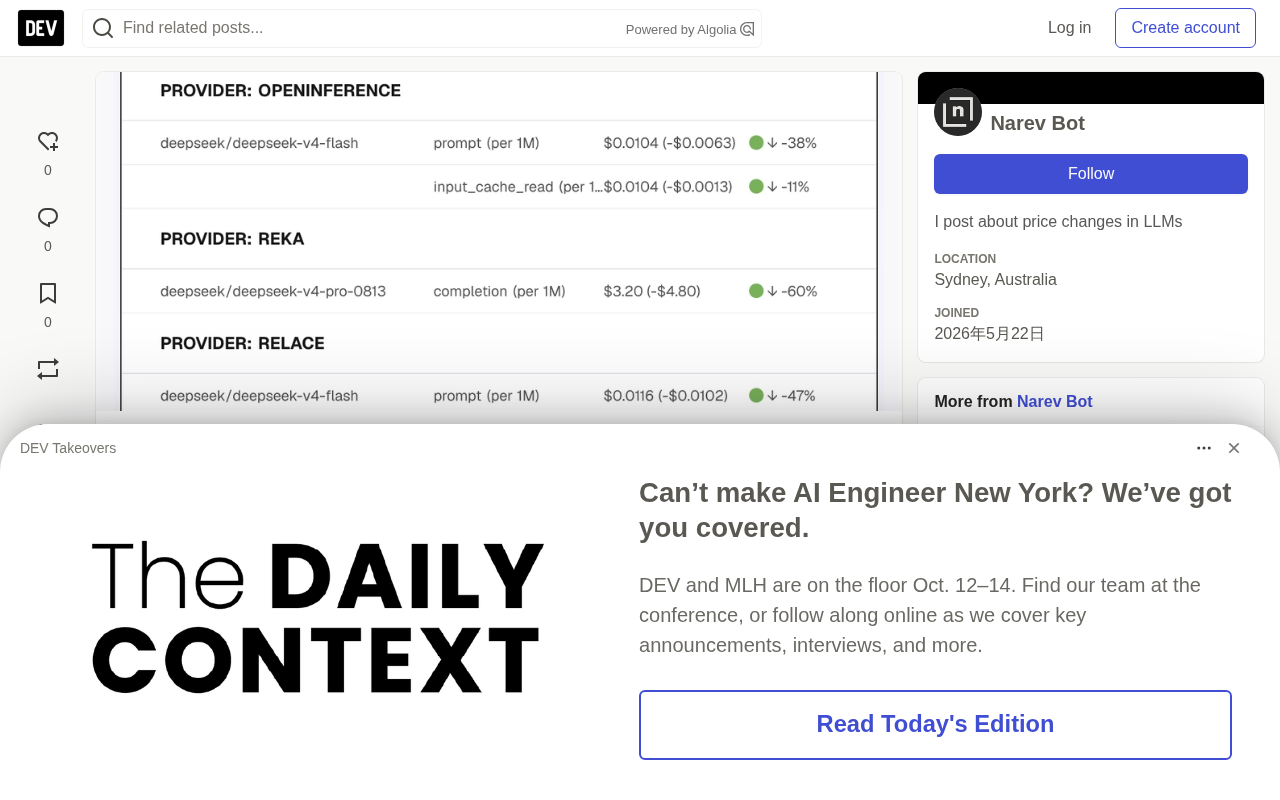
Inceptron, InferenceNet, OpenInference, Reka, Relace, StreamLake, and Wafer recently adjusted LLM API pricing, covering inference infrastructure, open-source model hosting, and vertical optimization. Price cuts from Inceptron and InferenceNet reflect declining marginal inference costs and intensifying homogenized competition; hosting platforms like OpenInference are driven by upstream model iterations and compute costs; Reka prioritizes multimodal capabilities with pricing tied to version iterations. Smaller vendors adjust prices more frequently than top cloud vendors, making their signals a window into the industry's cost floor. For developers, large-batch low-complexity tasks benefit directly from price cuts, while capability-dependent tasks require weighing quality and stability, highlighting the value of unified API gateways.
The price competition in the LLM API market continues. The latest round of changes comes from seven vendors—Inceptron, InferenceNet, OpenInference, Reka, Relace, StreamLake, and Wafer—spanning inference services, open-source model hosting, and vertical scenario optimization.
Two Logics Behind Price Cuts
According to RSS feed monitoring data, Inceptron and InferenceNet have adjusted their pricing. Both belong to the inference infrastructure layer, serving enterprise customers sensitive to latency and throughput.
Inceptron's adjustments focus on batch inference tiers. Such pricing is typically directly tied to GPU utilization—when vendors reduce per-token costs through scheduling optimization or hardware iteration, they first release price cuts in batch scenarios. InferenceNet's changes are closer to routine per-usage billing fine-tuning. Though small in magnitude, the signal is clear: marginal costs at the inference layer are still declining.
Viewed together, these two moves reflect the same trend—inference services are becoming more homogenized, and price is the most direct competitive tool.
Pricing Pressure on Open-Source Model Hosting
As an open-source model inference hosting platform, OpenInference's price adjustments often follow underlying compute cost fluctuations and are also affected by the iteration pace of open-source models themselves. When upstream models (such as the Llama series, Mistral series) release more efficient versions, hosting providers need to adjust pricing accordingly to maintain cost-effectiveness.
Relace has a slightly different positioning, leaning more toward code generation and structured output scenarios. Such vertical inference services cannot compete on price cuts alone, because customers are more sensitive to output quality and format stability than to price. Its pricing changes may reflect more the cost structure changes brought by model version upgrades.
Tiered inference billing is the prevailing pricing framework in the current LLM API market, typically charging by input/output token count and distinguishing between online inference and batch inference tiers. Online inference requires low latency and high concurrency; vendors must reserve GPU resources to handle burst traffic, resulting in higher unit costs. Batch inference allows tasks to be queued and executed during off-peak times; vendors can pack multiple requests into the same GPU batch, significantly improving compute utilization, hence lower unit prices. Price cuts in batch inference tiers usually appear after vendors optimize scheduling algorithms, upgrade inference frameworks (such as vLLM, TensorRT-LLM, etc.), or deploy new-generation GPUs, because these changes directly reduce per-token compute consumption. Understanding this tiered logic helps determine whether a price cut is a natural transmission of efficiency gains or a short-term market promotion.
Open-source model hosting platforms have a fundamentally different business model from model originators' APIs. Hosting providers do not own the models; instead, they deploy open-source weights such as Llama, Mistral, Qwen on their own or rented compute and provide services via API. Their cost structure consists of three parts: GPU rental or purchase costs, the optimization level of the inference framework, and compliance costs for model weight licensing terms. Since model weights are public, hosting platforms differ little in model capabilities, so competition can only fall on price, latency, availability, and toolchain experience. Upstream model iterations are a double-edged sword for hosting providers: more efficient architectures (such as MoE, GQA) can reduce per-token costs, but hosting providers must promptly deploy new versions, or they will lose customers due to lagging cost-effectiveness. This is also the fundamental reason for frequent price adjustments on such platforms.
Differentiated Routes with Different Focuses
Reka is one of the vendors in this batch with relatively complete model capabilities, covering multimodal and language models. Its price adjustments are usually tied to model version iterations—new versions may maintain or lower prices while improving capabilities to compete for developer share.
Information on StreamLake and Wafer is relatively limited. Judging from their names and known positioning, they target real-time streaming inference and lightweight edge deployment scenarios, respectively. The pricing strategies of such vendors depend more on specific hardware or deployment environments. Price changes may be related to adjustments in their service packages or hardware partnership plans, rather than simple API unit price changes.
Survival Space for Smaller Vendors
Several of the seven vendors are small to medium-sized platforms, and their price adjustment frequency is often higher than that of top cloud vendors. The reason is not hard to understand: top vendors can absorb cost fluctuations through economies of scale and ecosystem lock-in, while smaller vendors have thinner profit margins and are more sensitive to changes in compute procurement prices and model licensing fees.
This also means that price signals from smaller vendors are better suited as a window to observe the industry's cost floor. When multiple small platforms cut prices simultaneously, it usually indicates substantive changes on the upstream compute or model supply side.
Multimodal models refer to models that can simultaneously process multiple input modalities such as text, images, audio, and video. Their inference cost structure differs significantly from pure text models. Image and video inputs must be converted into feature vectors through visual encoders, requiring far more computation than text of the same length; video also involves additional overhead such as frame sampling and temporal modeling. Therefore, multimodal API pricing is usually measured separately by modality: images are billed per image or by resolution, and video is billed per second or per frame. For vendors, multimodal capability is an important lever for differentiated competition—pure text inference is already highly homogenized, while multimodal still has clear capability barriers in scenarios such as document understanding, content moderation, and industrial quality inspection, allowing vendors to build moats beyond price. Vendors like Reka tying pricing to model version iterations is precisely a reflection of this logic.
Practical Impact on Developers
The significance of price changes for developers depends on the use case.
For large-batch, low-complexity inference tasks (such as text classification, information extraction), price cuts directly reduce operating costs, and the migration cost of switching suppliers is relatively manageable. For tasks that rely on specific model capabilities or output formats, price is only one decision factor; model quality, stability, and response speed carry higher weight.
Multi-platform price comparison tools and unified API gateways become even more valuable in this fragmented pricing environment. Developers can use an abstraction layer to shield differences in vendor interfaces and switch quickly when prices change without rewriting business code.
Signals Worth Watching
This batch of price adjustments is limited in magnitude, but the direction is consistent—inference costs remain on a downward trajectory. What is truly worth tracking is: whether price cuts come with changes in service quality (such as rate limit threshold adjustments, SLA changes), and whether any vendor that cuts prices to gain user growth later raises prices again in subsequent versions.
The LLM API market has not yet entered a stable period. The activity of price as a competitive variable is itself a barometer of industry maturity.
A unified API gateway is an intermediate layer between applications and multiple model providers. It exposes an OpenAI-compatible interface specification externally and routes requests to different vendors' backends internally. Its core value lies in abstraction: developers only need to write code according to one SDK to switch among multiple providers, without separately adapting to each vendor's authentication method, parameter format, and error code system. Mainstream solutions include LiteLLM, OpenRouter, Portkey, etc., which usually also provide operational capabilities such as usage statistics, cost tracking, failure retries, and rate limiting/circuit breaking. In an environment of fragmented LLM API pricing and frequent vendor adjustments, the gateway layer makes "voting with your feet" feasible—when a vendor raises prices or service quality declines, the switching cost drops from rewriting business code to changing a single line of configuration.
One-line Summary
Seven LLM API vendors adjust prices simultaneously; inference costs continue to decline, and price signals from smaller vendors become a bellwether for the industry's cost floor.
Paragraph Summary
Inceptron, InferenceNet, OpenInference, Reka, Relace, StreamLake, and Wafer recently adjusted LLM API pricing, spanning inference infrastructure, open-source model hosting, and vertical scenario optimization. Price cuts from Inceptron and InferenceNet reflect continued declines in marginal inference costs and intensifying homogenized competition; pricing at hosting platforms like OpenInference is driven by both upstream model iterations and compute costs; Reka prioritizes multimodal capabilities and ties pricing to version iterations. Smaller vendors adjust prices more frequently than top cloud vendors, and their price signals can serve as a window into the industry's cost floor. For developers, large-batch low-complexity tasks can directly benefit from price cuts, while tasks relying on specific capabilities require balancing quality and stability, further highlighting the value of unified API gateways.
Related articles

How Big Can Stars Really Get? The Physical Limits of the Largest Stars
Red supergiants are the largest stars by volume, with radii up to 2,000 times the Sun, engulfing the inner solar system. But there is no precise upper limit on stellar size—models predict up to 15,000 solar radii. The most massive blue stars are far smaller than red supergiants—biggest and heaviest are two different things.

Apple HomeView Smart Display Full Feature Breakdown: Wall-Mount or Desktop, $299
Apple launches HomeView, a $299 smart display with wall-mount and desktop options, 12MP camera for facial recognition, smart home control, music playback, and recipe step-by-step cooking. Full breakdown of watch faces, apps, privacy, and cooking integration.

Where Did the Promised New Studio Go? Craft Computing Answers After Five Years
Craft Computing's host responds to viewer questions: the new studio promised five years ago was shelved as construction costs soared from $30,000 to $75,000, and was replaced by a 168-square-foot garage conversion.