MUNDO: A Multi-Resolution Generative Framework Tackles Temporal Downscaling

The MUNDO framework precisely generates fine-scale trajectories from coarse-grained observations via null-space parameterization and reverse Markov learning.
MUNDO is a unified generative framework for temporal downscaling that recovers fine-scale trajectories from coarse-grained observations. Its core innovations are null-space parameterization, which guarantees observational consistency through mathematical structure and unifies temporal interpolation and aggregation in a single forward pass, and reverse Markov learning, which decomposes the observation operator into a progressive coarsening hierarchy where each layer models the degrees of freedom lost between adjacent resolutions. Experiments on two-scale Lorenz-96, four 2D physical systems, and ERA5 European reanalysis data show MUNDO outperforms flow-based baselines on most tasks.
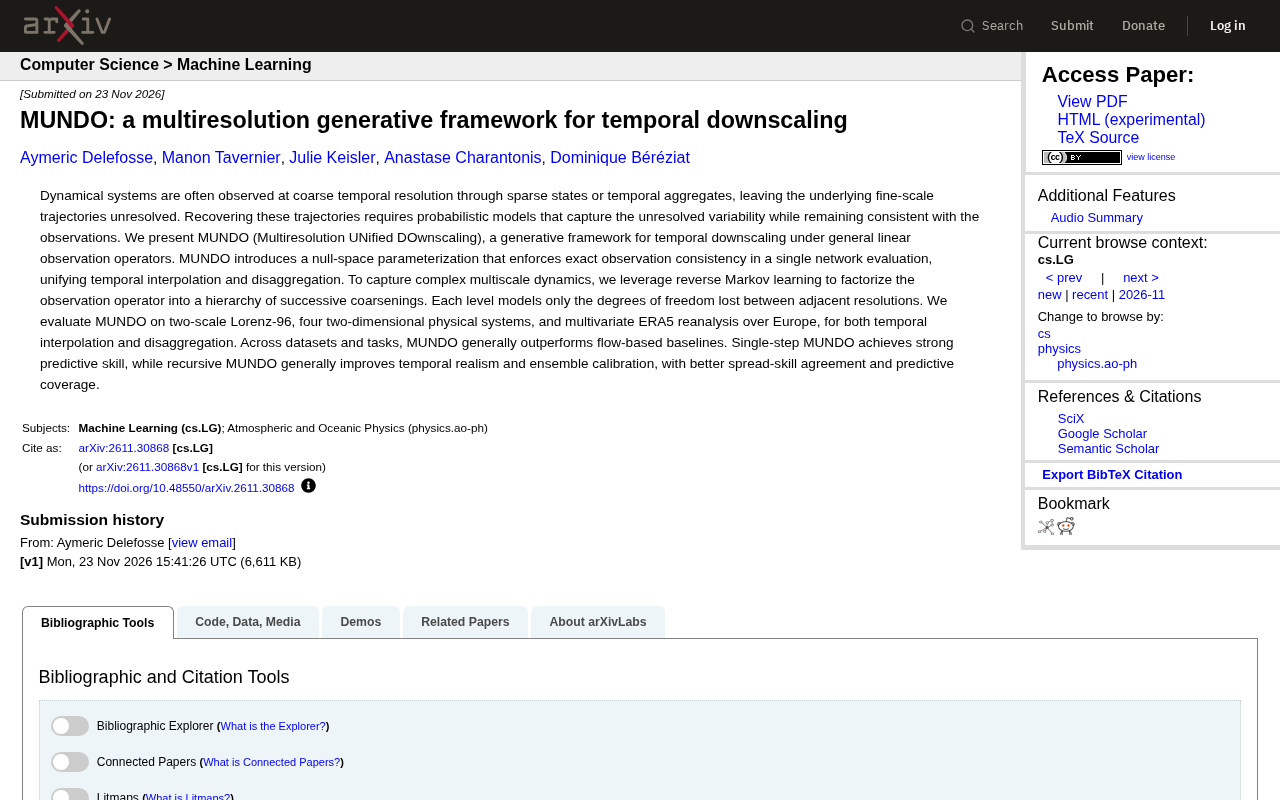
Dynamical systems are often observed at coarse temporal resolutions, where we only have access to sparse states or time-aggregated values, while the underlying fine-scale trajectories remain unknown. This observation pattern is extremely common in meteorology, climate science, fluid mechanics, and other fields, making the recovery of fine-grained trajectories from coarse-grained observations a core challenge in scientific machine learning. The recently proposed MUNDO (Multiresolution UNified DOwnscaling) framework offers a unified generative solution to this problem.
The Core Challenge of Temporal Downscaling
Temporal downscaling requires a model to generate fine-scale trajectories that are consistent with given coarse-grained observations. This is fundamentally a probabilistic problem: the same coarse-grained observation may correspond to countless fine trajectories, and the model must learn to capture this unresolved variability.
Traditional methods face a dilemma: either they rely on simple interpolation, which cannot generate physically plausible details, or they use generative models but struggle to guarantee strict consistency with observations. MUNDO's starting point is to satisfy both requirements simultaneously—both the flexibility of probabilistic generation and exact observational consistency.
Null-Space Parameterization: Exact Consistency in a Single Forward Pass
One of MUNDO's core innovations is null-space parameterization. Under a general linear observation operator, the model decomposes its output into an observation-space component and a null-space component, where the observation-space component is directly determined by the observations and the null-space component is generated by a neural network.
The key advantage of this design is that observational consistency is guaranteed by mathematical structure rather than by a "soft constraint" in the training loss. As a result, the model can output a fine-grained trajectory that exactly matches the observations in a single network evaluation, without iterative optimization or post-processing correction. This mechanism unifies two tasks—temporal interpolation and temporal aggregation—where the former fills in gaps between observation points and the latter recovers fine-grained sequences from aggregated values.
Linear Observation Operators and Null Spaces: In linear algebra, an observation operator can be represented as a matrix $A$ that maps a high-dimensional state $x$ to a low-dimensional observation $y = Ax$. The null space of matrix $A$ is the set of all vectors $z$ satisfying $Ax = 0$. Therefore, given a particular solution $x_0$ (satisfying $Ax_0 = y$), the general solution can be written as $x = x_0 + z$, where $z$ lies in the null space. Null-space parameterization exploits this property: by constraining the generative model's output to lie within the null space, it guarantees that $A(x_0 + z) = y$ always holds. This means that regardless of what null-space component the neural network generates, observational consistency is strictly maintained. In practice, the null-space component can be obtained by projecting the network output onto the null space of $A$ (e.g., using $I - A^+A$, where $A^+$ is the pseudoinverse). This approach avoids introducing soft constraints in the loss function, ensures exact observation matching, and preserves the generative model's ability to capture unobserved degrees of freedom.
Reverse Markov Learning: Capturing Multi-Scale Dynamics Layer by Layer
Complex dynamical systems often involve interactions across multiple time scales. MUNDO leverages reverse Markov learning to decompose the observation operator into a series of progressive coarsening operations, forming a hierarchical structure. Each layer is responsible only for modeling the degrees of freedom lost between adjacent resolutions, rather than generating all details at once.
This hierarchical decomposition allows the model to focus on capturing the dynamic features specific to each scale, avoiding the capacity bottleneck that arises when a single network must handle all scales simultaneously. From a generative modeling perspective, this amounts to decomposing a complex multi-scale distribution into a product of conditional distributions, with each layer's learning task being more focused.
Reverse Markov Process: In generative modeling, a reverse Markov chain refers to the process of starting from a simple distribution (e.g., Gaussian) and gradually generating a complex data distribution through a series of Markov transitions, with diffusion models being a typical example. MUNDO draws on this idea but applies it to multi-scale decomposition: the observation operator is decomposed into progressive coarsening operations, forming a hierarchy from fine to coarse. Each layer corresponds to a resolution level and learns the conditional distribution from a coarser scale to a finer scale, i.e., modeling the degrees of freedom lost between adjacent resolutions. This decomposition transforms a complex multi-scale generation task into a series of relatively simple conditional generation tasks, with each layer focusing only on the dynamic features at a specific scale. Compared with generating all details at once, reverse Markov learning reduces the learning difficulty and improves model scalability and generation quality.
Experimental Validation: Covering Multiple Classes of Physical Systems
The research team evaluated MUNDO on multiple datasets, including the two-scale Lorenz-96 system, four 2D physical systems, and multivariate ERA5 reanalysis data covering the European region, with tasks spanning temporal interpolation and temporal aggregation.
Results show that MUNDO outperforms flow-based baselines on most datasets and tasks. Single-step MUNDO demonstrates strong predictive capability, while recursive MUNDO is generally superior in temporal realism and ensemble calibration, exhibiting better spread-skill consistency and forecast coverage. These results indicate that the combination of null-space parameterization and hierarchical modeling indeed delivers practical benefits.
Implications for Scientific Machine Learning
MUNDO's value extends beyond the downscaling task itself. It demonstrates an approach to embedding physical constraints (observational consistency) into the structure of generative models: rather than penalizing inconsistency in the loss function, it eliminates the possibility of inconsistency within the network architecture.
For fields such as climate simulation, weather forecasting, and fluid simulation that require reconstructing fine-grained processes from coarse-grained data, this design paradigm of "structural consistency guarantees" is worth emulating. Meanwhile, the reverse Markov decomposition provides a scalable framework for multi-scale generative modeling, which may be extended in the future to more complex scenarios such as joint spatiotemporal downscaling.
Of course, MUNDO currently targets primarily linear observation operators, and generalization to nonlinear observation conditions remains an open problem. In addition, the trade-off between computational cost and accuracy introduced by recursive generation also needs careful evaluation in specific applications.
One-line Summary
MUNDO precisely generates fine-scale trajectories from coarse-grained observations through null-space parameterization and reverse Markov learning.
Paragraph Summary
MUNDO is a unified generative framework for temporal downscaling that aims to recover fine-scale trajectories from coarse-grained observations. Its core innovations include null-space parameterization, which guarantees observational consistency through mathematical structure and outputs fine-grained trajectories that exactly match observations in a single forward pass, unifying temporal interpolation and temporal aggregation tasks; and reverse Markov learning, which decomposes the observation operator into a progressive coarsening hierarchy where each layer models only the degrees of freedom lost between adjacent resolutions, thereby effectively capturing multi-scale dynamics. Experiments on the two-scale Lorenz-96 system, four 2D physical systems, and ERA5 European reanalysis data show that MUNDO outperforms flow-based baselines on most tasks, with single-step MUNDO exhibiting strong predictive capability and recursive MUNDO being superior in temporal realism and ensemble calibration. This work demonstrates a design paradigm that embeds physical constraints into the structure of generative models, offering new insights for scientific machine learning.
Related articles

Xenon Flash Bug Returns: Radxa Dragon Q8B Affected
The Xenon flash bug resurfaces, this time on the Radxa Dragon Q8B board. This article reviews early Hacker News discussion and analyzes the potential impact and community concerns.

ChatGPT Plus Subscription Guide for Users in China: Official Top-Up Channel Walkthrough and Comparison
A complete guide to subscribing to ChatGPT Plus from China via official top-up platforms: plan selection, account login, copying account info, payment verification, plus a comparison of top-up, proxy, and self-supplied card channels.

The Complete Guide to Subscribing to ChatGPT Plus in China: Hands-On Walkthrough of Third-Party Top-Up Channels and Risk Analysis
How can users in China subscribe to ChatGPT Plus? This article breaks down the complete process of third-party top-up platforms, analyzes account security, renewal sustainability, and risk-control risks to help you decide which subscription option suits you better.