Murmell: A Cloud Canvas Tool for Multi-AI Agent and Team Collaboration

Murmell is a cloud canvas enabling multiple AI agents and teams to collaborate on the same codebase without conflicts.
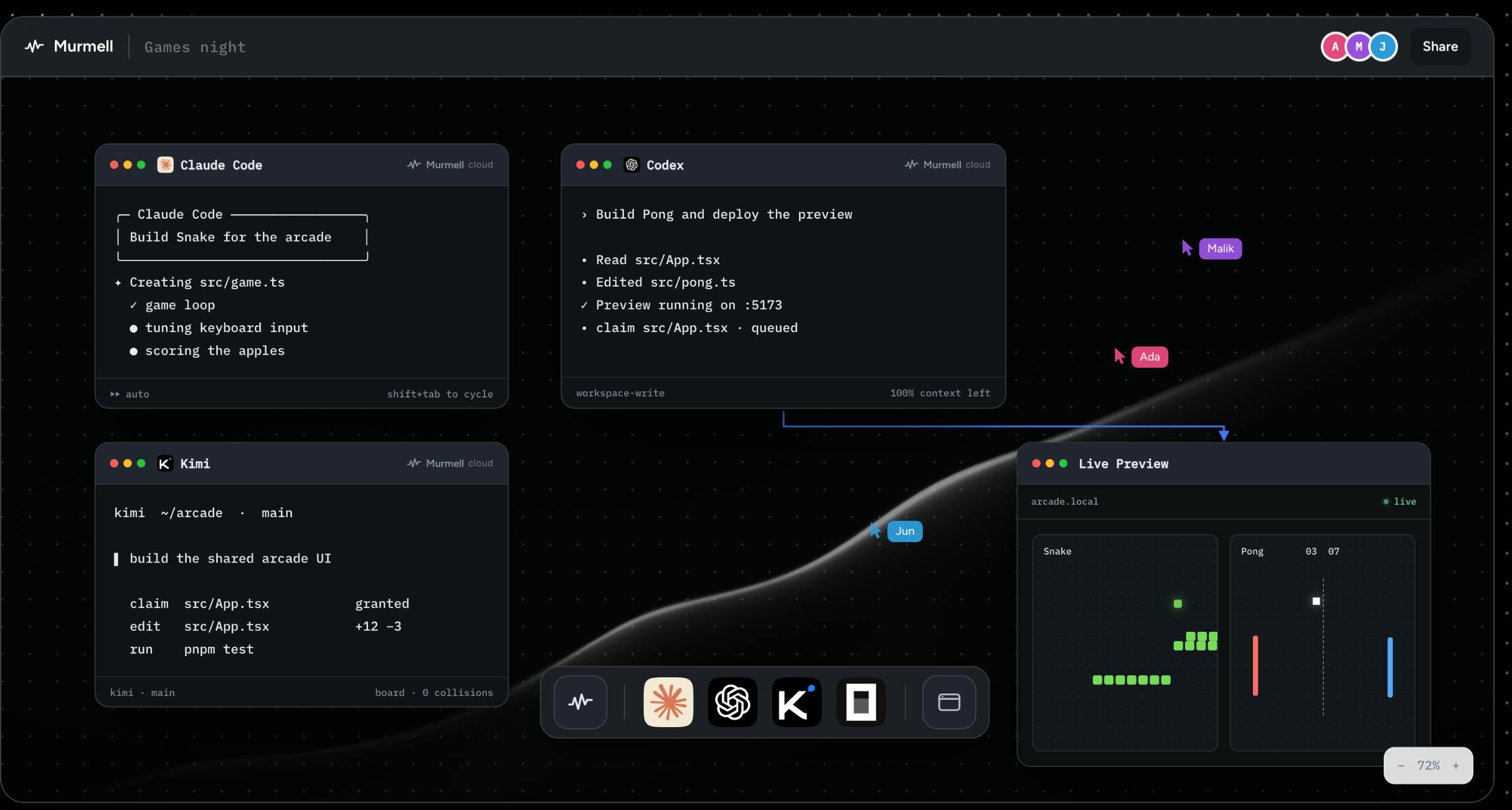
Murmell is a cloud-first collaboration tool that lets teams and multiple AI agents (Claude Code, Codex, Kimi, OpenCode) work simultaneously on the same code repository. Its key innovations include persistent cloud execution, a file claiming mechanism that prevents human-agent and agent-agent conflicts, and seamless Git integration ensuring all output becomes standard traceable commits.
When Teams and AI Agents Work in the Same "Room"
As coding agents like Claude Code and Codex become more widespread, a new problem is emerging: when multiple AI agents and human developers simultaneously operate on the same code repository, how do you avoid conflicts and unify collaboration? Murmell, a new product that recently appeared on Product Hunt, offers its own answer—a cloud canvas that enables team members and AI agents to collaborate "in the same room, on the same repository."
The product was built by developer Moss'Ab Mirande-Ney. After launch, it received 92 upvotes and 6 comments, ranking 13th on that day's leaderboard, categorized under Software Engineering, Developer Tools, and Artificial Intelligence.
The Rapid Rise of Coding Agents
Claude Code, mentioned here, is Anthropic's command-line AI coding tool that can understand codebase context directly in the terminal and execute coding tasks. Codex is OpenAI's coding agent, providing code generation and modification services based on its powerful language model capabilities. The common characteristic of these coding agents is that they don't just generate code snippets—they can understand entire project structures, execute shell commands, create files, and run tests, essentially possessing the operational capabilities of a junior developer. Since 2025, these tools have rapidly evolved from assistive code completion roles to autonomous agents capable of independently completing feature module development. It's precisely this leap in capability that makes the coordination problem of multiple agents working in parallel increasingly urgent.
Murmell's Core Philosophy: Close Your Laptop, the Work Keeps Going
Murmell's most compelling positioning is its "cloud-first" collaboration model. According to the official description, it's a shared cloud canvas where teams and AI agents run in the same environment, working around the same code repository.
The most intuitive experience is—"Close your laptop and the work keeps going." This means agent task execution doesn't depend on a local machine staying online; instead, it runs in the cloud, allowing developers to leave at any time and come back to check progress whenever they want. This is especially valuable for long-running coding tasks or asynchronous collaboration scenarios.
The Significance of Cloud Execution vs. Local Execution
Traditional AI coding tools are mostly tied to local IDEs or terminals—once you shut down, the task is interrupted. Murmell moves the execution environment to the cloud, transforming human-agent collaboration from "being present in real-time" to "continuously online," essentially treating AI agents as team members who can work 24/7.
Cloud development environments aren't an entirely new concept—GitHub Codespaces, Gitpod, AWS Cloud9, and similar products have long moved development environments to the cloud. But Murmell's innovation is that it doesn't just cloudify the human development environment; it also unifies AI agent execution environments in the cloud, creating a persistent workspace shared between humans and agents. This model solves several inherent problems with local agent tools: local machine resource limitations, task interruptions from network disconnections, and the inability for team members to share agent running states. As AI coding tasks grow in complexity (some large refactoring tasks might require hours of continuous execution), the value of persistent cloud execution will become increasingly apparent.
File Claiming Mechanism: The Key Design for Resolving Human-Machine Concurrency Conflicts
Murmell's most engineering-valuable design is its file claiming mechanism. The official documentation states: agents "claim" a file before writing to it, so humans and agents, or agents and agents, can push work forward simultaneously without overwriting each other's changes.
This essentially introduces the concept of "locks" from distributed systems into the human-machine collaborative programming scenario. In distributed systems, a "lock" is a fundamental mechanism for coordinating multiple concurrent processes accessing shared resources. Common lock types include pessimistic locks (acquiring exclusive access before operating) and optimistic locks (no locking during operation, checking for conflicts at commit time). Murmell's file claiming mechanism is closer to the pessimistic lock approach—an agent must declare exclusive usage rights over a file before modifying it, and other agents and human developers cannot modify the same file during that period. This design sacrifices some concurrency granularity (locking at the file level rather than the code line level), but gains implementation simplicity and deterministic conflict avoidance, which is particularly suitable for scenarios where AI agents might modify file contents extensively.
When multiple agents modify a codebase in parallel, overwrite conflicts are the easiest pitfall to encounter. Murmell uses a lightweight file-level coordination mechanism to make concurrency safe—this is what distinguishes it from "single-person, single-agent" tools.
Why Multi-Agent Parallelism Needs Conflict Coordination
When you only have one agent, the conflict problem isn't prominent. But when a team wants to run Claude Code, Codex, and other agents simultaneously while humans are also modifying code, the lack of a coordination mechanism leads to chaos. Murmell's file claiming mechanism essentially provides infrastructure-level order guarantees for "multi-agent collaboration."
Multi-Agent Systems (MAS) are a core research area in distributed artificial intelligence, referring to multiple autonomous agents collaborating or competing in a shared environment to complete tasks. In software development scenarios, different agents may excel at different task types—for example, one agent might be good at frontend UI generation, another at backend API design, and yet another focused on writing test cases. Challenges in getting multiple specialized agents to work collaboratively include: task allocation, state sharing, conflict resolution, and result integration. Current industry exploration paths include multi-agent frameworks like AutoGen and CrewAI, while Murmell provides coordination capabilities at the code repository level from the infrastructure layer, solving the "last mile" engineering problem for these agents' practical deployment.
Multi-Agent Support and Git Workflow Integration
In terms of agent compatibility, Murmell currently supports running Claude Code, Codex, Kimi, and OpenCode simultaneously, with announcements that more agents like OpenClaw and Hermes will be integrated soon. This open attitude of "not being tied to a single model/agent" makes it more like a middle platform coordinating various AI capabilities, rather than a closed product from any single vendor.
More importantly, all work ultimately flows back to the Git repository. The official statement emphasizes: "Your work goes back to git, so you can always find your project there." This point is crucial—it means Murmell doesn't try to replace the existing version control system, but rather seamlessly integrates AI agent output into the Git workflow that developers are already familiar with. No matter how many agents are used or how long they've been running, the final deliverables are standard, traceable Git commits.
Why Git Integration Is a Must-Have for Multi-Agent Collaboration
Git is currently the de facto standard version control system in the software development industry. Its distributed architecture, branch management, and commit history traceability are cornerstones of modern software engineering. When AI agents enter the development process, a key question is: how does agent-produced code seamlessly integrate with human developers' work? If agent modifications bypass Git and write directly to the file system, they would break mature engineering practices like Code Review and CI/CD. Murmell's choice to have all agent output ultimately flow back as Git commits means every modification has a complete diff record, traceable author information, and compatibility with existing CI/CD pipelines. This allows teams to review agent code just as they would review human code, maintaining controllability of engineering quality.
Murmell's Product Positioning and Future Outlook
From a product form perspective, Murmell addresses a real pain point in current AI coding evolution: moving from single-agent assistance to multi-agent and human team collaboration. Its three core designs—persistent cloud execution, file claiming for conflict prevention, and output landing in Git—all point to the same goal: making AI agents first-class citizens in team collaboration.
The official site also mentions "preview features and more capabilities coming soon," indicating the product is still in its early stages. For teams exploring AI-assisted development, Murmell offers a collaboration paradigm worth watching: no longer "one person paired with one agent," but rather "one team and a group of agents sharing the same workspace."
Of course, as a new product, its stability, cloud costs, and actual performance in large complex repositories still need more user validation. But the multi-agent collaboration direction it represents is likely to be one of the important trends in future AI development tools. From a broader perspective, as AI agents' programming capabilities continue to strengthen, "how to manage and coordinate a group of agents" will gradually replace "how to make a single agent write better code" as the core proposition in the developer tools space. Murmell may be standing at the starting point of this transition.
Key Takeaways
Related articles

Apple Accuses Former Employees of Taking Confidential Data to OpenAI: The AI Talent War Escalates
Apple accuses former employees of taking trade secrets to OpenAI, spotlighting the escalating AI talent war and intellectual property challenges in the tech industry.

Dashi Metrics: A Real-Time Visualization Tool That Maps Revenue Data onto a 3D Globe
Dashi Metrics maps revenue and visitor data onto an interactive 3D globe in real-time, giving SaaS teams and indie founders intuitive geographic visualization of their global business.

Adform Hacked: Why You Should Be Using an Ad Blocker Right Now
Ad tech giant Adform was hacked, exposing security risks in online advertising. Learn why ad platforms are targets, how ad blockers protect against malvertising, and get practical tips on uBlock Origin and Pi-hole.