Murmur: A Voice-First Private Thought Notebook

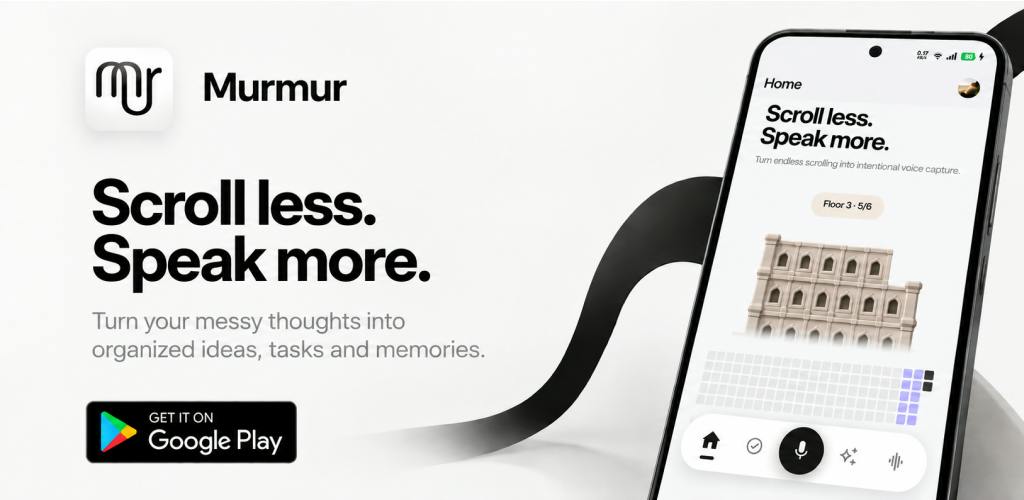
Murmur is a voice-first private notebook that turns spoken thoughts into searchable memories.
Murmur is a voice-first private notes app whose core value proposition is replacing keyboard input with speech, converting fleeting thoughts into a searchable text memory vault. It deliberately distances itself from mainstream social apps — no feeds, no followers, just your own thinking. Beyond basic voice transcription, Murmur offers a "Future Capsules" feature that lets users seal away present-moment ideas to revisit at a later date. Currently in early stages and primarily targeting Android, key metrics like transcription accuracy, multilingual support, and privacy data protection remain to be validated.
When Recording Thoughts No Longer Requires Typing
Our days are filled with fleeting ideas — a concept that sparks during a commute, a to-do item that pops up right before sleep, a sudden burst of inspiration. These thoughts often vanish before we even get a chance to open a notes app and type them out. Murmur, a recent arrival on Product Hunt, targets exactly this pain point: it's a voice-first private note-taking tool that lets you speak instead of type, transforming ephemeral ideas into searchable memories.
In terms of positioning, Murmur has no intention of becoming yet another social app. Its tagline is refreshingly direct: "No feeds. No followers. Just your thoughts, remembered." At a time when social media fatigue is increasingly widespread, this "anti-social" private stance is itself a form of differentiation.
Core Features: From Voice to Searchable Memory
Speak It, Don't Type It
Murmur's core interaction is voice input. Users simply speak, and the app converts their words into text and stores them. Compared to traditional keyboard input, voice recording has the advantage of speed and low friction — when walking, driving, or when your hands are occupied, speaking a sentence is far more natural than pulling out a phone and tapping out every word. This relies on speech-to-text technology to convert audio streams into structured, indexable text.
Speech-to-text (also known as Automatic Speech Recognition, or ASR) is the technology that converts human audio speech signals into text. Its core has evolved through several generations: from traditional Hidden Markov Models (HMM) to Deep Neural Networks (DNN) in the deep learning era, and now to large models built on Transformer architectures (such as OpenAI Whisper). Modern ASR systems can achieve over 95% accuracy for Mandarin and English recognition in quiet environments, but still face challenges with accents, background noise, proper nouns, and colloquial expressions. For products like Murmur where voice input is the core interaction, transcription accuracy directly determines whether the fundamental value of "recording" can be delivered — if a spoken thought is incorrectly transcribed, subsequent retrieval and review become meaningless. This is why transcription quality is one of the most important benchmarks for evaluating this type of product.
A Searchable Memory Vault
Simply recording isn't enough — Murmur emphasizes "searchable memories." This means that what you've said in the past gets organized into a knowledge base you can look back on and query. The product description mentions that users can "later, ask what you were thinking about" — going back afterward to find out what was on their mind, and rediscovering forgotten ideas. This design philosophy aligns more closely with a personal "second brain" than a simple voice memo recorder.
The concept of the "Second Brain" was systematized by productivity researcher Tiago Forte. Its core idea is to use external digital systems to capture, organize, and retrieve personal knowledge, thereby freeing our limited biological memory from the burden of "storage" so it can focus on creative thinking. This philosophy spawned the rise of note-taking and knowledge management tools like Notion, Obsidian, and Roam Research. Murmur's "searchable memory" positioning aligns closely with this framework — the key difference is that it shifts the entry point for knowledge capture from keyboard to voice, aiming to further reduce the friction cost of "externalizing thought." When the act of recording becomes light enough, the density of accumulated knowledge can truly increase, and the value of retrieval grows alongside it.
Future Capsules: A Letter to Your Future Self
One particularly intriguing feature is Future Capsules, which allows users to "send" a thought to their future self. This is a design with a temporal dimension — sealing away a present-moment idea to resurface at some future point in time. It carries both emotional value (capturing a state of mind, reinforcing goals) and practical value (delayed reminders, long-term planning).
Product Positioning and Market Context
Murmur is listed under several categories on Product Hunt — Android, Social Network, Social Media, and Audio — and was built by developer Subhrajyoti Sahoo. After launching, it received 80 upvotes and 5 comments, ranking 18th. By the numbers, this is an early-stage product that has yet to gain significant traction.
Interestingly, while it's tagged under Social Network/Social Media, the product itself deliberately emphasizes its "no social" identity. This tension in positioning reflects the creator's attempt to carve out a private, personal path within the voice content space. In the current market, voice note tools (such as various transcription apps) and AI-driven personal knowledge management tools are in a period of convergence, and Murmur's combination of voice capture with searchable memory sits squarely within this trend.
What Real Problem Does It Solve?
From a UX design perspective, Murmur targets the universal frustration of "idea loss." The high friction of text input means many thoughts are never recorded; traditional voice recordings are hard to search and difficult to navigate. Murmur's value proposition lies in using voice to lower the barrier to recording, and then using search capabilities to solve the secondary problem of "recorded but never found."
However, as an early-stage product, there are still plenty of things worth watching: transcription accuracy, multilingual support, the intelligence of memory retrieval, and the data storage and privacy protection mechanisms behind the "private" promise — all of these are critical to the product's success, and the currently available public information isn't sufficient to make a judgment. Additionally, the app currently targets primarily the Android platform, which limits its reach.
Privacy and data security represent a structural challenge for voice-based tools. Voice data inherently contains the speaker's voiceprint, which is biometric information — far more sensitive than ordinary text. When using such apps, users should pay attention to several key questions: Is the raw audio file uploaded to cloud servers? Is transcription completed on-device or remotely? Is the stored text data encrypted? And could the data potentially be used for model training? Most mainstream ASR solutions rely on cloud APIs (such as Google Speech-to-Text, AssemblyAI, etc.), which means audio or text passes through third-party servers. For Murmur, which emphasizes a "private" positioning, clearly disclosing its data flow and storage architecture is a prerequisite for building user trust.
Summary
Murmur represents a concrete attempt at combining voice interaction with personal knowledge management. It uses "voice-first" design to lower the barrier to recording, gives notes a temporal and retrieval dimension through "searchable memories" and "Future Capsules," and draws a clear line from mainstream social products with its "no feeds, no followers" private positioning. For users who constantly lose inspiration and are tired of social noise, this kind of tool offers a worthwhile direction to explore. Whether it can hold its ground in the competitive voice and notes market ultimately depends on how much refinement goes into transcription quality, retrieval intelligence, and privacy protection going forward.
Related articles

How Big Can Stars Really Get? The Physical Limits of the Largest Stars
Red supergiants are the largest stars by volume, with radii up to 2,000 times the Sun, engulfing the inner solar system. But there is no precise upper limit on stellar size—models predict up to 15,000 solar radii. The most massive blue stars are far smaller than red supergiants—biggest and heaviest are two different things.

Apple HomeView Smart Display Full Feature Breakdown: Wall-Mount or Desktop, $299
Apple launches HomeView, a $299 smart display with wall-mount and desktop options, 12MP camera for facial recognition, smart home control, music playback, and recipe step-by-step cooking. Full breakdown of watch faces, apps, privacy, and cooking integration.

Where Did the Promised New Studio Go? Craft Computing Answers After Five Years
Craft Computing's host responds to viewer questions: the new studio promised five years ago was shelved as construction costs soared from $30,000 to $75,000, and was replaced by a 168-square-foot garage conversion.