Muse 2 Pro vs DJI Pocket 4P: Image Quality Nearly Indistinguishable, But You Can't Buy It in the US

Muse 2 Pro and DJI Pocket 4P are neck and neck in image quality and design, but the former's unavailability in the US is the deciding barrier.
This article compares the new brand Muse 2 Pro with the DJI Pocket 4P. Testing shows image quality differences are minimal—footage is almost interchangeable. The Muse's one-sided handle offset brings the display closer to a right-handed user's line of sight, and it integrates a tripod thread directly while being more compact; DJI uses a symmetric design and needs an external adapter for tripods. Since product strength is so close, market access becomes decisive: the Muse 2 Pro isn't sold in the US, so US creators can effectively only choose the DJI Pocket 4P.
Muse 2 Pro vs DJI Pocket 4P: Image Quality Nearly Indistinguishable, But You Can't Buy It in the US
A new brand has entered the pocket gimbal vlog camera market, and its Muse 2 Pro goes directly after DJI's Pocket 4P. Interestingly, the differences between the two products in image quality and handling are so small that you need repeated comparisons to tell them apart—yet their market fates are completely different: one is available in the US, the other isn't. After a hands-on comparison, one YouTube reviewer reached a rather blunt conclusion: if you strip the labels off and mix the footage together, almost no one could tell the difference.
Image Quality Comparison: Differences So Small You Have to "Try Hard" to Find Them
The Muse 2 Pro supports up to 10bit X-Log 3 color profile, and packs a wide-angle main camera alongside a telephoto lens, the latter of which can enhance portrait performance. It also has built-in storage. The manufacturer claims dynamic range of up to 17 stops.
But the gap between spec-sheet numbers and real-world perception is exactly what makes this comparison worth paying attention to. The reviewer pointed the lens at a local memorial statue for a real-world shootout, and ultimately concluded that the Pocket 4P's color saturation on the statue was "slightly higher." But he immediately added that this could be a difference in color profile or in sharpening, and admitted he was "trying hard to nitpick." In other words, in the vast majority of shooting scenarios, the two cameras work in highly similar ways, with differences at a barely perceptible level.
X-Log 3 and 10bit Color
X-Log 3 is a logarithmic (log) color profile used by the Muse 2 Pro, a custom log curve defined by the camera manufacturer. Its purpose is to compress contrast during recording and preserve more highlight and shadow detail, leaving more room for color grading in post. The number "3" typically indicates the curve has reached its third generation, with optimizations in dynamic range allocation and skin tone reproduction. 10bit means each color channel is recorded with 10 bits, capable of displaying roughly 1.07 billion colors—significantly reducing color banding compared to 8bit's 16.7 million colors, with clear advantages especially in high-contrast scenes or sky gradients. Together, the two mean the footage is better suited to professional post-production workflows, but also require editing software and display devices that support 10bit workflows.
17 Stops of Dynamic Range
Dynamic range refers to the span between the brightest and darkest details a camera can simultaneously record in the same frame, usually measured in "stops," with each stop representing a doubling of brightness. 17 stops is a fairly aggressive claim, approaching the level of high-end cinema cameras. It's worth noting that manufacturer test conditions (such as using log curves, specific noise reduction and compositing algorithms) differ from everyday real-world shooting, and actual usable dynamic range is often lower than the nominal figure. This comparison did not specifically verify this number, so it's better treated as a reference point than a basis for a decision.
Handle Design: Symmetric Rotation vs. One-Sided Offset
The two products take clearly different approaches to handle structure. DJI's design rotates the handle body out symmetrically and returns it to a centered position; Muse's rotates out to either side and locks into a fixed position.
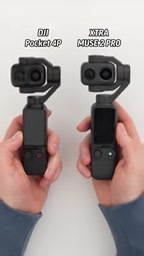
This difference has a direct impact on real-world use. For right-handed users, the Muse handle typically extends to the right side, which brings the display closer to the center of the frame in the line of sight, making it more comfortable to monitor while shooting. This offset design is clearly intentional rather than an arbitrary assembly choice.

The Form-Factor Logic of Pocket Gimbal Cameras
This category of product integrates a three-axis mechanical stabilization gimbal, camera module, and handle into one unit, with the core selling point being portability and stability while shooting on the move. The handle serves both as a grip and as a protective structure when the gimbal is stowed—rotating it closed locks the gimbal arms in place, preventing damage from shaking during transport. So the way the handle rotates affects not only feel but also stowed volume and deployment speed. DJI's symmetric rotate-out-and-center design emphasizes ambidextrous use and symmetric stowing; Muse's one-sided offset sacrifices some symmetry in exchange for bringing the display closer to the center of the line of sight for right-handed users, a targeted optimization for vlog selfie scenarios.
Tripod Mount: One Needs an Adapter, the Other Doesn't
The Muse 2 Pro integrates a tripod thread directly into the handle, so it can be mounted on a tripod immediately. The DJI Pocket 4P requires attaching an external adapter first, then snapping it into place.

In terms of size, the Muse is actually more compact, while also eliminating the extra step of an adapter. For creators who frequently switch between handheld and fixed-position shooting, this detail saves quite a bit of hassle.
The Core Contradiction: Similar Product Strength, Different Market Access
The most valuable conclusion from this comparison isn't on the spec sheet—it's the often-overlooked reality it reveals: when two products are so close in maturity that you need frame-by-frame comparison to find differences, what determines user choice is often no longer image quality or design, but whether you can buy it at all.
The reviewer's stance is quite clear—he repeatedly emphasizes that the two cameras work in "very, very similar" ways, that their footage can be edited interchangeably, even describing it as "just cut them together." Given that, the fact that one product is sold in the US market and the other isn't constitutes a substantive barrier to choice. For US vlog creators, no matter how obvious the Muse 2 Pro's spec and design advantages are, they can't translate into an actual purchase.
Buying Advice
If you're in the US market, the DJI Pocket 4P is currently the more realistic choice, at the cost of accepting the extra step of an external adapter. If you're in a market where the Muse 2 Pro is available, then built-in storage, a directly usable tripod mount, and a handle offset design that brings the display closer to the center of your line of sight are all real advantages worth weighing. As for image quality, the gap between the two products is too small to serve as a basis for a decision.
One-line Summary
Muse 2 Pro and DJI Pocket 4P are neck and neck in image quality and design, but the former's unavailability in the US becomes the deciding barrier.
Paragraph Summary
This article compares the new brand Muse 2 Pro with the DJI Pocket 4P, two pocket gimbal vlog cameras. Hands-on testing shows the image quality differences are minimal—the reviewer had to deliberately compare to notice the Pocket 4P's slightly higher saturation and possibly different sharpening, with footage almost interchangeable in editing. In design, the Muse's one-sided handle offset brings the display closer to the center of a right-handed user's line of sight, and it integrates a tripod thread directly while being more compact overall; DJI uses a symmetric rotate-out-and-center design and requires an external adapter for tripod mounting. The article points out that when product strength is so close it's hard to distinguish, market access becomes the decisive factor—the Muse 2 Pro isn't sold in the US, so US creators effectively can only choose the DJI Pocket 4P.
Related articles

If The Office Premiered in 2026, Would It Survive Six Episodes?
Vergecast discussion: If The Office premiered in 2026, it would likely be canceled after six episodes due to immediate-return pressure. This article analyzes how streaming-era ROI anxiety stifles creative evolution, and why data-driven decisions need room for belief.

Moral Dilemmas at 30,000 Feet: Can Flying Make Us Better People?
From the moral landscape of first class versus economy, we explore how the flying environment mirrors everyday moral dilemmas—and whether mastering coexistence in flight can make us better moral people.

How to Detect Timestomping? A DFIR Interviewer Explains Core Forensic Methods
DFIR interviewer Jessica Hyde explains how to detect timestomping: from MFT records, Shell Bags, and event logs to EXIF comparison, with answer differences across junior to senior engineers and practical forensic methods.