Muse Gadget Running on a Nintendo 3DS? One Tweet That Sparked a Wild Discussion

A viral tweet claims muse gadget runs on a Nintendo 3DS — but key technical details are entirely missing.
A tweet claiming someone got "muse gadget" running on a discontinued Nintendo 3DS went viral with the caption "no fucking way," but offered almost no technical detail. The article places the story in the context of homebrew culture — where running unofficial software on constrained legacy hardware is a long-standing tradition — while cautioning readers to trace claims to their source, distinguish proof-of-concept demos from genuinely usable ports, and approach emotionally charged tech posts with critical skepticism.
The Information Gap Behind One Tweet
A tweet making the rounds on social media claims that someone got an app or device called "muse gadget" running on a Nintendo 3DS handheld, captioned with "no fucking way" alongside a screenshot and an adorable little dog.
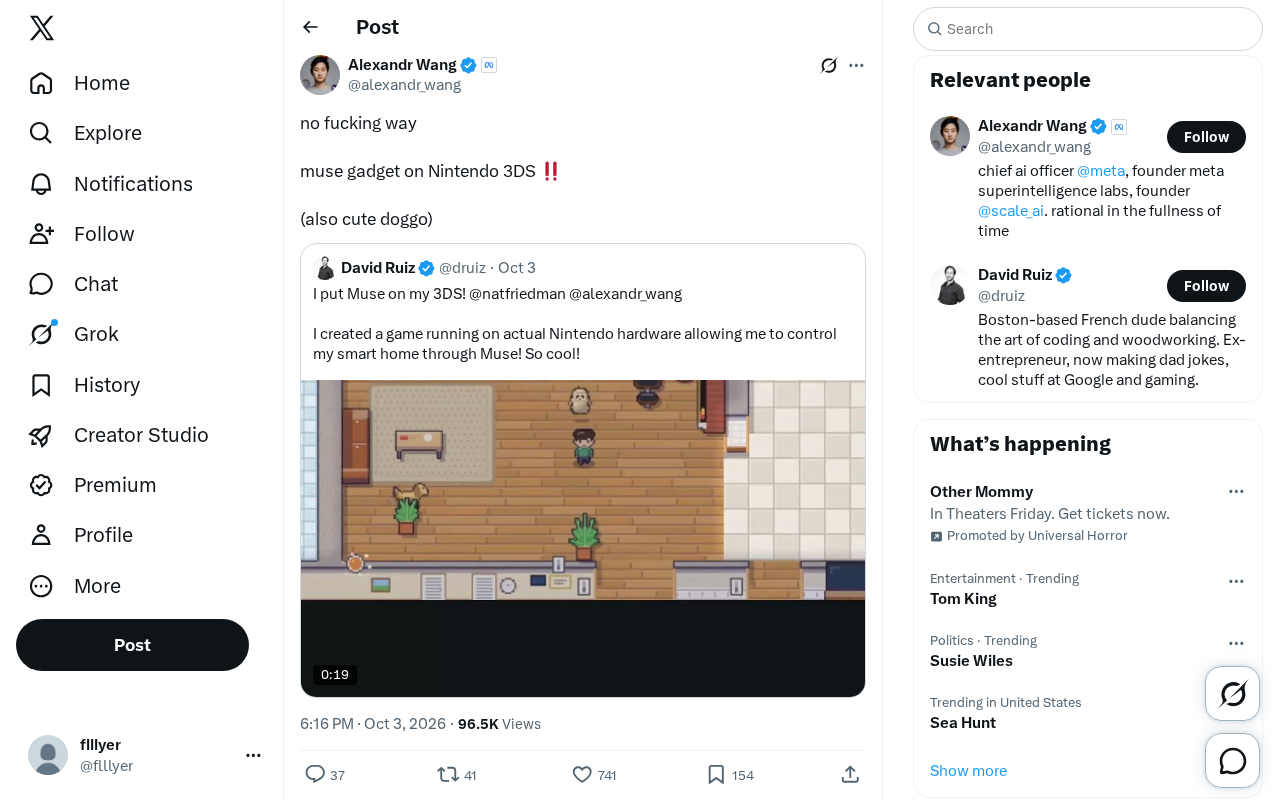
Based on the available material, the tweet itself offers almost nothing to go on — no explanation of what muse gadget actually does, how it was made to run, or any technical details or verifiable demonstration. From a content analysis standpoint, we can only make cautious inferences based on publicly available context, and readers should be warned: posts of this "wild hack" variety tend to spread fast and say little. A healthy dose of skepticism is warranted.
Why "Running New Stuff on Old Hardware" Always Goes Viral
The Nintendo 3DS is a discontinued handheld console with hardware that looks extremely limited by today's standards. Precisely because of those constraints, developer communities and homebrew enthusiasts have long been drawn to running unofficial software on hardware like this — from media players to simple apps, and even lightweight AI inference experiments.
There's something inherently viral about "running something somewhere it has no business running." It's both a technical flex and a way of satisfying people's curiosity about what vintage hardware can still do. The emotionally charged caption — "no fucking way" — is a direct expression of that sense of surprise.
The Nintendo 3DS launched in 2011 with a dual-core ARM11 processor (clocked at around 268MHz), 4MB of main RAM (expandable to 8MB), and a GPU that lagged far behind contemporary smartphones. Nintendo officially discontinued it in 2020, but its robust custom firmware (CFW) ecosystem has kept it a popular platform for homebrew developers to this day. "Homebrew" refers to the practice of running unofficial, self-made software on locked-down hardware — developers bypass manufacturer restrictions through reverse engineering or exploit chains to port programs that "shouldn't" run onto older devices. The 3DS homebrew community is particularly active, with projects ranging from emulators and media players to lightweight neural network inference frameworks, all of which provide the technical backdrop for the muse gadget port discussed here.
What Muse Gadget Might Actually Be
Since the original post offers no explanation, the exact identity of "muse gadget" is unclear. It could be:
- A widget or app called Muse
- Some kind of creative tool or music-related software ("Muse" commonly evokes inspiration and music in English)
- A community nickname for a specific project
Without further evidence, any definitive claim would be irresponsible. The information that would actually matter includes: where the program comes from, who did the port, what the frame rate and stability look like, and whether it's open source and reproducible. All of these are absent from the current post.
It's worth noting that a "Proof of Concept" (PoC) is an extremely common release format in the homebrew community: a developer demonstrates that a program "can launch or run" without promising full functionality, smooth performance, or long-term maintenance. These demos often run at very low frame rates, with incomplete features, and may require specific firmware versions or additional hardware. Screenshots on social media typically show the most impressive single frame, not the day-to-day usable state. So even if muse gadget genuinely runs on a 3DS, there could be a significant gap between its actual usability and the "mind-blowing" impression the screenshot conveys.
The Right Way to Approach This Kind of Content
Sensational tech posts spread extremely easily on social media, but their credibility and information density are rarely proportional to their reach. A few things worth keeping in mind:
- Trace it to the source: Look for the original project repository or a full write-up from the author — don't draw conclusions from a single screenshot.
- Distinguish between a demo and something usable: "It boots" and "you can actually use it" are two very different things. Many ports are nothing more than proof-of-concept.
- Be wary of emotionally charged language: The more "unbelievable" the framing, the more calmly you should verify it.
As for that "adorable little dog" — it's part of what made the tweet grab attention, completely unrelated to the technical subject, yet it perfectly illustrates the logic of social media virality: emotion, cuteness, and novelty all stacked together are what make something break through.
Closing Thoughts
This tweet reads more like a fragment of community trivia than a complete technical report. It reflects the enduring vitality of the tinkering culture, but it also reminds us: in an age of information overload, the real question worth asking after "no fucking way" is "okay, but how exactly was this done?" Until more concrete details emerge, this is best treated as an interesting lead — not a conclusion.
Related articles

Workbuddy for Absolute Beginners: How a Desktop AI Agent Fits Into Real Workflows
A beginner's guide to the Workbuddy desktop AI agent: installation, claiming credits, file management, and building automated workflows—compared with CodeX for fit and cost, helping professionals shift from AI question-askers to AI managers.

OpenAI's New Agent Stack: Computer Use, Decisions API, and Ultra-Fast Workflows
OpenAI Dev Day unveiled a new agent stack: Computer Use outperforms humans, Decisions API delivers ultra-low-latency classification via Luna, Agents API opens the same Computer Use capabilities, and GPT-6.1 Sol costs only one-seventh of Astra. Core updates, benchmark data, and developer insights.

Liang Wenfeng Open-Sources DeepInfo Inference Framework, Takes On U.S. Ban
DeepSeek open-sources its DeepInfo inference framework after its models, featuring GPU/CPU cross-pipelining, small-model prediction with large-model verification, and full Huawei Ascend and NVIDIA chip support—facing the U.S. federal ban head-on. This article analyzes its significance for AI deployment and open-source strategy.